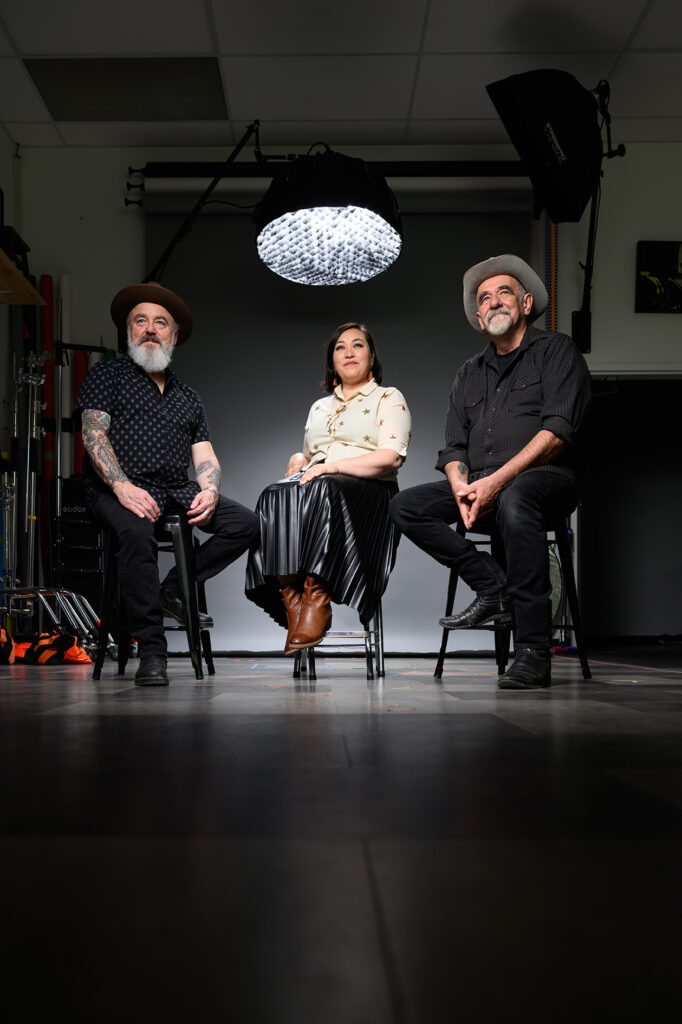
DIYET & THE LOVE SOLDIERS (Courtesy/Alistair Maitland Photography)

Yukon band Diyet and the Love Soldiers will be playing at the Chilkat Center on Sept. 12 at 7 p.m. The band’s lead singer, Diyet, sat down with CVN reporter Will Steinfeld to discuss the upcoming performance and the band’s story. 

WS: Is this going to be your first time performing in Haines?

Diyet: It will be. I have been to Haines numerous times but I’ve never performed.

You’ve performed all over the world in all sorts of crazy places. Is it different at all playing in a town the size of Haines?

Well, I think I’ve played almost every town that’s not on a map in Canada, and I’m from a really small community — Burwash Landing — so I feel like it’s a natural environment for me to be in. 

Is it a different relationship with the audience when you’re in a smaller setting?

It is, because you’re usually physically a little bit closer, and you can connect more personally, which is something that I love. 

Having some sort of engagement back and forth, it just makes it really special for us to play in that environment. I think it makes it more meaningful for an audience as well to feel like they’re part of the show.

You and your band are so tight. Your harmonies really sound like one person singing. Tell me about how the band came together.

We’ve been playing together for around 15 years as this trio. Robert van Lieshout, who’s the  rhythm guitar player and the drummer, he’s actually my husband so we’ve been playing together for about 25 years. 

The three of us have really connected. Sometimes you just find musical partners that you’re able to play with with a lot of ease and that’s what it’s like for the three of us. We’ve played together so much that we’re able to read each other, to know where a song is going, or where it needs to go, just by listening to each other. We don’t even have to look at each other. I think that kind of relationship just makes it a lot of fun to play together. There’s a lot of trust that we have with each other. I know that no matter what, they have my back and I have theirs. 

Was it like that when you first started playing together?

Since the beginning, there’s always been this understanding that you don’t always have with people immediately. But with the three of us, since the beginning, there’s always been that connection. It made it easy to grow together. 

Are the two of them also Yukoners?

I’m born and raised, Bob (Hamilton) has been here for like 40 years. Robert is originally from the Netherlands, but the two of us moved to Canada about 25 years ago.

I anticipate people in Haines are going to be super excited about your music, especially because a lot of the things I’ve heard you write about feel pretty close to home, to the region. 

Has writing about home and the land changed your relationship to the place?

I think it has. I feel more connected. I feel like this area, this environment, this community, is constant inspiration. I never run out of things to write about. I’m born and raised here. This is my traditional territory. And I feel like I have a different relationship that’s grown over time because I’m always asking questions. I don’t always get answers, but I feel like the longer that I examine this environment around me, the closer I get to some kind of answer to my questions.

What does your practice look like? What do you draw from to be able to find those questions to ask?

I try to get outside as much as I can, to be on the land, to be with community and family. 

We’re such a small community here. There are 100 people that live here, and if we’re not related we know each other very well. I feel like it’s a petri dish — a smaller version of what happens in the greater world. Sometimes when the world itself can feel really, really overwhelming, I find I’m able to write about things that feel closer to home, but with implications in the greater context of humanity and the world. I feel like that’s allowed me to examine some universal kinds of questions or truths. But in a much closer, more intimate way.

There are so many historical connections and cultural connections between this part of Alaska and the Yukon, going back before this was the United States and Canada. This year there’s been a lot of talking about Canadians who don’t want to cross the border. Is coming to the United States to perform different this year with political conflict and disagreement?

It’s definitely harder. For example I just got confirmation today that our visas are here so that we could actually cross the border. Logistically it’s a little bit more difficult to tour the states. 

And there’s questions, right? I mean, we’re so close; I have family in Haines. My great-great-grandmother came from Dyea. We were kind of raised to not necessarily see borders between our family connections. It’s kind of strange to be around at a time when there’s obvious tension and disagreement that doesn’t have anything personally to do with you, but that you are involved in, regardless, because of where you live. 

Where does your sound come from? Was it the kind of music you grew up playing or did you pick it up somewhere along the way?

I feel like our sound is what I would consider northern mountain music. It’s a little bit country, it’s a little bit rock, it’s a little bit folk. I also sing in my traditional language, in Southern Tutchone, so it has traditional roots; it’s what I heard growing up. It feels like home. 

But also it’s influenced by Robert and Bob. Bob’s been playing 50 years of live music. He cut his teeth the old-fashioned way, in all the bars and clubs and through touring. He has a really deep connection to country and bluegrass. Robert is a rock drummer. And I studied classical voice. My university education was in classical musical performance. You put that together and you get kind of a mishmash of sound. But it’s really the sound that you hear in the north. It’s not necessarily Americana, not necessarily something you hear in Southern Canada. When you live north of 60, you get it.

That’s so interesting. It’s ok if you don’t have an answer to this question — I’m just wondering if there’s a specific sound that makes it northern that you could describe to people. And if you can speculate about a connection between the place and how you get that specific northern sound.

I don’t know. It’s a feeling. There have been plenty of times we have been in a studio and we are working out a tune, and we play it different ways. We might play it with an R&B feel, or more of this or more of that. We sort of are relentless to not committing to something until it feels right, and usually when it feels right, it’s that feeling of connection, I guess, to the sound.

You have a new album coming out this month. What are you most excited for people to hear from that new album?

I hope that people can connect with the story and resonate with the overarching themes of deeper connection and healing. For me, it was an examination of my own feelings about having less control over things in life or the world around you: how you can look inward, or look closer to home, to find some relief.

Will you be playing any of that new material next week?

Absolutely. We’re going to play a lot of new songs. The album comes out on the 19th, officially, but we’ll be bringing copies of the album in advance. Alaska gets the first crack at it. 

Will Steinfeld is a documentary photographer and reporter in Southeast Alaska, formerly in New England.