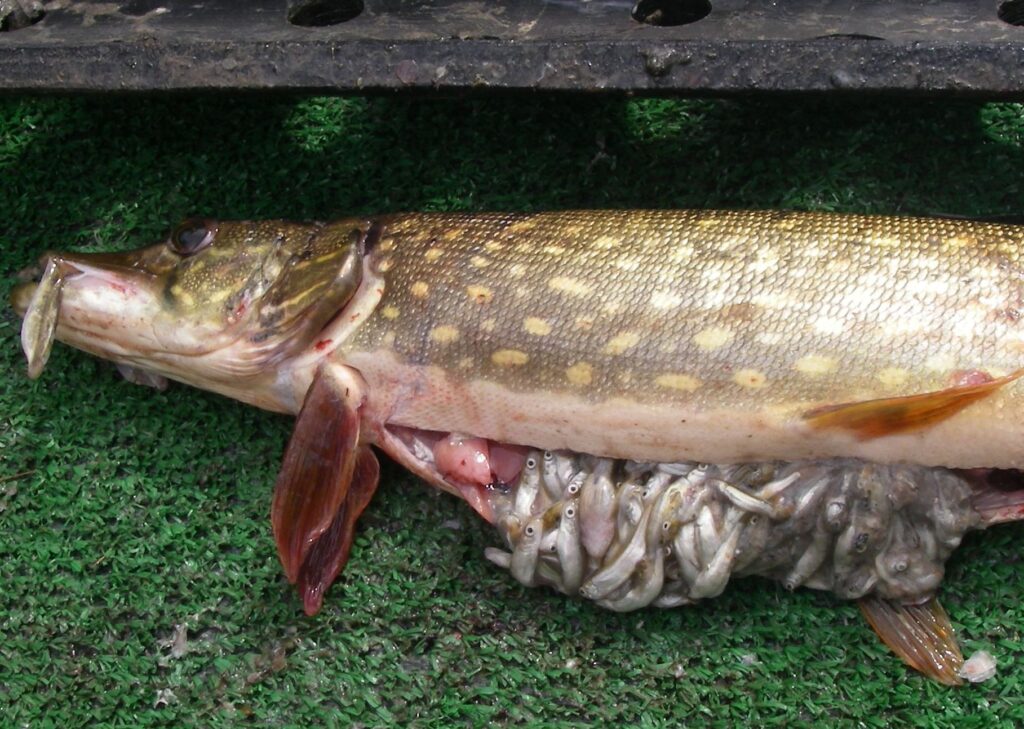
An invasive northern pike is shown to have its stomach stuffed with tiny juvenile salmon. Invasive northern pike are well-established on the Deshka River, where they are eating their way through the supply of salmon and other fish. As tempertures have risen, pike are eating more, a new study found. (Courtesy/Alaska Department of Fish and Game)

Invasive northern pike have wreaked havoc in Southcentral Alaska rivers and lakes. Introduced illegally in the 1950s, they have been devouring juvenile salmon and other native species.

Now a University of Alaska Fairbanks study warns that matters could get even worse.

As temperatures rise in waterways, invasive pike eat more, said the study, published in the journal Biological Invasions. And as temperatures continue to rise, that trend will continue, the study said. Based on expected temperature trends, invasive northern pike will eat 6% to 12% more by the end of the century, the study said.

“We expect there will be significant warming in the future, and the amount of fish that pike consume is going to increase with it,” Benjamin Rich, who led the study while earning a master’s degree at UAF’s College of Fisheries and Ocean Sciences, said in a statement released by the university.

The UAF study found that over the past decade, northern pike of all age classes ate more as waters warmed. The increase was most dramatic in year-old pike, which upped their intake by about 63% over the period.

The study site was the Deshka River, a Matanuska-Susitna Borough waterway that is an important feeder to Cook Inlet and commercial fisheries there. The 44-mile river, a tributary of the Susitna River, is also a cherished destination for Southcentral Alaska sport anglers.

It is famous for its abundance of salmon — or it has been. Salmon in the Deshka is a lot less abundant now than in the past.

The decline is a decades-long problem that affects king salmon in particular. State and federal biologists have cited numerous reasons for  the decline.

The presence of invasive pike is one of them; pike have eaten a lot of juvenile king salmon, also known as Chinook, and coho salmon, also known as silver salmon.

Southcentral Alaska. (Photo by Benjamin Rich/U.S. Fish and Wildlife Service)
A pair of juvenile Chinook salmon emerge from the stomach of a northern pike caught on the Deshka River in Southcentral Alaska. (Photo by Benjamin Rich/U.S. Fish and Wildlife Service)

Heat stress is also among the myriad causes of declines. The Deshka is particularly vulnerable to heat. It is in a flat area and not glacier-fed, and it is known to be one of the warmest river systems in the Matanuska-Susitna Borough.

It is the subject of ongoing temperature monitoring and studies by the U.S. Fish and Wildlife Service, the conservation group Cook Inletkeeper and others.

In 2019, a record-hot year in Alaska, waters in the Deshka were particularly warm — exceeding 81 degrees Fahrenheit that July, according to readings by Cook Inletkeeper.

Warmer temperatures, along with speeding pike metabolism and spurring more food consumption, appear to be sharpening the northern pikes’ predation skills, said Erik Schoen, a UAF fisheries biologist and a study co-author.

Fish, which are cold-blooded animals, have varying physiological responses to heat, Schoen said. Compared to salmon, which get sluggish in warm temperatures, northern pike thrive and become speedier swimmers, he said.

“If it keeps getting warmer, they get much better at catching salmon,” he said. “They’re amazing ambush predators.”

Deshka pike are actually eating less salmon than they did in past years, analysis of stomach content shows. But that is not because they are turning away from salmon; rather, it is evidence of salmon declines in the river.

The abundance of adult king salmon in the Deshka dropped by 42% over the past decade. At about the same time, the biomass of juvenile salmon eaten by northern pike decreased by 30% to 74%, depending on age class.

Do not expect the pike to go away if they deplete all the salmon, warned Schoen, who grew up in Anchorage and spent a lot of time fishing in the Deshka.

Rather, they will turn to other fish, as they appear to have done in the Deshka, such as whitefish and rainbow trout. If they can’t eat fish, they eat flies, he said. Northern pike are even known to eat birds, such as eagle chicks and ducklings, small mammals like voles and shrews — and, on occasion, each other.

“Once they wipe out the salmon, the pike don’t die off because they run out of food,” Schoen said.

Two Chinook salmon, also known as king salmon, migrate up the Deshka River. (Photo by Katrina Liebich/U.S. Fish and Wildlife Service)
Two Chinook salmon, also known as king salmon, migrate up the Deshka River in this undated photo. The Matanuska-Susitna Borough river is a popular spot for sport anglers, but its salmon runs, especially its runs of Chinook salmon, have dwindled. (Photo by Katrina Liebich/U.S. Fish and Wildlife Service)

Northern pike are native to the Interior and northern parts of Alaska, but they are not part of the natural ecosystem south of the Alaska Range. The first introduction was about seven decades ago, prior to statehood, and traced to the Bulchitna Lake, which is part of the Susitna River drainage. Through the following years, flooding and reproduction spread the fish to new places. And they have proved persistent, showing up not just around the Matanuska-Susitna Borough but also in Anchorage and, to biologists’ dismay, on the Kenai Peninsula.

As entrenched as the pike infestation is in the Matanuska-Susitna Borough, the salmon picture there is not beyond hope, Schoen said.

Pike prefer areas with slow-moving waters and lots of plants. That means areas with swift-flowing waters and gravelly banks are much less likely to be invaded by pike, and there are several such pike-resistant spots in the borough.

Even though it can’t get rid of all the pike, the Alaska Department of Fish and Game has had some success suppressing the invaders in certain important Matanuska-Susitna spots, Schoen said.

One is Alexander Creek, a 40-mile waterway that was one of the most important Northern Cook Inlet freshwater sites for king and silver salmon.

A multiyear program launched by the department resulted in removal of more than 25,000 Northern pike from Alexander Creek by 2021, according to a department report. Salmon numbers have improved. But pike remain a persistent problem, and suppression should continue, the report concluded.

Through its activities as part of the Alaska Invasive Species Partnership, a multiagency organization, the department is pursuing a long-term plan to control northern pike.
