
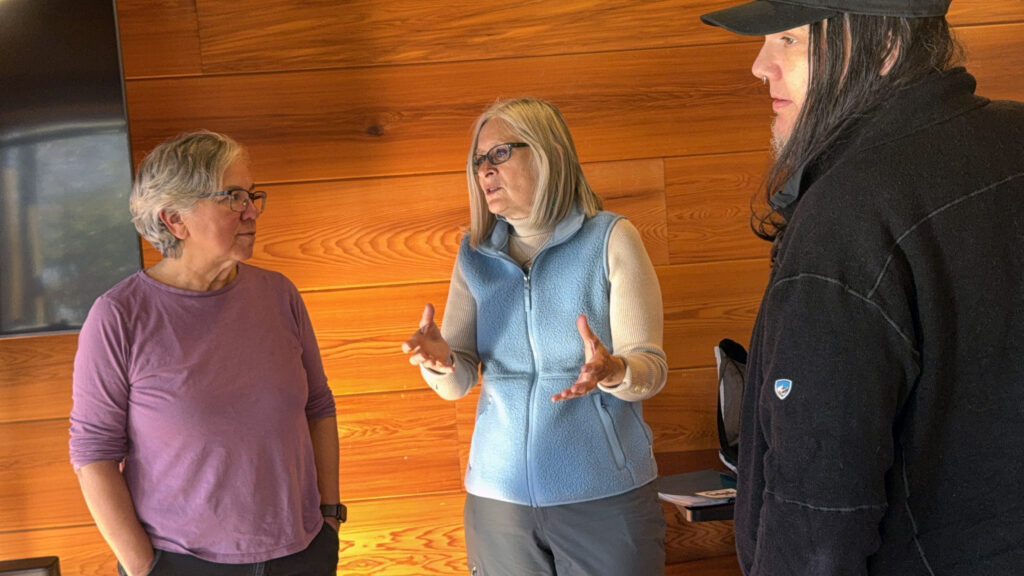
Tribal council members Kimberely Strong and David Strong talk to Alaska Rep. Andi Story (center) during a meeting on Saturday, Oct. 11, 2025, in Klukwan, Alaska. (Rashah McChesney/Chilkat Valley News)

The Chilkat Valley’s state Rep. Andi Story and Sen. Jesse Kiehl began the state’s legislative session with a set of proposals that include changes to school funding and public retirement benefits — all colored by questions about the state’s finances, the legislators said. 

The legislative session began last week and will end no later than May 20, the deadline to pass laws and a budget for the upcoming fiscal year. 

Education funding

Both representatives enter the session with a focus on public education, particularly Story, a longtime Juneau school board member and the current co-chair of the House Education Committee.  

Haines Borough School officials have been outspoken in the past year about a need for increased funding, but also the difficulties of budgeting for a school year before the amount of incoming state funding is clear. 

 One of Story’s bills seeks to provide  clearer and earlier funding picture to school districts.

Under the current funding system, the state distributes a set amount of funding per student to school districts. A district counts the total students each fall, which determines funding for the following school year. 

The bill would maintain that same general structure, but allow districts to use a student count from a year prior, or a three-year average. That would allow districts to accurately project their following year’s funding before the fall student count. 

One benefit of being able to project finances earlier in the year, Story said, would be earlier recruiting for open teacher positions. 

A second Story education bill would reward Alaskan students for taking public-school teaching or government jobs in-state. 

As currently written, the bill would create a grant program to pay back up to $24,000 in student loan debt per grant recipient over three years. 

Up to 125 grant recipients would be chosen per year, and they would have to fulfill one of two specific criteria: Alaska residents who earned a degree out of state and then returned for a public school or other public-sector job; or they earned a degree from a University of Alaska school, and spent at least 12 months living out of state before returning for the in-state teaching or government job. 

The aim would be to bring “skilled individuals back to Alaska and reduce the vacancies in our schools and state services,” Story wrote in a statement.

The bill proposes funding the program from the Alaska Higher Education Investment Fund, a state investment fund for educational grants and scholarships. 

According to the state treasury, the investment fund had a market value of $313.5 million at the end of December. That would theoretically avoid having to appropriate new funding in the state’s budget to put the plan into place, significant, Story said, at a time when the state is looking at a $1.5 billion deficit as written in the governor’s proposed budget. 

“This year we are in a very austere budget, so we know bills with significant fiscal notes will have a hard time passing,” Story said this week. 

Another Story bill would expand financing options for workforce housing. 

Addressing housing shortages was a top concern she heard from constituents at this year’s Southeast Conference, she said. 

Her proposal would allow the Alaska Industrial Development and Export Authority (AIDEA) to finance workforce housing of five units or more. Because AIDEA is funded in the governor’s budget, the bill wouldn’t have to appropriate new money. “We have good policy where we have some areas of revenue available to us within state government,” Story said. 

State pensions

One of Kiehl’s priorities is a change to the state pension system he says will allow the state and municipalities to more effectively recruit and retain public employees. 

The change would be to create a defined-benefit tier for public employees that pays a monthly amount after retirement, rather than the current system’s 401k-style payout. 

That would incentivize employees to stay on board longer in Alaska, Kiehl argues. 

“In the current system you only get an individual account, and that money stays there and grows while you go work somewhere else and work a pension,” Kiehl said this week. “The best economic decision you can make as an Alaskan interested in public service is to start with state or local government, work five years, and then leave. That’s the current economic incentive structure we have.”

Kiehl submitted his own bill on the issue, but now backs a different bill from Senate Majority Leader Cathy Giessel. He says her bill will have a similar effect, and has drawn more support. 

Address protection

Kiehl also introduced a bill he says will protect address information for vulnerable Alaskans.

The bill would establish a state-run post office box that residents could use as their public mailing address. The state would then confidentially forward their mail to a private address. Alaskan survivors of domestic violence, stalking, and sexual assault, and law enforcement officers would be eligible for the program. 

The current text of the bill states that survivors would be eligible if a court had issued a protective order on their behalf, or if they met “other standards set by the (Alaska Department of Administration).”

Will Steinfeld is a documentary photographer and reporter in Southeast Alaska, formerly in New England.