Growing up in the Chilkat Valley, there was always talk about energy challenges, Chandler Kemp said. Talk of fuel prices going up, debate about Haines and Skagway’s joint hydropower system, disagreement over a proposed hydropower plant at Connelly Lake.
For a kid who had “always been interested in science and engineering,” those were natural topics to gravitate toward, the 2008 Haines High graduate said last week. Now, he’s a professor at the University of Alaska Fairbanks, an engineer working on sustainable energy.
“I love Haines and I always wanted to find a way back to Alaska. It’s felt like a way to do something that felt meaningful but was in that discipline,” Kemp said in an interview last week.
Kemp is now back in the news, right alongside those longstanding questions of how to power Southeast, its residents, and its economy, newly relevant following skyrocketing fuel prices.
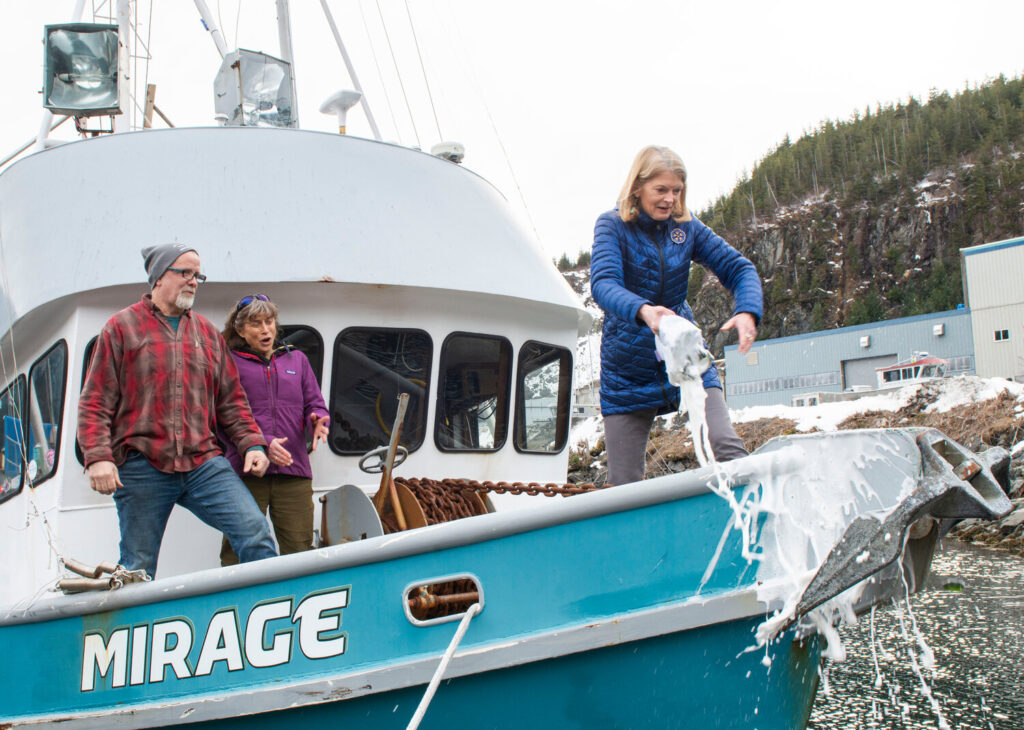
Earlier this year, Kemp was one of the main science brains on a team that overhauled the F/V Mirage, a longtime Sitka-based longliner, with a hybrid electric-diesel propulsion system.
The pilot program, an initiative of the Alaska Longline Fishermen’s Association, has the Mirage able to haul pots or slowly cruise on battery power, switching back to a standard combustion engine for longer motoring legs.
That kind of hybrid boat propulsion isn’t groundbreaking in and of itself, particularly over the last decade, as battery technology has improved rapidly; for instance, the state’s ferry system plans to begin shifting a large portion of the ferry fleet over to hybrid systems, including a planned shuttle ferry that could run between Haines and Skagway.
The technology, however, is novel for this application: Kemp believes the Mirage is the first boat in the country fishing commercially with that sort of hybrid propulsion.
Fisheries like Sitka’s longline fleet or the Lynn Canal’s gillnetters pose unique challenges for hybrid propulsion, Kemp said.
For one, unlike a ferry or a tugboat, commercial fishermen don’t necessarily dock every night, making battery recharging more difficult. On top of that, the boats are mostly their own, one-boat floating small businesses. That makes it a harder proposition for owners to take risks on new, unproven systems.
News of Kemp’s work seems to have not yet made its way up Southeast. Members of the Lynn Canal fishing fleet this week largely said they hadn’t heard about the work in Sitka.
Some expressed skepticism, like Karl Johnson, who pointed to the high initial costs of converting to hybrid technology, though he said he didn’t know the details of the work.
“I really can’t see it being economical here for what we do,” he said.
Some were more open to hybrid technology, like Brian O’Riley, who said that given current fuel prices, “an electric boat sounds better and better.”
“I wonder if one can get long-term (horsepower) out of such a system,” O’Riley added. “Trollers operate at slow speeds and we gillnetters need access to more HP at times.”
Gillnetter Jeff Klanott said that if the Sitka fleet was open to the new technology it “might be worth looking into.”
Kemp emphasizes that he welcomes and agrees with much of the skepticism.
He’s an academic working on solutions, not someone selling a product, and skepticism is healthy for any new technology, he said.
“These pilot projects, we hope to show you can have an electric-powered boat and you can save some fuel, but I don’t think we’re at the point of saying this is the solution that everyone should be adopting.”
For one thing, he agrees with Johnson that the technology needs to become cheaper before it can be more widely adopted. It also needs to be more reliable: for now, he and his team members continue to be in touch with F/V Mirage captain Jeff Turner to troubleshoot problems in the system as they pop up.
Those are all challenges to tackle now that the proof of concept is floating and catching fish.
“I think there’s often an expectation that some projects are going to solve all these problems at once, and that’s not the case here,” Kemp said.
“But now that we’re getting on the water, we can think about if people want to do this and what needs to be done to make it practical without support in the future.”