
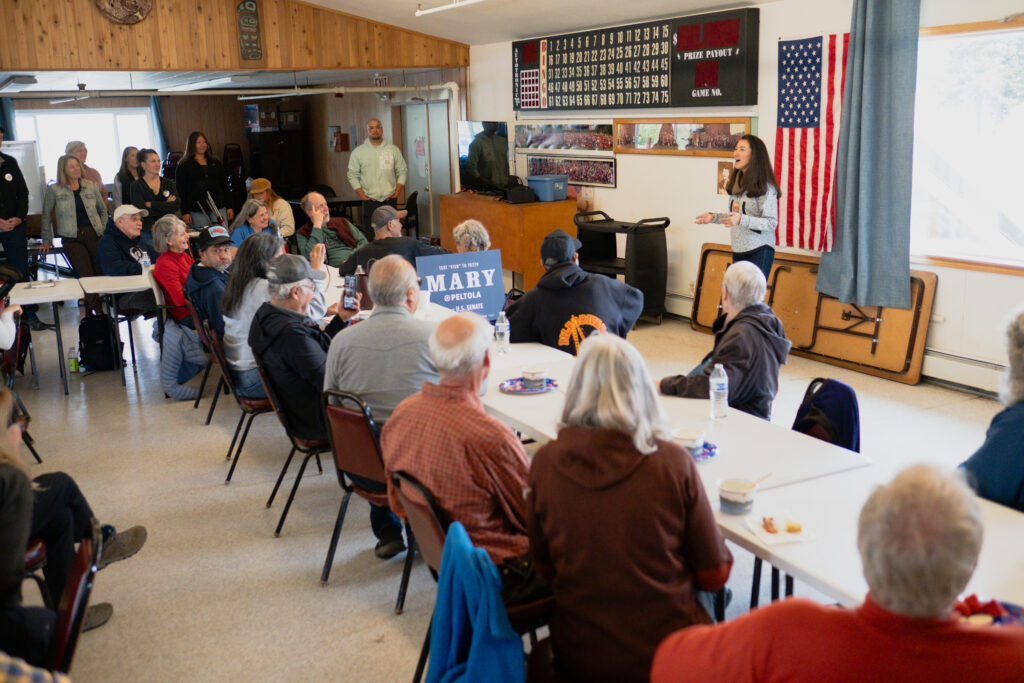
Senate candidate Mary Peltola speaks at Haines’ Alaska Native Brotherhood Alaska Native Sisterhood Hall, Saturday, May 30, 2026. (Will Steinfeld/Chilkat Valley News)

Mary Peltola’s campaign for U.S. Senate arrived in Haines last week with little fanfare: a Saturday campaign event was announced by a lone, letter-size flier on local bulletin boards. It was sandwiched between flyers for karaoke night at the Pioneer Bar and a babysitting club advertisement.   

Meanwhile, Peltola has had the largest first quarter of fundraising in state history, a sign of how high-profile her race against incumbent Sen. Dan Sullivan has become nationally. 

Saturday’s stop was one in a tour of Southeast towns, and roughly 80 people attended the event at the Alaska Native Brotherhood/Alaska Native Sisterhood Hall on Willard Street. Some supporters already on the campaign’s contact lists said they had been notified of the event by email and text, while others found out from community Facebook posts just hours before.

Peltola brings to the race a long political career across all levels of government, with a decade as a state representative, a term on the Bethel city council, and a term in the U.S. House of Representatives, where she was the first Alaska Native member of Congress.

After losing her seat to current representative Nick Begich in 2024, Peltola took a position at law and lobbying firm Holland & Hart LLP. It was there that she most recently appeared in the Chilkat Valley News, as a member of a prospective lobbying team nearly hired by the borough.

With her national stature, the campaign brought with it some layers of formality less frequently seen in Haines: attendees were required to sign in with the campaign before being allowed to enter the ANB/ANS Hall, and local news outlets were not allowed to ask Peltola questions, which has been the campaign’s policy with local media at other stops in the region.

But the theme among attendees was a feeling of familiarity with the candidate, who spoke to and took a photo with each attendee individually after delivering prepared remarks.  

Local gillnetter Brian O’Riley voted for Peltola in her 2022 House race, even as he has moved away from supporting other Democrats, he said. O’Riley voted for Robert F. Kennedy Jr. in the 2024 presidential election. 

“I don’t like dogma, all the talking points of legacy media,” O’Riley said. “I like people that aren’t politicians. I think (Peltola) is the real deal.” 

In something of a theme among supporters Saturday, O’Riley pointed to Peltola’s in-state roots, growing up in the Yukon-Kuskokwim Delta, as a factor behind his support. 

“Going to fish camp as a little girl, hunting and fishing, you don’t really have people like that in government,” O’Riley said. “There are a lot of intellectuals in there, and you can intellectualize things to death, which is good sometimes, but common sense goes a long way.” 

Peltola supporter Sara Chapell said she first met Peltola when the now-Senate candidate was a low-level Alaska Department of Fish and Game employee, working with Chapell’s husband. 

“Mary was an intern or something, going around checking test nets. Personally, I’ve known Mary as a mom and somebody who cares about Alaska. And so yeah, naturally I have trust in her,” Chapell said. 

Chilkoot Indian Association tribal administrator Harriet Brouillette said she had not yet committed her vote to either Peltola or Sullivan, but said Peltola “feels familiar.”

“She was born and raised in Alaska, her family has been here for a millennia — I think that goes a long way.”

Brouillette also spoke to Peltola’s work while in Congress on legislation that would allot land to communities that did not receive land under the Alaska Native Claims Settlement Act, Haines/Deishú being one of them. 

“She has a track record,” Brouillette said. 

Land allotments were a specific policy reason for Peltola support for others as well, like Jim Strong and Jack Young, both Alaska Native veterans of the Vietnam War. 

In 2019, national legislation opened a new round of allotment opportunities for Alaska Native Vietnam veterans, like Strong and Young, who missed initial opportunities for land claims while serving overseas. 

Many say the process has yet to work out as expected, including Strong, who said he’s had 13 applications rejected already because of his selections already being taken. 

Peltola acknowledged during her remarks what she said were issues in the process. 

“The parcels the Department of the Interior are offering are thousands of miles away, in Good News Bay, North Slope Borough,” she said. “Good News Bay is a community that costs $400 one-way to get to just from Bethel. There’s no way someone from Haines is going to find that an attractive allotment.” 

In recent years, members of the state’s congressional delegation have spoken in support of the veterans’ allotment program, including Sullivan, Peltola’s opponent. Sullivan, Sen. Lisa Murkowski and Rep. Nick Begich sponsored a bill passed last year that extended the application period for the program.

But Strong and Young said they had confidence that Peltola, more so than Sullivan, would effect real movement on the issue. 

“Sullivan has been involved in the Native allotment issue and met with us several years ago, but it hasn’t gone anywhere,” Young said. 

“She’s been around the problems. She’ll keep it not in the rearview mirror, so it can come to some sort of settlement,” Strong added. 

Other Chilkat Valley-focused sections of Peltola’s remarks included what she referred to as “the struggle between resource development and protecting our environment.” 

It’s a contentious topic in the Chilkat Valley, with advanced mineral exploration at the Palmer Project in the upper valley. Opposition to the project has been spearheaded by the Chilkat Indian Village’s Chilkat Forever initiative. 

Peltola has supported a number of major resource development projects as a national politician, but seemed to lend some support to those opposition efforts Saturday. 

“I really believe, fundamentally, there has to be social license to operate,” Peltola said. “If there’s a project coming into a region, the people who live close to that project have to be supportive. I do think our permitting process is really designed for these projects to go through, whether or not there’s social license to operate. That’s something I worry about.” 

Chilkat Indian Village and Chilkat Forever leaders have also used the language of social license, saying this year they aim to show the Palmer Project does not have social license to operate in the Chilkat Valley.

Peltola will continue campaigning through the Aug. 18 non-partisan primary, which will advance the top four vote-getters across all parties to the general election. Voting in the general election will conclude Nov. 3. 

Will Steinfeld is a documentary photographer and reporter in Southeast Alaska, formerly in New England.