
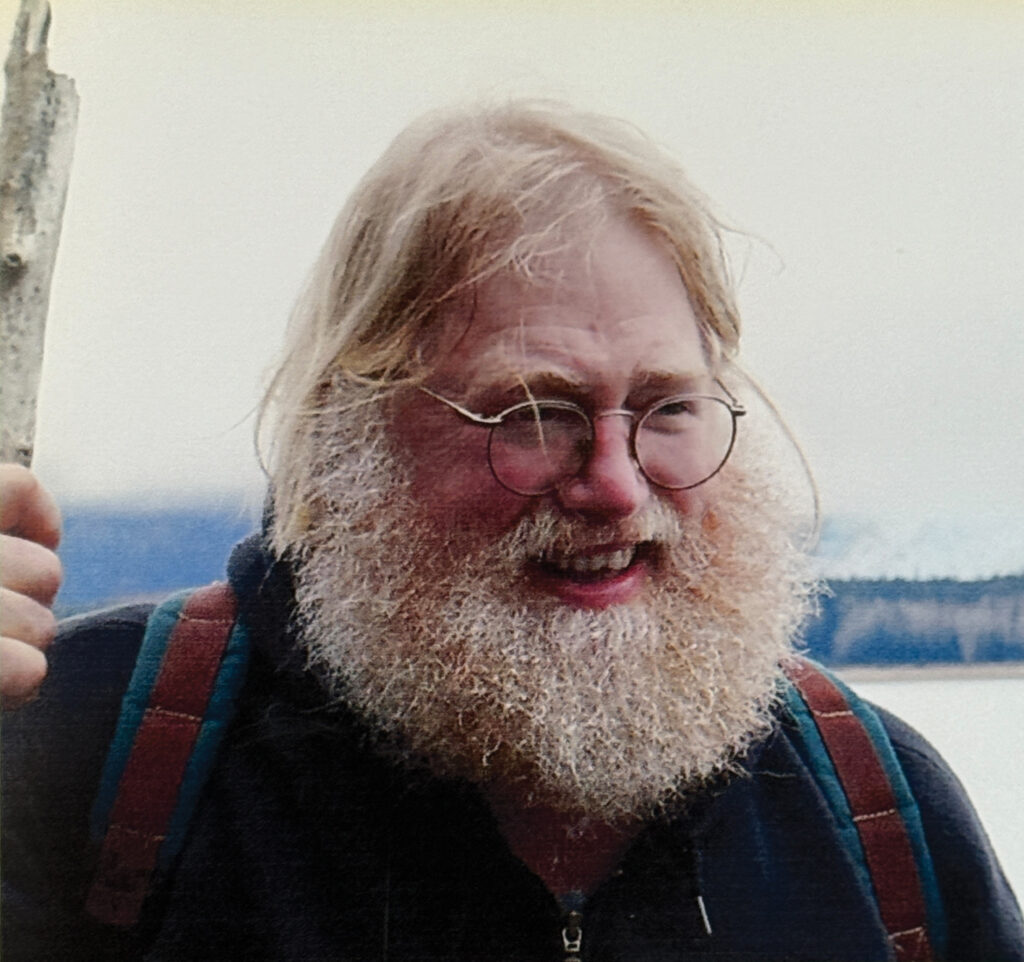
Editor’s note: In the weeks before he died, Andrew Degen outlined the obituary he wanted to see written about himself. His partner of 53 years, Sandra Degen, filled in some of the gaps, but the following largely follows his plan for what he thought people should know about him.
Andrew “Drew” Degen was born Dec. 3, 1945, in Flushing, Queens, New York. He died at his Mud Bay home on Nov. 18, 2025 from the complications that come along with three decades of congestive heart failure and three years of sepsis. He was just two weeks shy of his 80th birthday.
Drew was both an intellectual force and a gifted athlete. He was a member of the 1964 Wantagh baseball team, that year’s Nassau County, New York, champions.
He caught the eye of scouts while playing baseball during his junior and senior years; his team won a state championship. So Drew – who played both as pitcher and third baseman – was invited to try out for the New York Yankees and the Cleveland Indians (now Guardians). They advised him to head to Southern California or Arizona, where he could play all year long.
“He had to go home and think about it, but he decided by himself ‘I want to go to college,’” said his wife Sandra “Sandy” Degen.
He stayed close to home and enrolled in Colgate University, a private liberal arts college in Hamilton, New York. He started as an architecture student, but soon switched majors and graduated with a bachelor’s degree in philosophy and a minor in religion.
But that early love of baseball lingered and he played in the college World Series in Princeton, New Jersey, in 1968. “They lost,” he wrote. And every year he’d watch baseball in the spring. He was a Yankees and Dodgers guy.
“Did he have a favorite? Nope. He just wanted either of them to win,” Sandy said.
After getting his undergraduate degree, Drew would study for 10 years at the Crouse College of Music at Syracuse. It was there that he met the woman he called his “steady light in a challenging life.”
“I worked at the library at the circulation desk,” Sandy said. “So Drew would have to take his books from the art library over to the music library … and so he’d roll his cart by the circulation desk. Every day I’d see him like maybe eight times or something going back and forth. We’d kind of smile at each other.”
Drew was an excellent speaker. Sandy said she realized she fell in love with him while standing in the basement of the building with 156 other librarians listening to him talk passionately about why they should unionize.
“I was just mesmerized by his dedication, his intelligence, his strength to mobilize people. And we won,” she said.
They were a couple for 53 years.
Before they met, Drew had been the assistant manager for the Syracuse symphony. Every week, he’d buy a classical music record. To this day, his home is filled with his pristine vinyl collection.
Sandy signed him up for a synthesizer class, which turned out to be a powerful influence as he gravitated toward the Experimental Electronic Music Department, enjoying early access to one of just four fully-developed analog Moog synthesizers in the entire world at the time.
That journey and love of music later led him to compose two albums, “Ex-Nihilo” which is out of print and “Alaskan Birdsong Music.”
While he was flexing his creative muscles, Drew also was active in the environmental movement, including a successful effort to end a project that would have seen a toxic waste dump in upstate New York, about 20 miles away from the couple’s home.
The couple moved to Haines in 1985. He followed up that environmental advocacy by pushing back on the Windy Craggy mine in the early 1990s. That was a plan to mine 100 million tons of copper, deliver it via pipe slurry about 150 miles to Haines, and then ship it to Japan.
But Drew saw the downsides in a type of mining that could contaminate the Tatshenshini-Alsek and Lynn Canal ecosystems. And while he wasn’t a very social guy, Sandy said he stood in front of a packed high school gym in Haines to fight against the project. “He was instrumental in being able to logically tell people … why we had to fight this and we did,” she said.
Eventually, the Tashenshini-Alsek Provincial Wilderness Park was created, protecting 3,700 square miles of the Yukon, British Columbia and Alaska.
The Degens bought a steep, rocky 7.5 acres in Mud Bay in 1987. Sandra said for the first five years, they used the 11 weeks off she had from teaching at the school to clear land and then build the epic staircase (at least 349 steps) that leads up to their home.
After several minutes of walking, or a quicker ride up the 410-foot tram, one arrives at what Drew called the aerie. He didn’t get out much, and it’s clear from the creative use of storage space, vivid colors, storage closets packed with well-ordered supplies, large garden boxes and the proliferation of music and reading material that he designed and built the perfect refuge for their family.
To this day, Sandy admires his attention to detail and perfectionism of his architectural drawings and renderings of the space. While going through his effects, she recently found some of those drawings with his precise handwriting laying out enough detail about each building, foundations, roof construction and materials, the tile patterns, wall colors and carved wooden flourishes, that there is virtually no room for interpretation,
“Nothing was an add-on, when he gave the plans – the beautiful, beautiful plans to an [architect] in Juneau, everything was included,” she said.
The couple’s home took about six years to build and is an off-grid marvel that incorporates everything from rainwater collection to solar and wind power generation, to a composting toilet, and cold-storage pantry that relies on outside ventilation.
Above it all, in a circular, window-filled room at the top of a narrow spiral staircase, Drew’s music studio has a commanding, nearly 360-degree view of the Lynn Canal.
“For heaven’s sake, he grew up on Long Island in New York,” Sandy said. “This was magic for him to be here.”
During all of that time secluded in their space, Drew wrote a book titled “Beyond Belief,” using the pseudonym Martin M. Martin. It’s something of a magnum opus that explores the convergence and opposition between science and spiritual belief.
He worried that the premise would be poorly received in the Chilkat Valley and did not publicize that he’d written it until now, Sandy said.
Drew also wanted people to know that while he was here, he enjoyed gardening, cross-country skiing, ice skating and biking trails.
Many of the couple’s outdoor adventures were done with longtime friends Ann Myren and Tim McDonough. “They were our go-to people,” she said.
Often the group would go up into the Yukon, and spend time hiking, biking and canoeing – sharing a love of the outdoors.
He also enjoyed cooking, formline design and dancing. Sandy credits her brother, Tim June, with that last one.
“Fast, you know, rock and roll dancing,” she said. “He fell in love with it.”
He is survived by his wife, Sandy Degen, brothers, Donald, Paul and Robert Degen.

