
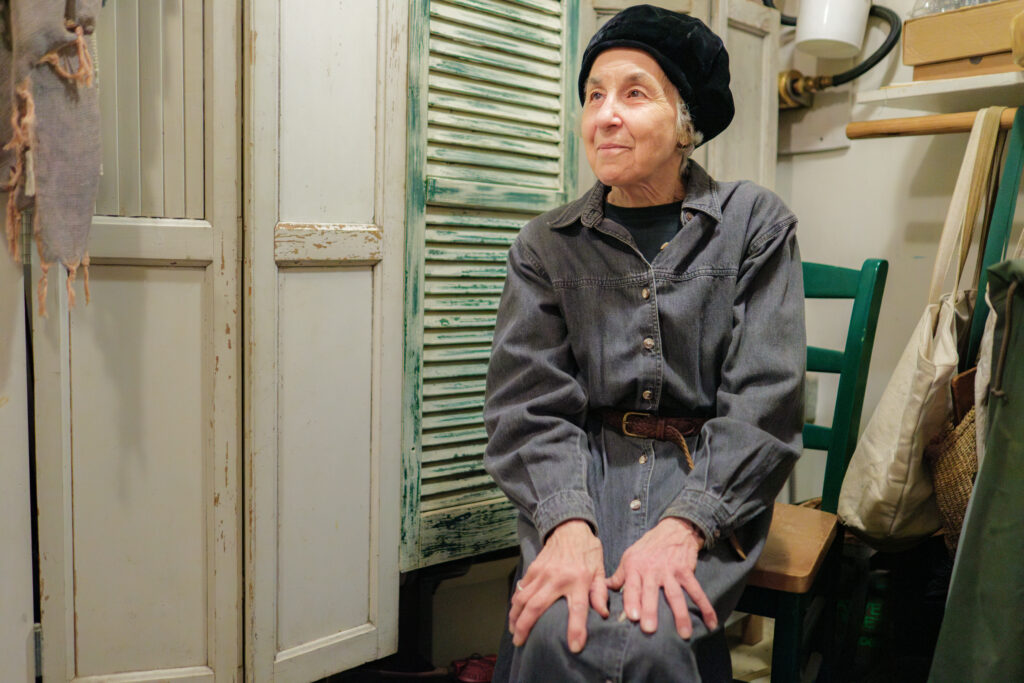
Locals might recognize Evelyna Vignola by the berets she always wears — maybe the only beret-wearer in the Chilkat Valley — or by the wire cart she wheels up Main Street with groceries; maybe also by the hammer-shaped cookies she’s baked for Hammer Museum First Fridays. What people might not know is that recently, she was considering leaving town.
It came about when Vignola had gotten some advice that maybe, amid health challenges, she might get out of Haines. The advice came from an astrologer, a respected one, she said.
According to the astrologer, at her spot on Deishu Drive, halfway down the Chilkat Peninsula, the stars weren’t — and might never — line up enough for good health.
Stars be damned, she decided to stay put.
“I’ve figured there’s a reason I’m here, and I’m going to figure out what that is, or I’m going to know when it’s time to go,” Vignola said.
Still, it’s not always easy, looking at a road back to health she estimates in years, not days. It means pushing to get out of the house, to keep up routine, even when it’s difficult. More difficult, perhaps, on holidays, when it seems like nearly everyone around has some sort of activity planned.
Plus, she’s not much of a holiday person. On the third Thursday afternoon of November her home smelled of the spruce and the birch burning in the wood stove, the lemon peel cut up for tea — a smell to beat back the coldest day of the year yet, but not necessarily a Thanksgiving smell: no turkey, no gravy on the stove, no mashed-potatoes.
It was only a call from friend Tom Bender that morning, asking what there was to do in town, that got her out to a community meal at the high school.
There, the two chatted with the rest of their cafeteria table and Vignola worked on a plate of pie. She skipped the entrees — the kind of piping-hot, gravy-glued piles of holiday cranberry, tryptophan and lard that had residents tottering slowly out to cars after.
That’s not something Vignola does, 55 years into her “food trip,” as she calls it. She first came to the state to live at Ionia, an intentional living community in the Kenai Peninsula community of Kasilof organized in large part around the macrobiotic diet. Practitioners of the diet, which was said by its creators to be based on a kind of Zen Buddhism, say it holds health benefits including curing serious illnesses, both psychological and physical.
Under the strict rules of the diet, community Thanksgiving green-bean casserole, lovingly prepared or otherwise, is a no-go. As such, Vignola was there less for the food, and more for the conversation. She got plenty; eventually, Bender headed to the Fogcutter and Vignola headed home.
It’s been years since Vignola left Ionia, which just didn’t click for her. Now, cooking for herself back on Deishu Drive, Vignola is willing to break some rules. The diet, anyway, was for her more about the philosophy behind it than the specific rules.
“I don’t know anybody else doing it — they all live somewhere else, so it’s just changing somewhat for me,” Vignola said.
As winter has settled in, she’s stocked frozen vegetables (technically not allowed, due to being frozen), good backup for when the ice on the ground makes it hard to get over to the supermarket. She has potatoes too, (also not allowed, being members of the nightshade family), which were gifted by a friend; she kept them because the “one-bite” potatoes, as she called them, seemed like they were meant to be floating around in a soup.
So on Thursday night, absent other plans, soup it was: halibut, leeks, some of the frozen vegetables, and the small potatoes. “A way to join in on the holiday in some fashion,” Vignola said, “but to make it my style.”
It’s not new to her, shaping traditions to her own style, and she’s seen a lot of them come and go.
Some she inherited, growing up in Washington D.C. decades ago, where her mother, aunt, and sister-in-law split the holiday cooking every year.
Some she created, leaving college early, getting married, having children, and eventually returning to get a fine-art degree in Massachusetts — by then a decade older than most of her classmates. One November, her children were with their father, who Vignola had separated from, and their step-mother; she was at school. With one art-school friend who had decided to stick around for the break, she drew up a menu, and the two of them cooked their own version of Thanksgiving dinner. None of the traditional foods, she noted.
“That sticks out because it was so purposeful,” Vignola still recalls, decades later. Soon after, Vignola graduated from school, as did Laurie, the friend. They went separate ways.
Vignola’s travels have meant going separate ways from a lot of people. She’s up here, but her family remains down south. Nowadays, that’s feeling further and further away. Of one recent visit to her son in Oakland, California, Vignola recalls a specific moment, sitting in the parking lot of a Whole Foods Market. Just that one minute, waiting for her son to come out of the store, it was the people she couldn’t stop watching — the crowds going in and out.
Until then, she said, she thought of herself as a person who could live anywhere. When she had last visited, she had looked around at Oakland and seen a place she could have maybe moved to. The number of people hadn’t necessarily changed, but by the time her son got to the car, it just felt less tenable.
“This last time,” Vignola said, “I was saying, you know what, I don’t think so anymore.”
Haines remains home. But as she knows from sometimes-strained relationships with her sons, home, and sharing it with others, is not always easy.
For years, there was an annual Thanksgiving that Vignola went to at a friend’s home in town. But during the COVID-19 pandemic, they had a falling-out. Not enemies, but just “no longer socializing,” as she put it. So it was with her hiking group, too, though that activity would be on pause anyway due to her health.
That’s left her open — looking, at least in her own way — for something new. Especially now, standing on the threshold before a road to recovery that is still unfolding.
“I don’t know what’s going to happen next,” Vignola said.
What is heartening, amid the uncertainty, are the things she doesn’t have to wait to do, or give up, until she gets better. That includes measures like replacing LED lightbulbs in her house because of health concerns she has about the technology. But also simpler things, like deciding to go to the community meal, to sit with new people and chat.
For Halloween, she’s developed a tradition of putting out two small burn barrels on her front lawn, and standing beside those fires to hand out “halloween treats” — as she calls it — to the kids on Deishu Drive.
And deep in November, after the burn barrels get put away, she has the leeks, the potatoes, some kind of fish soup: bringing back the old art-school days of drawing up some special menu of her own choosing for Thanksgiving dinner.
Sitting in her front room between a stack of New Yorker magazines and a photo of a younger version of herself, smiling behind two hiking poles up in the alpine, Vignola wondered aloud if it was a stretch, that the potatoes and leeks and halibut on their own could count as a way to participate in the holiday.
A stretch, maybe, but still, a reason to pause, and take stock, she said — a practice she wants to return to.
At a different time, she taught her sons to say grace, and even though she stopped, they continued. When she visited recently, and her son paused before their meal, it was a reminder.
“There always used to be at least a little prayer I said before eating,” she said. A tradition that in recent years had “kind of fallen apart,” but not necessarily for good.
Thinking forward to her completed soup on Thursday, she said she planned to pause before eating, to hope for some grace, in the sometimes-difficult dynamic between her and her sons. She planned to be grateful, for the chance to live through “exciting times.”
And as she talked through it, she seemed to decide it was less of a stretch than it might have seemed. “To be grateful at any time is good for us, you know?” Vignola said. “It matters. I don’t know if it matters more now, but it feels like it matters more.”
And maybe next year, she said, if the soup was good, two years could make it a tradition.

Will Steinfeld is a documentary photographer and reporter in Southeast Alaska, formerly in New England.