
Editor’s Note: The Chilkat Valley News called each of the candidates to ask about their AI use in responding to these questions. Two candidates, Kimberly Rosado and Nathanael Reams, disclosed the use of AI in assisting with answering these questions. In Reams’ case, he used it for grammar and proofreading. Rosado used it to proofread and, in some cases, help answer the questions. We edited candidates’ answers to be closer to the 100-word limit we asked them to adhere to.
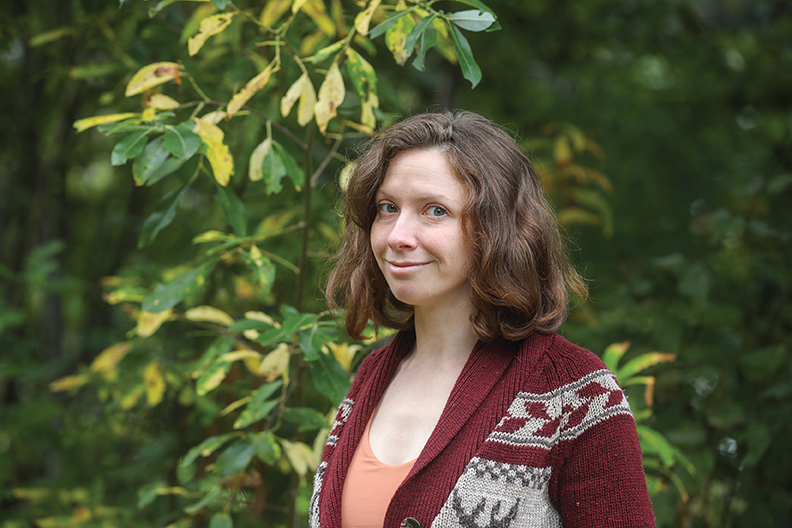
A more in-depth profile of Rachel Saitzyk can be found here.
Our next borough election is set to take place on Oct. 7. That means we’re working to get you the information you need to know to cast an informed vote here at the Chilkat Valley News.
We asked Chilkat Valley residents to weigh-in on what they’d like to hear from candidates and dozens weighed in asking nearly 50 questions.
We pared down the list to 12 and asked candidates to answer them in about 100 words. We’ve edited those that came in significantly longer or contained grammatical errors.
Question 1 (from Carol Tuynman): What role can the planning commission play in providing affordable childcare; affordable housing; and/or workforce development?
Rachel Saitzyk — To address affordable housing, I would recommend that the assembly classify certain borough-owned lands as “for sale.” This could provide opportunities for first-time buyers and open a conversation about direct financing by the borough, bringing in additional sustained revenue. I’d also like to see an increase in duplex allowability. To develop the workforce, public and private organizations have historically provided and even sponsored training for would-be home inspectors, which I’m researching. This could be applied to other essential jobs as well. These training plans would have to take the form of recommendations for the assembly to consider.
Question 2 (from Fran Tuenge): Do you want Haines to thrive and grow economically? Give an example of what you will promote.
Rachel Saitzyk — What? Of course! We keep each other standing and the entire community thriving through mutual support—in this case I’m talking about business. This requires practicing flexibility with our neighbors and the evolution of what it takes to run a successful business with realistic income. My priority is to proactively support private enterprise, recreation infrastructure, regenerative tourism, medical care facilities, hospitality, entertainment, and exporting local goods and services. Things that translate directly to high quality of life! I also dedicate myself to helping build all plans that our residents want for our community (regardless of my own ideals) with broad success, sustainability, safety, and affected economies at the forefront.
Question 3 (from Thom Ely): Our population in the Haines Borough has remained relatively stable over the past 40 years at about 2,500 residents. Do you want our population to grow or stay about the same?
Rachel Saitzyk — I don’t see that what I want matters here. Our elders here in Haines are living long, very high quality lives, especially relative to their peers elsewhere. That’s amazing! That is what we all want for ourselves and our loved ones! These are signs of success. With a larger community of retirees we also need higher income brackets in the working class, more working residents, or both if we want to sustain our community at all. A role of the planning commission is to design and recommend plans for how we want our future to be, based on what we currently have, as well as to steer us toward the best outcomes from changes—some of which are less intuitive, but no less inevitable.
Question 4 (from Patty Brown, current planning commission member): The category of General Use in zoning designations is intended to be a transitional label during a period which would lead to more specific zoning applications later. Since the Haines Borough was reclassified as a Home Rule Borough in 2002, more than two decades have passed. As there have been conflicts expressed in the past several years and new residents moving into the area, particularly out the Haines Highway, what ideas do you have for establishing some restrictions and formally declaring allowances that meet today’s needs while allowing for future economic growth?
Rachel Saitzyk — I think it would be important to grandfather in existing uses by residents in GU zones. Many folks “out the road” choose to live outside the townsite for less restrictive land-use requirements as well as for quiet that comes with distance from neighbors. They also surrender access to some services that townsite residents receive. We have a lot of data about how residents use their land. Conversations and proposals for zoning changes need to begin here. More formal zoning designation in GU zones should be applied through likely relatively small areas to meet the needs of specific micro-communities. There are so many nuances.
Question 5: What do you recommend as consideration criteria in deciding whether to increase commercial use of public infrastructure that could displace local users?
Rachel Saitzyk — My first thought is: public infrastructure is for the public. That is who should have priority. Increased commercial use is different than exclusive or even prioritized commercial use. I’d want to know whether or not there’s an executable plan/accountability to bridge the gap adequately. If that infrastructure is borough owned (as opposed to state or parks), then public opinion, health and safety, monetary and resource benefit to borough residents, commercial users paying for maintenance and repair of that infrastructure, and potential environmental hazards would all be part of my recommended criteria.
Question 6 (from Deborah Gravel): How would you support civility in all and any public meetings, including the school board, planning commission, and borough assembly?
Rachel Saitzyk — I see this as an issue at every level of government. If we want to maintain democracy we need to be able to have basic respectful discourse, negotiation, rules of order, and first amendment rights. When I see it I will call out abusive language, call out-of-order arguing, and call for meeting breaks when I think involved parties need to cool off. I practice active listening, maintain calm awareness of my own emotions, and encourage other members to do the same. I also think basic needs like exhaustion and hunger come into play and could be met with meeting time limits.
Question 7 (from Karen Wallace): What is your vision for the Lutak Dock?
Rachel Saitzyk — In my ideal plan we would demolish the current dock, leaving dolphins in place during reconstruction for barges to rely on temporarily. Demolishing two docks in the future is unlikely to be more economically feasible for our descendants than demolishing one is for us now. Then we’d construct a dock that’s comparable in size to our current dock, but with deep water access. Our contractor would develop a design with robust community and Borough engagement according to industry seismic and tidal standards.
Question 8 (from Kay Clements): What is your position on the Mosquito Lake Community Center?
Rachel Saitzyk — I’m adamantly for keeping its current uses as they are, but flexible to ownership and changes to operational and maintenance responsibilities. Shifting these to Four Winds Resource Center or a to-be-determined party could happen gradually to enable successful transfer without interrupting operations. A potential short-term solution could even include updates to the standing MOU, adding accountability for the Resource Center to raise a minimum amount of its own funding. To those among us who benefit from it FWRC is crucial to food sovereignty, resource affordability, community building, and provides an emergency muster station.

