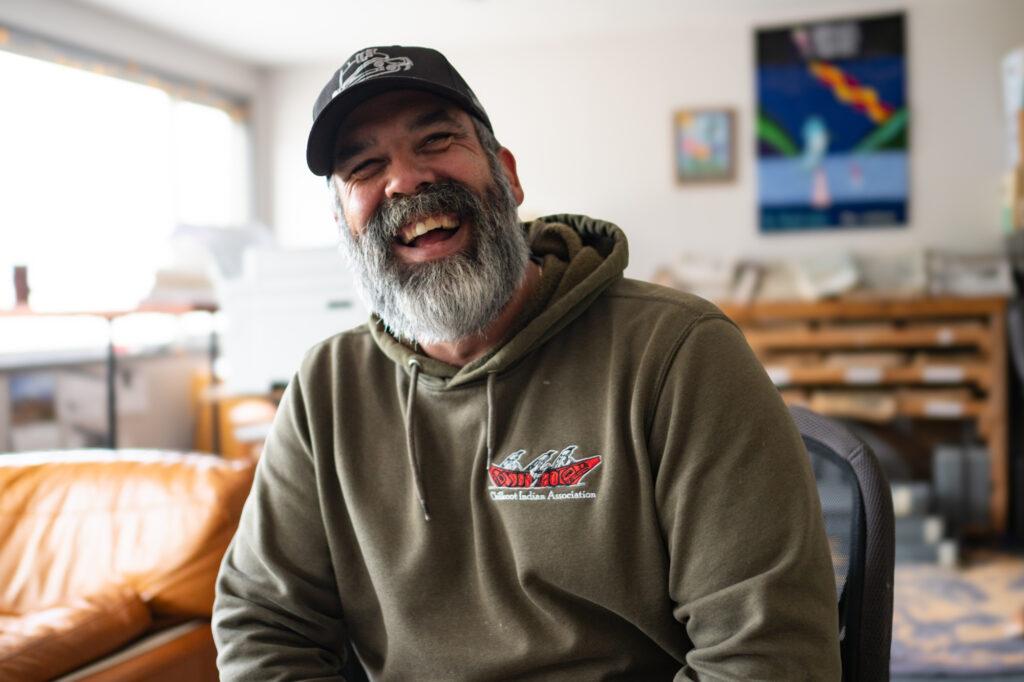
A more in-depth profile of Gabe Thomas can be found here.
Our next borough election is set to take place on Oct. 7. That means we’re working to get you the information you need to know to cast an informed vote here at the Chilkat Valley News.
We asked Chilkat Valley residents to weigh-in on what they’d like to hear from candidates and dozens weighed in asking nearly 50 questions.
We pared down the list to 12 and asked candidates to answer them in about 100 words. We’ve edited those that came in significantly longer or contained grammatical errors.
Question 1 (from Barbara Nettleton): You may have your own ideology as to how, say, the Lutak Dock is repaired or replaced, how the school should be funded, how nonprofits should be funded, who our lobbyists are or if we should have them, that we should have more taxes, or that we should sell off borough assets, etc. How will you listen, process, and execute a topic that receives a broad spectrum of support and opposition?
Gabe Thomas — I have consistently demonstrated a willingness to engage in open dialogue on all matters, welcoming input from every stakeholder. I firmly believe that public service requires representing the entire community—not just select interest groups. During my time on the dais, I have made it a priority to listen attentively to every individual who speaks during public comment. Every citizen’s voice matters. For some, speaking publicly requires great courage; for others, it comes more naturally. Regardless, each deserves to be heard with respect and consideration.
Question 2 (from Deborah Gravel): How would you support civility in all and any public meetings, including the school board, planning commission, and borough assembly?
Gabe Thomas — At times, public discourse can become heated, and it’s understandable—people care deeply about the issues that affect their lives and their community. While I cannot control the behavior of others, I remain committed to conducting myself with civility and respect. The citizens of Haines are passionate about their town, and that passion is a strength. But it’s important to remember that beyond the meeting room, we are neighbors. We’ll cross paths again—at the grocery store, the post office, school events, or simply walking down the street. Maintaining mutual respect ensures that our community remains strong, even when we disagree.
Question 3 (from Kay Clements): How will you balance the needs of younger adults when the assembly is comprised mainly of older adults and leans toward older voter interest.
Gabe Thomas — As the second youngest member currently serving on the dais, I bring a perspective that reflects the realities many younger residents of Haines are facing. Issues such as housing, childcare, and the rising cost of living are not abstract concerns for me—they are part of my daily life. I am presently the only member of the dais who rents rather than owns a home, and given current market conditions, homeownership feels out of reach in the near future. Additionally, I am the only one navigating the challenges of securing daycare for a child under the age of two. These lived experiences allow me to connect directly with the struggles of younger families in our community and advocate for solutions that reflect their needs.
Question 4 (from Thom Ely): Our population in the Haines Borough has remained relatively stable over the past 40 years at about 2,500 residents. Do you want our population to grow or stay about the same?
Gabe Thomas — Growth is essential for Haines—not just for economic vitality, but to ensure we have the workforce needed to care for our aging population. However, meaningful growth cannot occur without first addressing foundational needs like housing and childcare. These are not luxuries; they are prerequisites for attracting and retaining families, workers, and young professionals. Until we make real progress on these fronts, it’s difficult to envision how Haines can grow in a sustainable and inclusive way.
Question 5 (from Cynthia Jones): What is your vision for the Chilkat Valley in 10 years, 20 years?
Gabe Thomas — I want the Chilkat Valley to remain a wonderful place to live—not just for my family, but for generations to come. My hope is that, over time, we can move beyond the divisiveness that too often clouds our conversations. Everyone holds a unique vision for what this Valley should be, shaped by personal values and experiences. For me, that vision is simple: a safe, supportive community where I can raise my children and continue to enjoy the natural beauty and sense of belonging that have defined my 46 years here.
Question 6 (from Carol Tuynman): What specific actions have you taken to balance the Haines Borough budget, and/or what steps would you recommend to balance the budget in the coming year?
Gabe Thomas — I was actively involved in developing the seasonal sales tax proposal. We must find responsible ways to address the Borough’s budget deficit. This measure was designed to place the financial burden primarily on visitors and seasonal residents. If passed, I believe the borough will still have significant work ahead to support our permanent population. Budget challenges cannot be resolved in a single fiscal year. We must be willing to re-evaluate the services we provide and the properties we maintain. Selling underutilized Borough-owned properties and reinvesting those proceeds into savings could create a more substantial financial buffer to help fund future budgets.
Question 7 (from Fran Tuenge): Do you want Haines to thrive and grow economically? Give an example of what you will promote.
Gabe Thomas — I absolutely want Haines to thrive, but that growth must be thoughtful and balanced. Relying on a single industry leaves us vulnerable to the boom-and-bust cycles.
Sustainable development means diversifying our economy and creating opportunities. This includes making land available for development, expanding housing options, and encouraging alternatives to traditional single-family homes. Not everyone can afford — or wants — a large house on several acres. Condominiums or smaller, more efficient housing could provide accessible options for young professionals, retirees, and working families.
We also need to invest in expanding our winter economy. A ski resort or similar attraction could draw visitors from the Yukon, Juneau, and beyond.
Question 8 (from Karen Wallace): What is your vision for the Lutak Dock?
Gabe Thomas — My priority is to see the dock built. I have no personal or special interests beyond ensuring the project moves forward. That said, the dock has the potential to serve multiple industries—shipping, fuel, and even cruise tourism. There’s been some misinformation circulating, particularly the claim that the dock is intended for ore export. That narrative is inaccurate.
We must stop delaying. The structural integrity of the existing dock is a serious concern, and postponing action increases the risk of failure. It’s also important to note that the Ro-Ro ramp is physically connected to the dock and would be severely impacted if the dock cells were to collapse.
Question 9 (from Jessica Plachta): Are you in support of public money being used for infrastructure projects that facilitate mine development?
Gabe Thomas —The dock project is intended to serve the needs of our community—not the mining industry. I am not part of any effort to fund the dock for mining purposes, nor is anyone on the borough staff. To date, I’m unaware of any borough funds being allocated to support a mine-related project.
Currently, there is no active mine—only exploration, which, to my understanding, is not even occurring this year. It’s important to separate fact from speculation. The dock is a critical piece of infrastructure for Haines, and its purpose is to support local industries and ensure public safety, not to advance any private or speculative interests.
Question 10 (from Shannon Donahue): What will you do to protect the Chilkat Valley from the environmental and social impacts of resource extraction?
Gabe Thomas — I believe it’s essential to establish clear policies and regulations before any major development occurs. This includes resource extraction taxes, PILTs (Payments in Lieu of Taxes), reclamation requirements, and other standards. However, it’s important to recognize that many of these rules fall outside the borough’s direct control.
Regarding social impacts, we must not frame the conversation in a way that implies inevitable social disintegration from a project that does not exist yet. Historically, Haines has weathered intense periods of change. I believe our community is more than capable of managing the presence of modern construction workers and the disruptions that may come with development.
Question 11 (from Cary Weishahn): Do you support the borough gathering past helicopter flight and landing data from the heliski permittees to be used by future heliski map committees? Why or why not?
Gabe Thomas — If the tool is being used to support mapping efforts, that seems entirely reasonable. However, if its purpose is to obstruct or preemptively shut down an industry, I cannot support it. This issue has been prolonged in Haines for far too long, and it’s time we move forward—for the sake of the community.
Progress requires clarity and purpose. We must focus on constructive solutions rather than continuing debates that stall development and divide us. Only by moving past these entrenched arguments can Haines truly begin to move forward.
Question 12 (from Sally McGuire): The Chilkoot River is critical to tourism in Haines. It has become only more overcrowded over the last 20 years, to the point that Haines is in great danger of killing the goose that laid the golden egg, and with less management rather than more. We no longer have the river monitor position, there are no volunteers trying to help with the congestion, and the park ranger is left to cope by himself. No one is dealing with traffic along Lutak Road including the burgeoning bicycle traffic all over the road, and as far as I know there is no longer bear-safety training for bus drivers let alone bike renters. Will you commit to funding river monitors, requiring driver/guide safety training, and other ways of addressing safety and congestion, such that the Corridor is once again a place that visitors can enjoy?
Gabe Thomas —It’s not the borough’s responsibility to assume the state’s duties, such as monitoring the park. While the borough could consider requiring training it should not bear the financial burden.
We should focus on solutions within our control. For example, the borough could construct an elevated walkway on borough-owned land. Starting at the end of the bridge, we could develop a well-sized parking area that connects to a secure elevated path running through the corridor.
This would require collaboration among multiple entities—including the Chilkoot Indian Association, the State of Alaska, and potentially Native allotment owners—but it could create a safer, more structured experience for visitors while also protecting wildlife.