
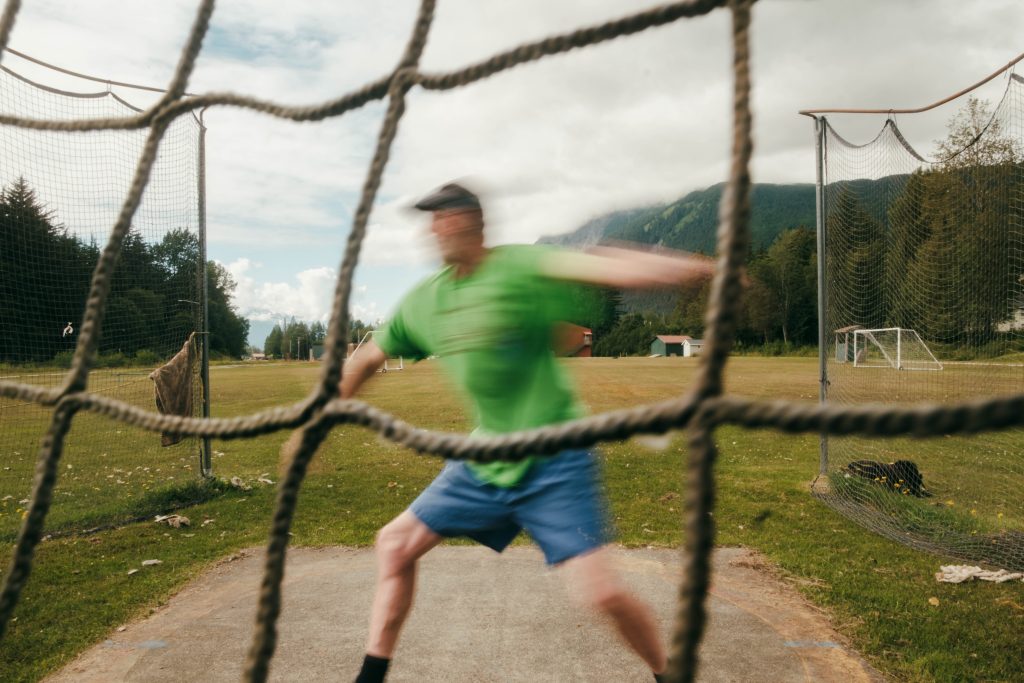
Jim Green throws the discus, Friday, July 25, 2025. (Will Steinfeld/Chilkat Valley News)

The height of summer is about as good as it gets at the high school track. The puddles in lane one are finally dried up, the mud slicks on the field no longer mud and no longer slick. Even so, it goes mostly unused — mostly, but not completely.

You’ve likely seen him: a slim man with a distance runner build and a neat gray beard playing a one-sided game of catch with an old traffic cone. 

That’s Jim Green. He’s an Alaska International Senior Games record holder and champion. But he doesn’t have much to show for it, because he gives the medals back. 

“I’ve been trying to convince them, just forget the medals,” Green says, of the event organizers. “Recycle this to someone else — what am I going to do with it?” 

Not only is Green a champion without medals, he’s an athlete without a coach; a thrower who throws softer to throw further.  And now, at an age when many stop competing altogether, Green is only adding more. 

It’s the final stretch of training going into the games next week, where swimming will be Green’s strongest event. After that is pickleball, which he and Joe Parnell won last year, table tennis, and then the 5k and 1500-meter races (“I’m middle of the pack,” Green says). Those are all lifelong activities for Green. 

He’s also throwing the discus, javelin, and shot put in the games. The discus he has thrown once before in competition; the javelin and shot put will be debut performances.

Unlike track events, where basic fitness can get someone quite far, the throwing events take precise technique. For discus, the thrower starts facing away from the throwing range, before spinning 540 degrees and unwinding their body in the other direction. It takes footwork to spin, but also to stride from the back of the throwing circle to the front while spinning — a motion that looks like a ballet maneuver. Then, after launching the discus, the thrower has to stay balanced within the 8 foot-wide circle, otherwise, the throw is voided.

Green got a one-off starter lesson on this from local throwing expert Jim Stanford. He got a similar lesson on the shot put throwing motion from Nancy Nash. He cites YouTube as a resource, too. But mostly, Green has been on his own. Except the traffic cone, of course, which for Green is a useful thing to aim for, just like the games themselves. 

“I tend to not be as motivated if there’s no target,” Green says.  

A scientist by training, Green is well-suited to tackle the self-teaching. With the cone at a manageable distance away, Green will throw, then jog out to retrieve the discus. On the way back to the throwing ring, he’ll give another short toss, working on a particular component of the motion he noticed during the first throw. And while he says his science knowledge doesn’t factor into his throwing skill, he explains between reps that “strictly theoretical physics” would support a 45-degree launch-angle being ideal, but that in practice it’s closer to 30 or 35 degrees. 

“Probably has to do with the little bit of lift you’re getting, that if you keep it lower you get a little more glide,” Green says. “I’m certainly not an expert, but I like to learn.” 

For the past few weeks, the cone has actually been set closer into the throwing circle than Green’s personal bests. That’s his strategy of throwing softer to throw farther. As Green sees it, slowing down is a way to work through the motion properly, which in the end he thinks will pay dividends.

“I swam a lot over the years and hardly ever had overuse injuries,” Green said. “Some people do, with shoulders and knees and stuff, which is often a sign of improper technique. I don’t want that to happen with these other sports.” 

And, good form is just more efficient. “Sports are more fun when you can do more with less effort,” he says. 

Through the training session, he’ll continue throwing, retrieving and throwing again at same intensity until the discus is consistently putting divots in the dirt right around the cone. Then he’ll move the cone just that much further out and repeat the process.

Regularly along the way he’ll switch from his right hand to his non-dominant left hand. He’s not competing left-handed ever, so it won’t make one bit of difference come the competition to be able to throw almost as far on both sides. But the Senior Games, after all, are about longevity. 

“It builds in a rest period,” Green said, of his left-handed reps. “I figure it might be good for the brain, too.”

Jim Green holds a shot put lent to him by Nancy Nash, July 25, 2025. (Will Steinfeld/Chilkat Valley News)

For most of the training session, the only sound is that quick shuffle of Green’s hard-soled tennis shoes spinning him over the concrete. Then a pause, and ultimately, the thud of the discus landing. As the session goes on, the cone gets walked a few paces further out, Green works up a sweat, and he adds another sound — a yell as he releases the disc — like a tennis player serving. It adds a 5-10 feet of extra distance, Green says. 

That’s one part of throwing Green didn’t teach himself. He learned from his son, Matthew, a shot put and discus thrower, who died in 2020. 

“The coaches tell the kids to yell, but a lot of high schoolers get self-conscious,” Green says. “But Matthew could just let it out.” 

Green won’t be self-conscious at next week’s meet, and he won’t be too nervous either. 

“There’s not that much that can go wrong in the discus, unless you hit the net, which is pretty embarrassing,” Green says. 

After all, he’s already in the pantheon of senior games record holders, alongside legendary performances like Herman Snead of Kenai going 100% from the line to win the free-throw competition, or near-centenarian Alyce Hansell of San Francisco sweeping age-group records in every track event from 50 meters through 800. 

But he’s not so concerned about that. He’s more concerned with seeing his daughter in Fairbanks, staying healthy, and the hope that next year, his training partners will increase, not decrease. 

“There have been times when we’ve had little masters training groups for swimming, but they tend to come and go,” Green says. “People are kind of individualistic, I guess. They’re busy.”

“But the biggest thing, besides staying healthy, is seeing friends, making new friends. The relationships: that’s the most important.”

Will Steinfeld is a documentary photographer and reporter in Southeast Alaska, formerly in New England.