

As snow creeps down hillsides, many construction projects are ongoing in the Chilkat Valley. Work on the Haines Highway will continue into the winter. In the townsite, borough facilities staff are focused on all things water, including improvements to the water treatment plants and culverts.
19 Mile Culverts
Roughly one month ago, a landslide came down the 19 Mile fan located along the Haines Highway. In this landslide, rocks and trees plugged up culverts designed to have debris pass through in landslide events. Secon, an Alaska Department of Transportation and Public Facilities contractor working on the Haines Highway, has been clearing out debris from the culverts.
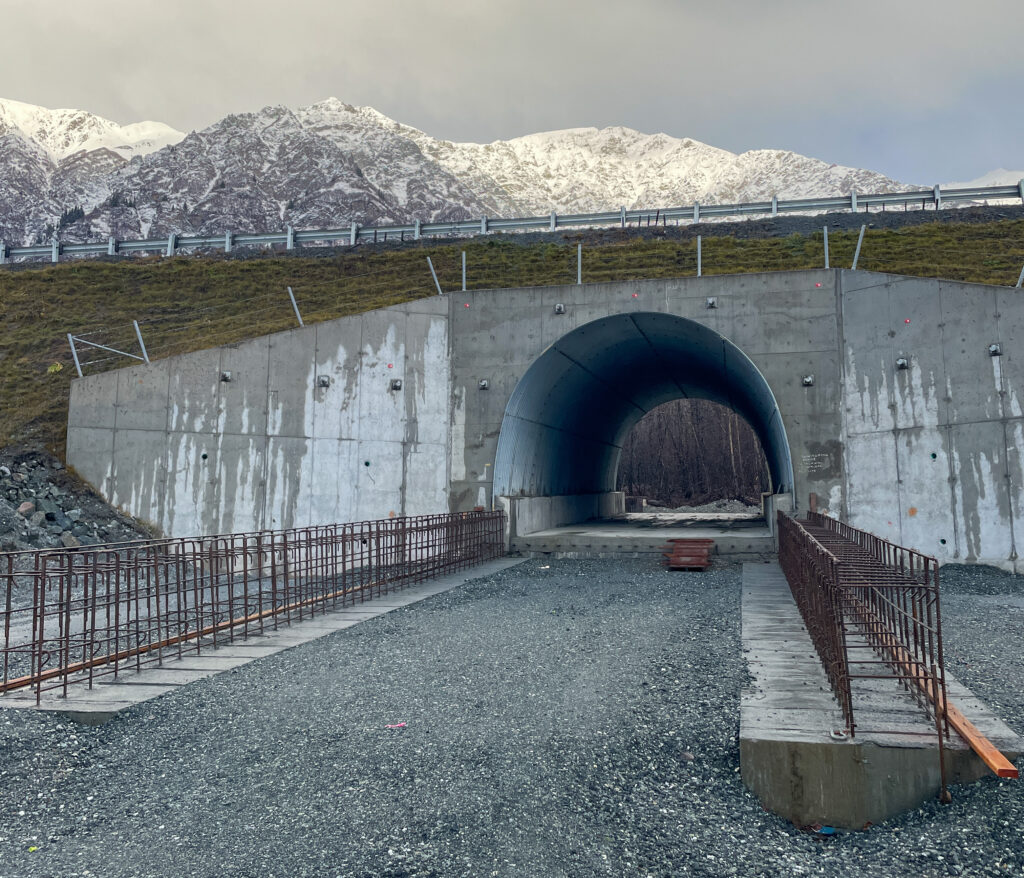
The 20-foot culverts at 19 Mile were installed three years ago as a part of road improvements along the Haines Highway. This summer, culverts of the same size were installed at 23 Mile. Both locations have landslide fans above, which have resulted in landslides and avalanches covering the road. DOT equipment operator foreman Matt Boron said the bigger culvert pipes were installed at a steeper angle compared with the previous culverts to allow debris flows to pass through. Additionally, the highway in both locations has been elevated, so the debris flows do not “immediately run onto the road.”
Since the new, larger culverts have been installed, debris has flowed down both fans. Boron said while DOT still has to deal with rocks and mud that come down, the culverts are not plugging up.
Up next on Boron’s radar are airport improvements. Earlier this year, lawmakers approved $6 million for the second stage of work on the Haines airport. This project aims to repave the runway and taxiways and replace drainage culverts and lighting.
Wells Bridge
Construction crews up the Haines Highway will continue work on the Wells Bridge through January. Currently, they are setting all of the girders, which are 130-foot-long horizontal structures that support a bridge’s top layer. Crews will work until Christmas, take a few weeks off and then return for a few weeks in January. Crews will then focus on putting up curbs and bridge rails, “so you can’t just walk off the side of it,” said Steve Rowe, operations manager at Swalling General Contractors. Crews will return in April to take down the temporary bridge and put asphalt over the top.
“We’re going to be in that 95% range here with about another four weeks’ worth of work,” Rowe said. The April work will include spraying on a coating to rough up the surface of the bridge and then topping it with asphalt. This step, Rowe says, has to be done when it is warmer.
Rowe said that pile driving ramps up in the winter months as the ground freezes, making it easier to access different areas. Swalling is starting three other bridge projects in the state this winter, including one in Girdwood, where workers need the marsh to freeze.
The Wells Bridge spans just over 500 feet, which is “a little more rare” of a length for crews to work on, Rowe said. He said bridges that are about 200 feet are far more common.
“The boys really like it when they get to work on the long ones [bridges],” Rowe said.
Around town
Haines Borough public facilities director Brad Jensen said he has a very long list of projects to work on this winter. A lot of them are centered around water — whether it’s improvements to the Piedad water treatment plant or a failed culvert on Muncaster Street.
Currently, Jensen said, he is finishing an upgrade to the water treatment plant, adding grates that could intercept debris from stormwater and keep it from going into the tanks. The new RV dump station at the treatment plant had a lot of gravel go through it, which damaged equipment, Jensen said. The grates should help intercept that gravel in the future.
At the end of August, the borough hired RESPEC, an engineering firm, to work on improvements to the Piedad water treatment plant and South Sawmill vault. The Alaska Department of Environmental Conservation approved a $1.8 million loan for the water treatment plant that the state will fully forgive. RESPEC will provide engineering, design and oversight on the project.
Jensen said the expansion of the Piedad water treatment plant will add a holding tank to increase the plant’s capacity.
Muncaster Street culvert repairs are in the works, but at a much higher cost than the borough was expecting to pay. Southeast Roadbuilders’ low bid of $141,000 for the project came in 48% higher than ProHNS’ engineering base estimate of $95,053. That’s, in part, because the road is “collapsing,” according to a resolution brought before the assembly during its Oct. 27 meeting.
With phase one of the Small Tracts water extension complete, Jensen said work on the design for the second step of the extension project has begun.
The second phase would install fire hydrants and expand water service by roughly 1,500 feet, according to the project description by ProHNS.
Over on Tower Road, Jensen said they need to replace the current water tank. The current 320,000-gallon wood stave tank will be replaced with a 500,000 gallon insulated steel tank, according to the project description.
The Alaska Department of Environmental Conservation prioritized this project as being one that would qualify for its Alaska Drinking Water Loan.
Of the $2 million loan, up to $1.7 million may be forgiven.