

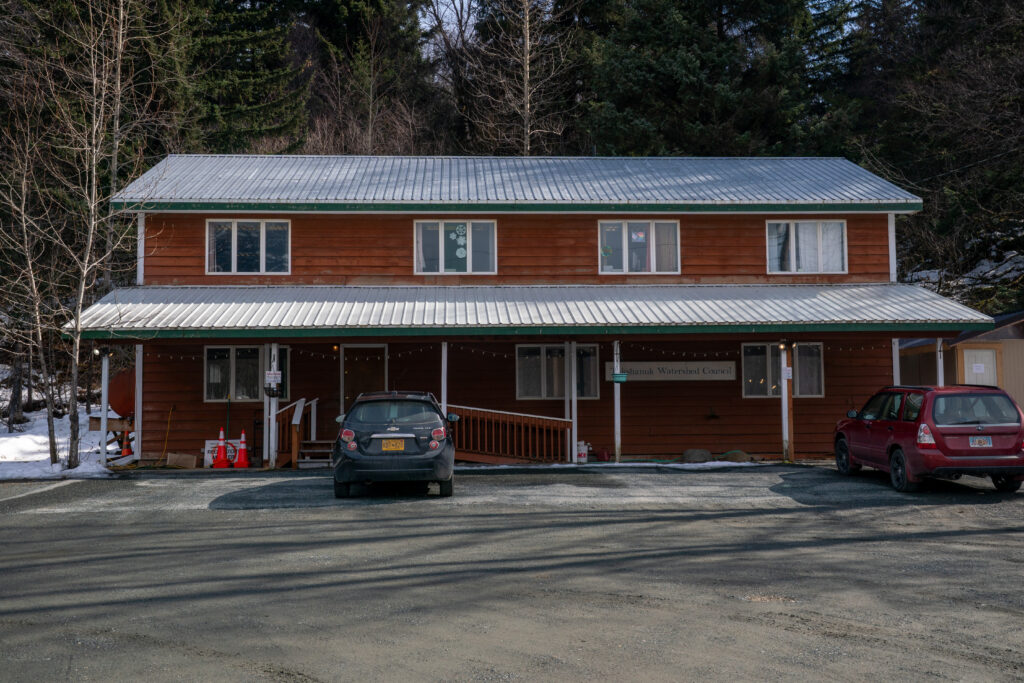
Takshanuk Watershed Council has withdrawn a permit application due to concern about proximity to a neighboring Native allotment.
The local nonprofit applied on June 2 to permit three tent platforms and an outhouse at its Jones Point property. The organization planned to use the site for an educational program it said would “consist primarily of environmental education, habitat restoration, watershed monitoring, volunteer projects, research activities, and related nonprofit mission activities.”
Deemed an “educational facility” by borough staff, the project was required to go through the borough’s more stringent conditional-use permitting process, including a public hearing in front of the planning commission. At that public hearing two weeks ago, the permit faced strong opposition from family members of the late Edward Warren, who died last year.

Warren owned a roughly 40-acre Native allotment, which is now in probate, and is in the process of being transferred to his children, family members say.
The allotment and the Takshanuk property are adjacent parcels at Jones Point, where Warren was born. Takshanuk purchased its roughly 50-acre parcel from Klukwan Inc. in 2015, three years after the village corporation filed for bankruptcy.
During the recent public hearing, the two parties presented differing views on the impact of the proposed project.
In Takshanuk’s eyes, the proposal was for a limited amount of building near the center of their property, away from property lines.
But members of the Warren family who spoke at the meeting viewed the permit application as part of a long history of fighting for jurisdiction over the allotment land.
“This is more than just land to us,” said Amanda Warren, Ed Warren’s granddaughter. “This is a legacy that my grandfather and great-grandfather had to fight for… It’s been a fight that’s so emotional that my grandfather had a hard time even talking about it. I look at paperwork for decades, over two people’s lifetimes, of what they had to do to protect the integrity of the land they had secured. It’s heartwrenching.”
Warren, in a later interview, said her great-grandfather had originally applied for a 160-acre claim to the land he had lived on. Today, the allotment is roughly a quarter of that size.
She also outlined a number of recent events that have increased her distrust of the property neighbors’ intentions.
One of the biggest issues is a heavily-used trail between Jones Point and River Road that runs through the allotment. People have repeatedly trespassed on the family’s allotment while using that trail, Warren said. Now, signs put up by Takshanuk mark the trail as private property and state that people using the Jones Point trailhead must return to the Jones Point trailhead.
Warren also has pushed back against Southeast Alaska Regional Health Consortium development on another neighboring parcel and a proposed cell tower nearby and worries that the development will lead to encroachment or will otherwise restrict the family’s use of the allotment land in the future.
“They think the public, and specifically tourists, should have more right to that land than we do,” Warren said of proposed development in the general area — specifically of trail infrastructure.
Warren added that she “didn’t trust” that Takshanuk was building the tent project “for just the purpose they’re saying. In our opinion there’s likely a bigger picture for what they’re doing here.”
The conflict, she also said, is deeply personal: “My great-grandfather and grandfather didn’t get to live to see all the effort they went through… What they went through, I won’t let it be in vain. Because there’s no excuse. If my grandpa could get on a boat around the age of 10 and catch a ride with a fisherman to Juneau to do the application then I can do this in my 40s.”
Takshanuk staff and board members, on the other hand, said they were actively working to avoid encroaching on the Warren land, pointing to the fact that the tent-platform project was at the center of the organization’s parcel.
“The location of this camp, three tents and an outhouse, is more than 600 feet from the allotment boundary on the parcel viewer,” Takshanuk executive director Derek Poinsette told planning commissioners at the hearing. “It’s kind of dead smack in the center of Takshanuk’s property. We couldn’t put it any farther away from any of our neighbors. It’s almost right in the middle.”
Poinsette is a planning commissioner and recused himself from deliberation and voting on the permit outside of his testimony.
Poinsette also said he had met with Warren family members last summer and had offered to block the River Road pass through, and had put up signage marking the trail through the allotment as private property.
“I’m willing to do more with signs,” Poinsette said. “Whatever is necessary. When the survey is done we’ll block the trail — we’ll block it on our side, we don’t need to do it right on the boundary.”
The survey Poinsette referenced is being conducted by the Warren family, and may offer a route toward less contentious land-use management in the area.
At the moment, the boundaries of the allotment aren’t certain, with it last being surveyed in 1914. Borough lands department staff said on properties surveyed that long ago, survey markers were often lost or buried, or boundaries were determined by other less precise means than actual physical markers.
The borough’s online parcel viewer does show property boundaries, including those of the Warren allotment, but planning commissioners say they aren’t legally enforceable.
Commissioner Rachel Saitzyk said during the meeting that guidance from borough staff is that “the lines can be off on the parcel viewer by acres.”
“I want to say we can rely on them here but our [Geographic Information System] guy has told us not to rely on those,” Saitzyk said.
Amanda Warren said Wednesday she would like neighboring land owners to hold off on any development until after the survey is completed, expected to be this fall. In her eyes, that would offer more legal protection against any possible encroachment.
In a similar vein, at the public hearing, she asked the planning commission to hold any approval for Takshanuk’s project until after her family had time to consult with lawyers.
At one point, commission chair Patty Brown asked Edward Warren’s daughter, Cora Lee Cooper, if there were special conditions the commission could place on the permit, besides holding it for a legal review, to make the family “feel more secure.”
“I think that would be better suited for a lawyer to answer than myself,” Cooper responded.
That appeared to be a complicated procedural question for the commission: in borough code, the planning commission is required to weigh input from neighbors when hearing conditional use permits like Takshanuk’s, but is not required to give neighbors any other power over the process.
“The (conditional use permit) is a requirement from the borough,” Brown said to Cooper and Warren at one point in the hearing. “It’s really a relationship between Takshanuk and the borough… You’ve heard how supportive people are, but it feels a little circular that other people have to ask their lawyers what Takshanuk is allowed to do. Takshanuk is the proprietor of the property.”
Ultimately, the permit never came to a vote. Between the planning commission meetings on June 18 and 25, when the commission was set to decide on the permit, Takshanuk withdrew its permit application.
Poinsette this week did not respond to requests for comment, but borough lands staff said the organization would not be going forward with its plans for the educational program at the Jones Point property.