
A lunch break on a gravel bar on the Klehini River wound to a close as Russ Lyman and Joe Ordóñez studied a massive log jam. The duo have guided raft trips in the Chilkat Valley for nearly 40 years.

The tangled pile of trees blocked one channel of the river and had the potential to flip one or both of the 16-foot rafts being used on this expedition. 
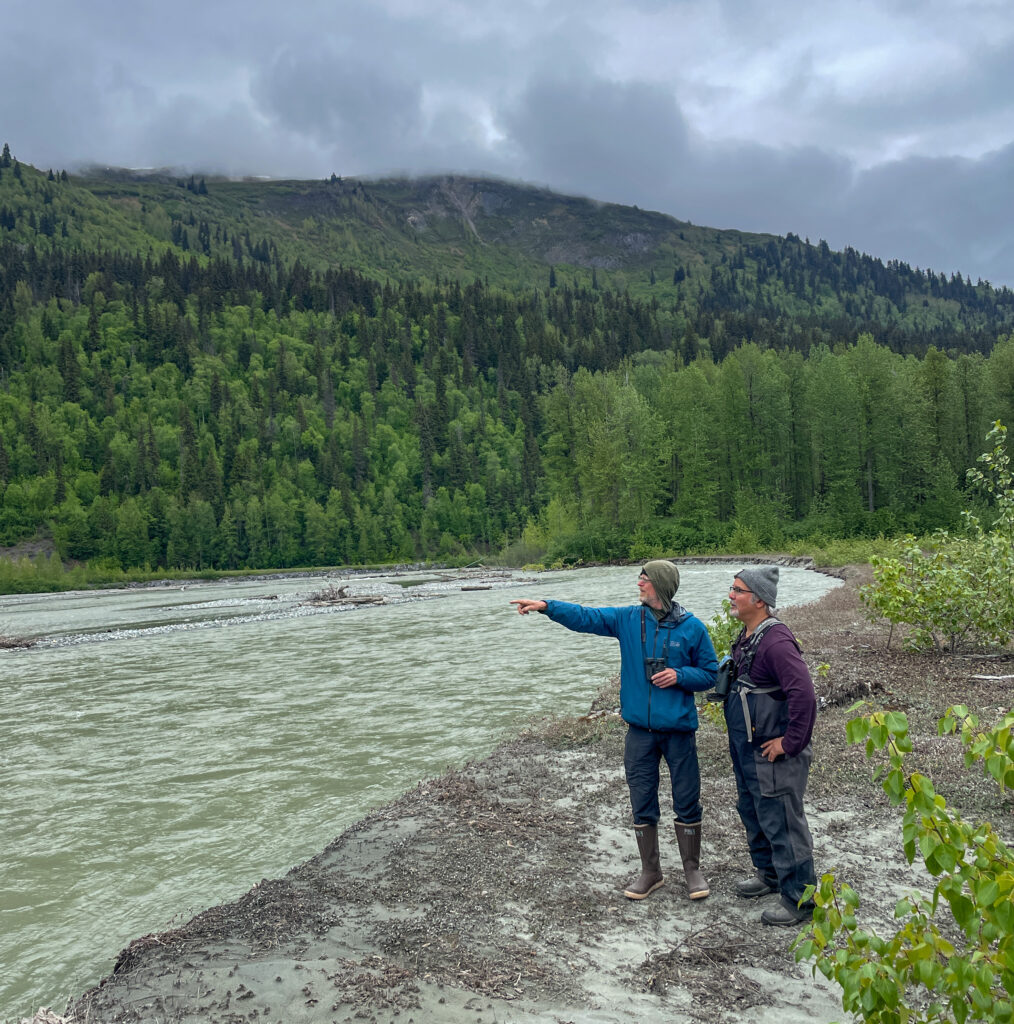
Russ Lyman, left, and Joe Ordonez analyze the river channels to avoid a log jam during a training run on June 5, 2026 on the Klehini River in Haines, Alaska. (Lizzy Hahn/ Chilkat Valley News)

The two stood on the riverbank, binoculars in hand, considering the group’s options.

In front of them, the logs were being squished together by the loud, strong current, with branches shaking. The white water below the logs pointed out just how much force was in front of this jam.

They devised a plan to avoid the jam entirely by crossing over two channels. 

Ordóñez and Lyman took over the oars from guides in training and brought the boats across the first channel, where passengers hopped out to scoot the boat over a gravel bar. They then crossed the second channel, sticking to one side and watching the log jam’s immense force as the boat drifted by, unscathed. Lyman approached the situation with calm expertise, as the new guides looked on, learning from each paddle stroke. Passengers gripped the rope on the perimeter of the boat, keeping a steady eye on the jam they had just passed.

Once past the obstacle, Rainbow Glacier Adventures’ newest guides, Lydia Andriesen and Jack Kendall, took over the oars again. This is the duo’s first season as raft guides in the Chilkat Valley.

While looking out for obstacles downstream, Lyman began counting up roughly how many trips he had done on the Klehini and Chilkat rivers. He estimated that he would do roughly 200 rafting trips a year, which adds up to “a thousand” trips on the river. Lyman started guiding on daytrips but switched over to 10-12 day trips on the Alsek and Tatshenshini rivers. Ordóñez also guided these longer trips.

“We spent all summer on those rivers and that’s how you really get good,” Ordóñez told the new guides during their lunch break on a bank of the river around 30 mile of the Haines Highway. 

New Rainbow Glacier Adventures rafting guide Jack Kendall, left, listens to RGA owner Joe Ordonez while on a training trip on June 5, 2026 on the Klehini River, in Haines, Alaska. (Lizzy Hahn/ Chilkat Valley News)

This June 5 training run for the river guides is something of an annual tradition for raft companies in Haines, helping prepare new guides to manage hundreds of passengers who want to float down the river and see wildlife. 

The upper Klehini River serves as a level-up for new guides, providing challenges that are not as common on the Chilkat River where they most often escort passengers. 

The Klehini has a steeper gradient, more debris and a swifter current than the Chilkat River. 

“I always believe that the guides need to be competent above their level,” said Rainbow Glacier Adventures owner Ordóñez . “They have to be able to perform in a situation beyond what the river is showing them right now.” 

Ordóñez has been rafting in Haines since 1987. He and raft guide instructor Lyman took the company’s newest river guides down the Klehini as part of their preparation for the summer season. 

As guides are giving their spiel, pointing out eagles, bears or other natural sights during rafting trips, they also have to navigate down the river and look ahead to avoid upcoming obstacles. 

Guides also learn how to move with the river, not against it, while paddling.

“You are not stronger than this river,” Ordóñez said. 

Rafting requires knowledge not only of the river but also of its surroundings. Lyman said one of the biggest challenges for guides is learning how to read the river’s ripples, which indicate where the deep water is to avoid unwantedly beaching the raft. 

“With the fast pace of the Klehini, you really got to be making those quick choices and committing to a good line,” said Kendall.

The river changes day to day, week to week.

When Lyman started guiding in 1989, the Tsirku River was running in a completely different area through the forest. Lyman estimated that over the course of 15, maybe 20 years, “it worked its way… across the delta clear to the lower end.” Both the Klehini and Tsirku rivers join the Chilkat River. 

“It shifts around like that real dramatically,” he said. 

The Klehini is also changing, cutting further west toward the forest. Lyman said there is one section where this change is especially visible, in a bank cutting into the forest just after the Porcupine Bridge. 

He estimates that “eventually that’s probably where most of the river will go.”

The river, according to Lyman, is eroding everywhere. 

“Eventually, that little tiny flood channel we were seeing, years from now that could be the main channel cutting back through here,” he said. 

Guides have to learn how to read the river and manage changes that happen daily. 

At one point, passengers on one of the rafts got stuck on a gravel bar. They bounce on the inflated tubes to help push the boat off the bank and back into the current. 

Gravel bars, submerged trees, constantly shifting channels and swift-moving water are some of the obstacles guides face. 

Russ Lyman, left, explains the technicalities of a swiftwater stop to Lydia Andriesen, middle as Davey Ozahowski watches on during their June 5, 2026 training run on the Klehini River in Haines, Alaska. (Lizzy Hahn/ Chilkat Valley News)

“One of the biggest things is that the people who are training me have been doing it for 40 years, you don’t often get the experience,” Andriesen said while paddling the raft. 

The Klehini is classified as Class II and sometimes Class III river when water levels are high. Rivers are classified from Class I to Class V, with V being the most difficult or technically challenging whitewater. Class II rivers are defined as straightforward rapids with Class III having more intense rapids.

Andriesen and Kendall were practicing their swiftwater stop with lines. To conduct this stop, guides line up the boat to be at a 45-degree angle from the river bank, and get a bag with rope attached to the boat. Holding this rope, the guides jump onto the dry banks, stopping the raft from continuing down the river. Lyman said that this is a technique that is unique to the rivers in the Chilkat Valley. 

“We have to be able to stop where there’s not an eddy or anything, on our own.” Lyman has been rafting in Haines on and off for 37 years and has been instructing new guides on and off for the past 10 years.

All guides are required to have their wilderness first responder certificate and swiftwater rescue training. Swiftwater training teaches guides to be able to get a boat unstuck, utilize rope work and learn the current.

Every spring, Lyman helps instruct the new round of Chilkat Guides’ guides. This training lasts for nine days. For most of these guides, it’s their first time in Alaska and often their first time rowing. 

Before guides get out on the river, they practice in an on-land raft and then head to Chilkoot Lake or the harbor to learn the basics of rowing. Lyman estimates that usually two-thirds have never rowed before. During training, guides learn how to row a raft, read the river, navigate the channels and perform a swiftwater stop with eight passengers. 

This year, Chilkat Guides trained 27 new guides over the course of nine days and Rainbow Glacier Adventures trained two new guides, all of whom Lyman helped instruct.

Lizzy Hahn is a reporter and photographer from Nome. She has worked in newsrooms across Alaska including the Anchorage Daily News, Nome Nugget and UAF Sun Star.