

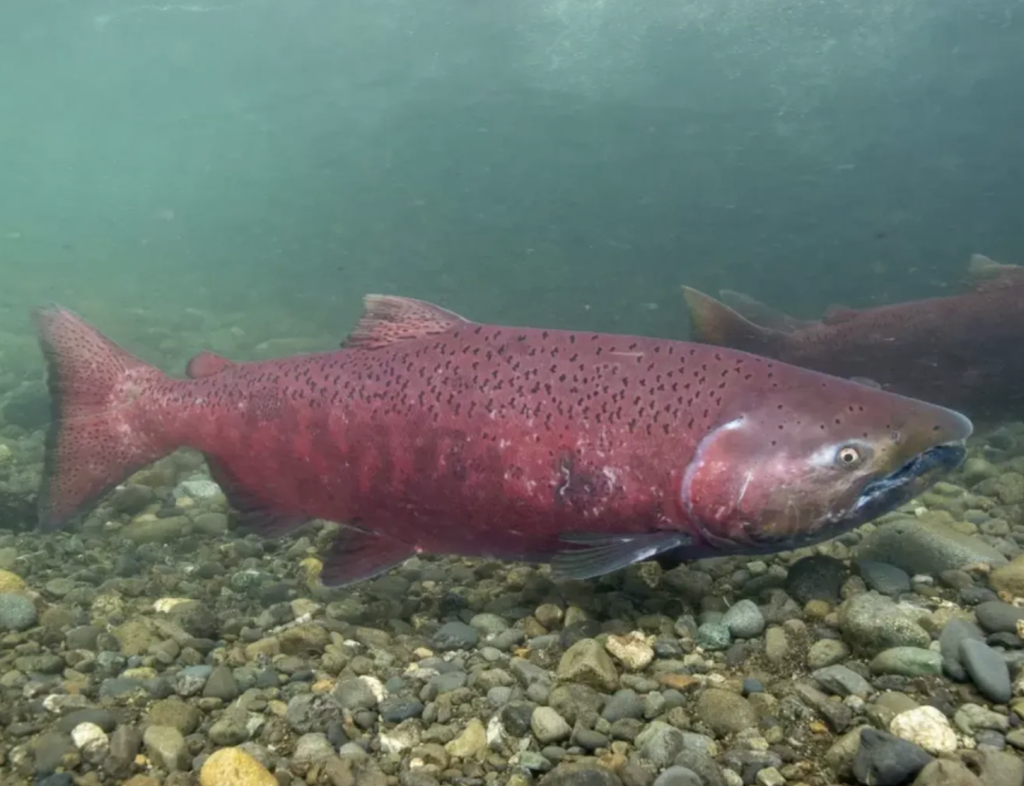
The Alaska Department of Fish and Game has added new restrictions to local king salmon sport fishing ahead of the fishery’s first opening in nearly a decade.
The Chilkat River king salmon, also known as chinook, run has long been closed after a sharp decrease in the run’s population that began about 15 years ago. From 2011 to 2018, the number of kings spawning in the Chilkat River came in below the state’s sustainability goal — or escapement — all but one year.
Since then, heavy restrictions, including shutting down the sport fishery, have cut down the portion of the run being caught by about 75%, state managers say.

This spring, state fisheries managers announced they would be reopening the Chilkat king sport fishery. Now, ahead of the June 14 opening, Fish and Game have decreased the area that will open to anglers in an attempt to maintain a more conservative level of harvest.
As opposed to opening the entire river as had been announced, anglers may now only fish for kings in saltwater south of a line at Kochu Island, near Paradise Cove and the Chilkat State Park campground. That area restriction will stay in place “until we have a better idea of what run strength and timing is,” John Whitinger, Fish and Game area sport fish biologist, said this week.
Run strength estimates are expected to come by early July, department salmon researcher Brian Elliott said, following king salmon tagging on the river beginning this week.
In addition to tighter area, delaying the opening to mid-June will help limit total harvest, Whitinger said. In much of the region the fishery opened April 1. Fish and Game commissioner Doug Vincent-Lang wrote earlier this month that the department estimates 90% of the run will have migrated into the river by the opening date.
“Could we have opened it up where we did historically? Yes. But I feel like the conversations I’ve had with commercial fishermen, sport fishermen, people on the ground, is that they are concerned.”
“This line is an attempt to meet all the user groups in the middle, between sport fish, commercial and subsistence,” he added, noting that state law prioritizes subsistence over other user groups.
There has been concern in the community that the opening is too soon, too broad, and could threaten the recovery of the run. Some anglers this spring raised concern that bag limits were too lenient, allowing anglers to take more fish per season than was necessary.
After June 14, Alaskan anglers in the Haines area may catch two 28-inch or larger king salmon per day, with no total limit for the season.
Non-resident anglers are limited to one large fish per day and three total through June 30, then limited to one total after that date.
Concern also includes the Chilkat Indian Village, which opposed the opening in a letter late last month, sent prior to the partial closure of the river north of Kochu Island.
State managers have justified the decision to open the fishery by pointing to recent returns, in which seven of the last eight years have been above escapement goals.
In the letter sent to Vincent-Lang, CIV tribal council president Kimberley Strong called those returns “evidence that precautionary management can be effective — not an opportunity to repeat the mistakes of the past.”
Strong’s letter questioned whether the recent string of returns was enough to stabilize the population and whether the state’s escapement goals accurately captured sustainable population levels.
“Department staff have publicly acknowledged that higher escapement levels may now be necessary to sustain the stock under present conditions, however, no changes to the escapement have been made,” Strong wrote.
Strong’s letter also questioned the motivations behind the management decisions.
Chinook harvest is regulated under the Pacific Salmon Treaty, which allocates specific portions of the harvest to geographic areas, gear groups and user groups in the United States and Canada. This year, sport fisheries have been allocated slightly more than 20% of the total harvest.
The divvying up of the harvest can be politically fraught, and Strong questioned if area regulations were loosening to meet allocation targets.
“(Fish and Game’s) recent inability to meet sport allocation targets should not justify increased harvest pressure on a run that only recently emerged from Stock of Concern status,” she wrote. “Wild Chinook salmon should not be managed at the edge of minimum thresholds in order to satisfy allocation objectives or short-term harvest opportunity.”
This year’s sport fish allocation for Southeast of 43,600 king salmon is significantly higher than last year’s 27,700 fish. Last year, the department closed the fishery for a month mid-season in much of the region so as not to overshoot the allocation, they said. State harvest estimates from 2021 through 2024 show total Southeast chinook sport fish harvest exceeded its allocation three out of four years.
In his June 1 response letter to the Chilkat Indian Village, Vincent-Lang stood by the rationale behind the opening, writing that “the department uses stock assessment data and modeling to identify escapement levels that maximize recruitment and production. We are not only mandated by the state to manage sustainably but also have international obligations to do so as well.”
Vincent-Lang also wrote that he “[does] not agree with the assertion that the department has been unable to meet allocation targets for any fishing sector, let alone the sport fishery,” and that “it goes against the department’s mission to increase harvest on stressed stocks to meet ‘allocation targets.’”