
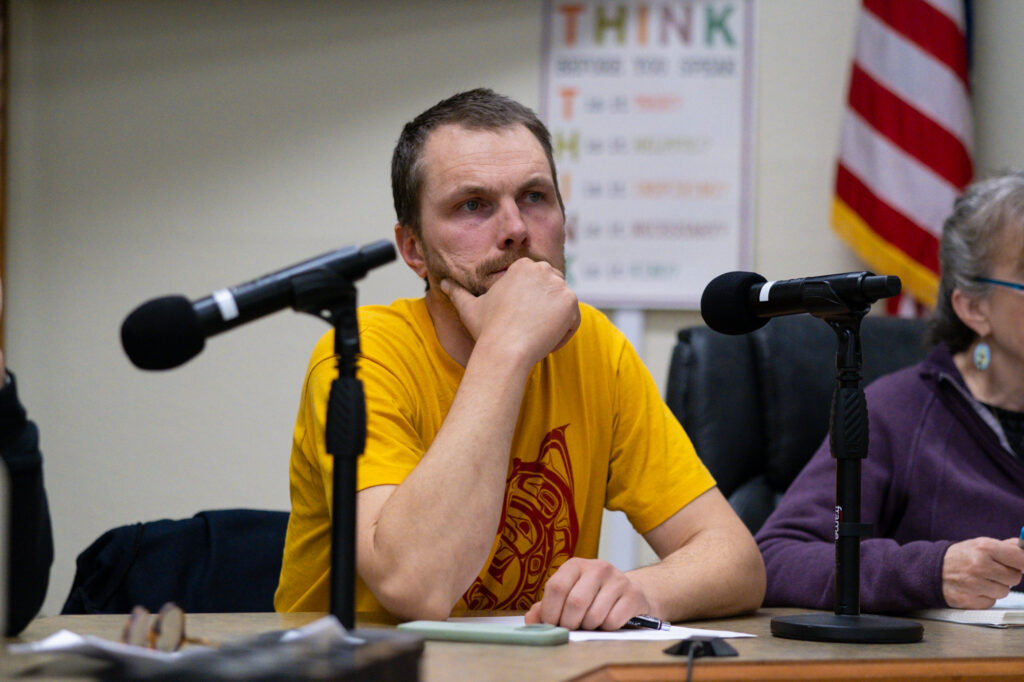
Assembly member Kevin Forster at the Oct. 14, 2025 assembly meeting. (Will Steinfeld/Chilkat Valley News)


Resource extraction vs. conservation: It’s a familiar fault line in the borough. But some say it shouldn’t be, at least not in such stark terms.

Those who advocate for some sort of middle ground now officially include assembly members Kevin Forster and Gabe Thomas, who introduced this week their “safety belt” proposal — a 38-page package of potential legislation that would provide “guardrails” if heavy industry were to begin operating in the borough.

At Tuesday’s assembly meeting, Forster pitched the proposal as an “à la carte menu” of regulations already in use around the state that could be considered for use in the borough.

Forster said in comments after the meeting that he and Thomas had received support in drafting the package from his wife Jess Kayser Forster and from “AI analytical tools.” He placed particular emphasis on the “draft” aspect.

“I want to be very clear, the document we’re discussing tonight is by no means a finished product, and is by no means a take-it-or-leave-it ordinance,” Forster said. “I’m not even saying I support every element of this packet. But I do believe the public deserves to see the full scope of what is possible across this state, so we can decide what’s appropriate for this community.”

The proposal will now enter into a 30-day public comment period, after which the assembly will presumably begin to edit down the proposal, though the process has not been completely explained yet. Included in the package are a host of what could be ordinances or ballot measures changing borough charter.

It’s somewhat unusual for assembly legislation, which generally arrives at the body ready for two public hearings and a final vote. More complicated proposals are often discussed and refined in committee meetings before being brought to the assembly.

Sargent was the lone vote against introducing the package, and he raised some of those process discrepancies in explaining his vote after the meeting.

Sargent raised concerns of staff and resident capacity while the Lutak Dock rebuild is ongoing. He also specifically referred to the fact that the legislation was changed and resubmitted by its sponsors after the assembly packet was released on Thursday.

“It’s happened twice in a row where Gabe and Kevin have done these privately, and then we get big changes right before the meeting,” Sargent said, referring also to an ore- containerization proposal at the last assembly meeting. “We’re basically voting on things we haven’t seen.”

Sargent said that while he supported the overall goal of the proposal, he had issues with some of the content.

“It was presented as a survey of things being done elsewhere in the state. That’s not really what it is. There are a number of things that haven’t been done elsewhere.”

Forster emphasized after the meeting that the rough-draft nature of the document was meant to provide a starting point, but still leave an opening for the public to speak. With the motion to introduce the package, the assembly also directed the package be reviewed by the borough attorney.

It remains to be seen whether the public will get behind the package, but it had preliminary support from officials at the meeting — including some like Morphet and Stickler — who have often been on opposite sides for other issues.

Forster himself recently signed a letter from Chilkat Forever advocating against any large-scale mining in the Chilkat Valley. But personal views aside, he argues the assembly has neither the authority, nor a clear mandate from voters, to block heavy industry.

Said Forster after the meeting: “The question that I think would get, like, 95% buy-in, would be, if you found out there was some kind of large-scale development, whether you wanted it or not, how would we see the most benefit and least harm. That’s the question.”

Will Steinfeld is a documentary photographer and reporter in Southeast Alaska, formerly in New England.