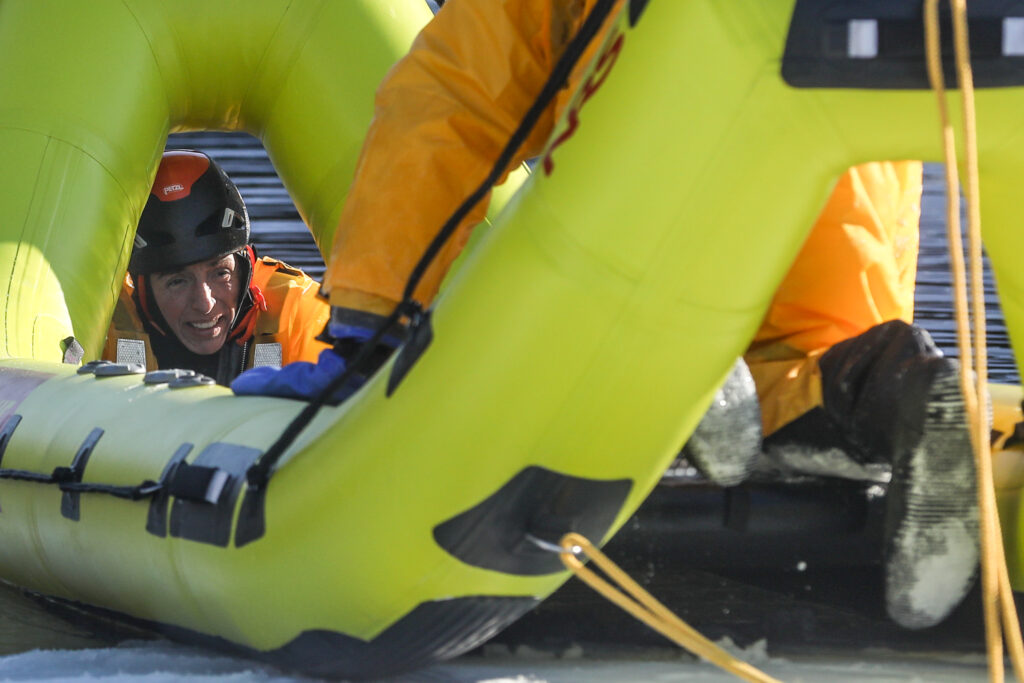
Jenn Walsh gets pulled onto a rescue boat during training with the Haines Volunteer Fire Department at Chilkoot Lake on Sunday, March 1, 2026, near Haines, Alaska. (Rashah McChesney/Chilkat Valley News)

It was windy and the temperature was in the single digits on Sunday as Nate Arrants stood on thin ice at Chilkoot Lake. 

The volunteer firefighter jumped up and down until he broke through and ended up in waist-deep water, laughing. 

Nearby, State Park Ranger Jacques Turcotte did something similar in a bright yellow Mustang survival suit. He’s tall enough that he could just walk out onto the ice, but certified ice rescue instructor Luc Mehl of Triple Point Training stopped him. 

“Get on your belly for the exit. Force yourself to do a flat body exit,” he said. 

Turcotte puts his hands in the snow, lets his legs drift up until he’s parallel to the shore and then drags himself out onto the ice. 

“There we go,” Mehl said. 

Arrants and Turcotte are among the 11 state and borough staff and volunteers who spent the weekend earning ice rescue technician certifications. They worked with Mehl and his company, Triple Point Training, to get the National Fire Protection Association rating. 

They ran through a progression of exercises learning to travel safely over thin ice, get into the water and climb back out. Then they added rescue hardware, a sling of webbing, a buoyant sling, a backboard and a stretcher. The course ended with the crew learning how to use the department’s new 15-foot inflatable rescue boat. 

The Haines Volunteer Fire Department is working to address a gap exposed last winter when they had to respond to an emergency call to Chilkoot Lake when local author Tom McGuire fell through the ice and disappeared.

That touched off a search with half a dozen volunteer firefighters and Turcotte teaming up and walking more than a mile out onto the ice to try to find him. But they had to turn back because of their limited rope and unsafe ice. 

“I was in the lead and the ice started to spiderweb under my feet,” Turcotte said. 

McGuire was later found dead and Mehl said first responders did the right thing by turning around. But Turcotte said he’s spent the last year reflecting on what he could have done differently. 

“Unfortunately, I don’t think the outcome would have been different. I think we could have been a lot safer in our approach,” he said. 

Mehl, who makes it part of his mission to go to Alaska communities after they experience close calls and incidents, said Liam Cassidy was the catalyst for the course. He put Mehl in contact with the fire department to run the ice safety training. 

Several firefighters credited Jenn Walsh with coordinating the class, the grant funding to buy new gear and everything else they needed. 

The department paid $3,400 for the class. It bought a new rescue raft for $3,300 with a grant from the Southeast Region EMS Council, and the department got four Mustang suits, specially made for cold water rescue. Those cost $4,000.  

Chief Zak Overmyer said the class was funded through donations via grants and the volunteer fire department’s nonprofit. 

“We can’t put this equipment in service unless we’re properly trained on it,” Overmyer said. 

In addition to learning the gear, Overmyer said the class included guidelines on how to develop standard operating procedures when they do have to respond to an ice or water rescue call. 

“This is the first step in bolstering our [search and rescue] program up to where we can really be more effective instead of just kind of piecemeal,” he said. 

Overmyer, who wasn’t yet in Haines during last year’s drowning, said he could see that the incident was on the forefront of everybody’s minds and that for some of them, that deep emotional connection made the training all the more valuable. 

“This is really useful training,” he said. “It’s something we could actually use, especially with as many people are out here on the lake, on Mosquito Lake and … as the weather changes and we have worse ice. All of those things.” 

Turcotte said he was grateful to the Haines fire department for spearheading the training, particularly because learning how to be safer on the ice with some of the same people he led onto it in the year prior felt good. 

“It was cathartic in a way after some of that trauma from last year,” he said. 

Some in the group said what they learned has prompted them to make sure everyone is wearing life vests when they go recreate on the water in the winter. Others said they’d be buying ice spikes to wear while they were out, to aid in pulling themselves out of the water. 

Turcotte said what stuck out to him the most was learning that when ice goes through regular freeze-thaw cycles, the thickness of it is no longer a predictor of its strength or ability to hold weight. 

“Going out on the lake is a beautiful thing, but it’s one of those activities that needs to get some extra respect from us and some reverence from us and maybe it’s not as simple as ‘the ice is really thick and I’m good to go.”

Rashah McChesney is a multimedia journalist and editor who has reported and edited newsrooms from the Deep South to the Midwest to Alaska. For the past decade, she has worked in collaborative news as the...