
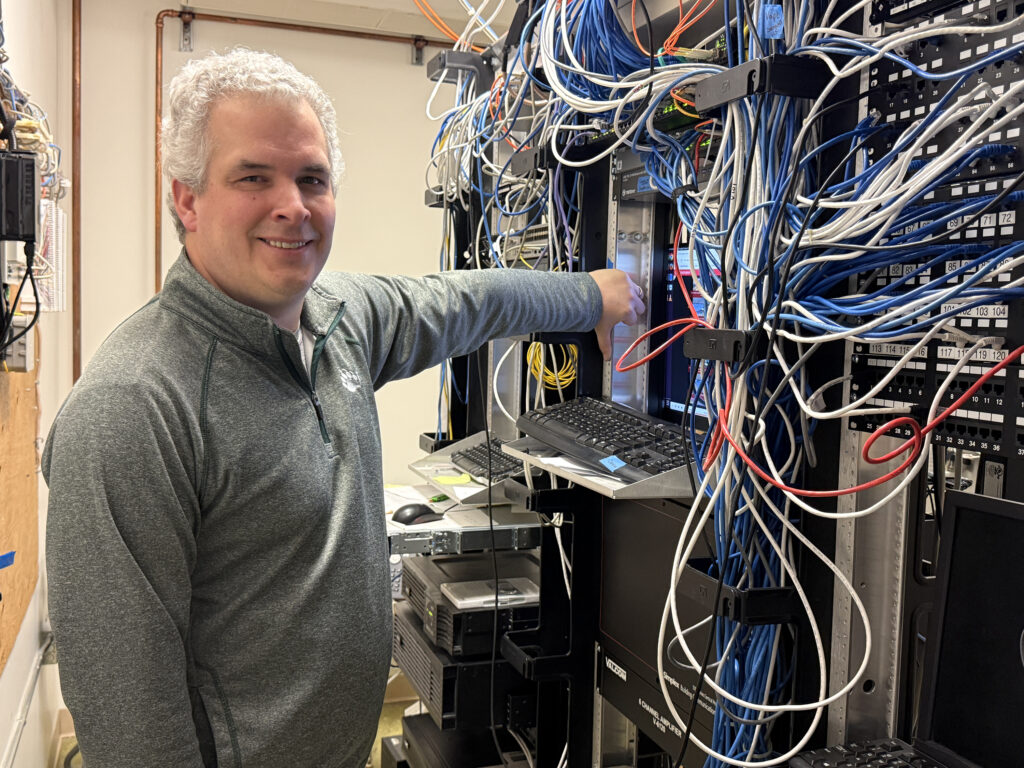
(Rashah McChesney/Chilkat Valley News) Retiring teacher Sam McPhetres poses in a server room in Haines High School.

In his classroom, with the steady thrum of a 3D printer in the background, district technology director and computer science teacher Sam McPhetres pulls up the internet archive Wayback Machine and scrolls back to 2002 when it first logged the domain hbsd.net

As near as he can tell, that’s the year he first established the domain. “It might have been before that. My bills went back to 2002 and I couldn’t go beyond that,” he said. 

This year, McPhetres is readying for retirement at the end of the school year. That means untangling 29 years of guiding – sometimes hauling – the district through each successive technological advancement. At some point he got a bill for the domain’s renewal and realized it was time to turn the keys over to that too. 

“It’s really good that it came up, that ‘ooh dang, I have the domain and it’s coming off of my credit card,’” he said. “If I would have been hit by a bus, within six months the domain would have lapsed.” 

Private ownership of a school district’s domain – essentially the front door of a website, that allows the public to find and enter it – is uncommon and increasingly rare. 

“It’s like finding out your house is owned by someone down the street,” said superintendent Lilly Boron, who taught computer science herself at one point in her career with the district. “It raises questions about your public face.” 

Boron said the district and McPhetres negotiated the transfer for about $1,000. “I was hoping it would be a simple transfer and it’s looking like it will be,” she said. 

While it’s rare to see private ownership of a public institution’s domain, McPhetres said it’s likely more common in places like Haines. “A rural Alaska issue,” he said. 

But, it’s just one of many relics of 54-year-old McPhetres’ career, which provides something of a time capsule into the technological evolution of the Haines Borough School District. 

When McPhetres joined the district he said the former technology director immediately turned the job over to him. In his first year, that meant being in charge of the district’s email server among other things. 

“My job every morning would be to go through and block all of the spam emails that would come into the account,” he said. “It was on a server in my room, so I had to sit there and go through it. It was a very slow process.” 

He also set up all of the computers teachers were using. That meant teaching them how to do things like, usinge athe grading program that required saving on a floppy disk and bringing it to the front office. 

“My favorite was a teacher who said that her coffee cup holder broke,” he said. “I said, ‘sorry what?’ On the front of the computer, this tray would come out that she’d set her coffee on. And it broke.” 

The disc drive had to be replaced. 

Another time, he walked into a room at the beginning of the school year when teachers were coming in for a few days of in-service training. before students arrived. 

“I plugged it in and turned it on and she said ‘How did you know I needed help getting my computer to work?’” he said. 

While it took teachers some time to become more technically savvy, McPhetres said students have always rapidly adapted to technology.  “They latch onto it,” he said. 

He pays students who can type more than 100 words a minute with 90% accuracy. “I give them $20,” he said.

“You know, the last couple of years Zander Willard [and] my son were able to do it,” he said. “I’ve got a couple of kids, this year they’re freshman, they’re at 90 words a minute. I’m like, oh no, there goes my retirement.” 

Looking ahead, he said the next obvious big technical leap is into student use of artificial intelligence technology. As it started to explode into use in late 2022 and early 2023, instead of blocking the sites, McPhetres said he tried to find ways to put the advanced tools into kids’ hands. 

He taught middle and high school units on how to use it, in part to circumvent conversations he’s had to have with students using language models to write for them. 

“Versus the awkward conversation that I’ve had sitting down with a student and saying ‘I can see on your computer that here’s your final document. But here are these other tabs where you told the bot to do this and then you copied that and pasted it and said ‘make it sound more human’ and then you copied that and pasted it into another one and said ‘make it sound like a fifth grader’ and then if you look at the third rendition where you’ve run it into as many AIs as you can … all that work you might as well have written it yourself,” he said. 

He tries to pass on to students that no technological tool is a substitute for their own brains. 

“You’re processing, you’re reasoning, you’re rationalizing, you’re making your own decisions,” he said. “The bot can’t do it for you.” 

Rashah McChesney is a multimedia journalist and editor who has reported and edited newsrooms from the Deep South to the Midwest to Alaska. For the past decade, she has worked in collaborative news as the...