
Has the state met its legal requirement to consult with local advisory boards while making changes to the Haines State Forest Management plan?
That’s a question the Upper Lynn Canal Advisory Committee raised last week and again Monday before sending a letter to the state’s Division of Forestry demanding that staff do more to meet its legal obligation and provide meaningful consultation opportunities for local user groups likely to be impacted by the changes.
In the Jan. 12 letter, the advisory committee – which focuses on fish and game management issues – asserts that the Division of Forestry started its process to amend the management plan in early 2024 but waited almost two years to reach out to the advisory committee.
“Reaching out to the [Upper Lynn Canal Advisory Committee] for general comments so late, while at the same time not providing any detailed information upon which the [committee] could provide meaningful input does not meet the statutory requirement for a good-faith consultation between [forestry] and the [committee].”
State forester Greg Palmieri disagreed with the assertion that the state has not reached out to the advisory committee. “Our contact list is extensive and we can document each time we’ve reached out,” he said. “At the end of the day, if their challenge to our process is that we didn’t legally follow statute … we have that documented. We have not ignored that committee.”
Advisory committee vice chair Mark Sogge said ultimately state statute requires more than attempts at communication, it requires meaningful consultation.
“As soon as we got an email from them, we immediately all jumped on top of this,” he said.
The scoping process for amending the current state forest management plan – which was adopted in 2002 – was opened specifically to include a new carbon offset program passed by the legislature in 2023. In 2024, local scoping meetings on the project were not well-attended but focused primarily on that carbon offset language.
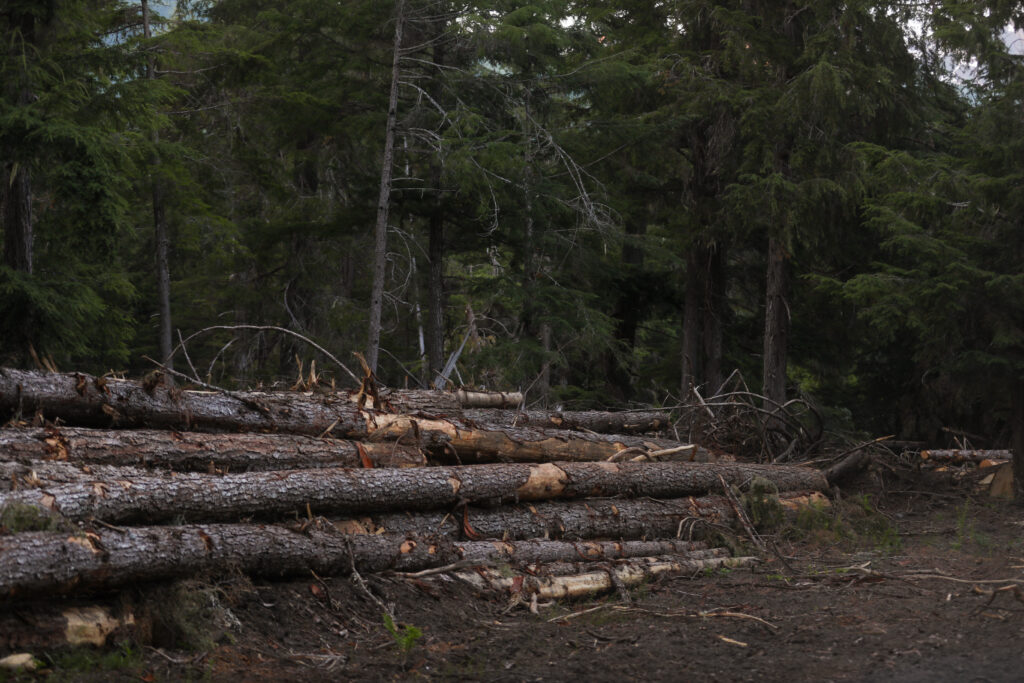
But after months of work on that plan revision, Palmieri said last September that he was directed by the commissioner of the Department of Natural Resources to pivot to something more broad. Residents who attended forestry meetings in Klukwan/Tlakw.aan, Haines and online in late August learned that the Division of Forestry intended to draft policy language opening the entire Haines State Forest to timber harvesting.
The current management plan allows for commercial timber harvest on about 42,000 acres of the 286,000-acre state forest. The change would put another 47,000 acres that are currently classified as not available for commercial harvest up for grabs, according to the advisory committee’s letter to the state.
One thing the advisory committee members and Palmieri agree on is that this would be a significant change in the forest’s management.
“The reaction to that suggestion is not unexpected,” Palmieri said. “I understand where it comes from and I understand how challenging it is for people to perhaps understand how to contribute constructively to change something that they may not have wanted to see changed.”
In the letter to the state, advisory committee members suggested that forestry staff could do three things that would help make the current process more meaningful:
1 – Provide the advisory committee with any information, studies or reports that are informing and justifying a reversal of its previous management and opening the entire forest to timber harvest.
2 – After the advisory committee reviews that information, and provides the Department of Natural Resources with additional recent fish and wildlife studies or local knowledge that could expand or diminish the amount of land that needs to be managed for fish and wildlife use – then the two bodies work together to examine the potential effects of the proposed changes to the plan on fish and wildlife.
3 – Allow the committee to review the new draft of the forest management plan before it is released to the public for an official public comment period, allowing the committee to provide input on the core concepts, direction and overall management intent.
“We should have been part of the process all along,” Sogge said. “It came too late and makes us feel like they weren’t paying attention.”
While Palmieri does not agree with the idea that his division is not following the legal requirements of consulting with area groups while updating the management plan, he said he and other members of upper management within the Department of Natural Resources will talk about the feedback they’ve gotten from the advisory committee. They’ve also met with other groups in the Chilkat Valley this week including the Haines Borough, and the Alaska Chilkat Bald Eagle Preserve Advisory Council. They’re scheduled to meet with the Chilkoot Indian Association as well, Palmieri said.
“The strategy moving forward can be molded by, and will be molded by those conversations,” he said.
Under his department’s original timeline, staff were planning to have a public draft of the management plan out for review by this spring.
“We had a strategy, but I think…we want to evaluate that moving forward and determine whether that time frame was responsible or not,” he said.
The Upper Lynn Canal Advisory Committee meeting is next scheduled to meet via Zoom on Jan. 20.
Correction: Advisory committee vice chair Mark Sogge’s comments were corrected to reflect that he and other members of the advisory committee have not been able to locate any records of communication from the state regarding consultation on the Haines State Forest Management plan before 2026. He does not believe such communication exists.

