
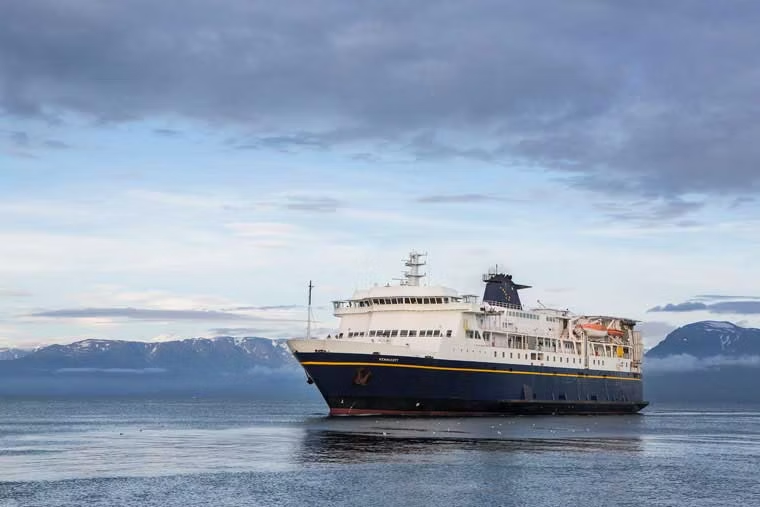
By the time Deanna Strong realized she’d be stuck in Juneau Sunday evening, the Haines-bound ferry she was on had been pitching and rolling hard for nearly two hours.
“You couldn’t hardly get up without holding onto something, otherwise you were going to fall over,” she said. “It was nasty. There were big waves coming up over the railing, a lot of spray coming up over the bow.”
Strong said they were among the luckier passengers as their hotel room was paid for due to her trip being medical travel with her brother, but then they had the logistical challenges of sorting out travel to and from the ferry terminal in Juneau with no car, and navigating the several hours between hotel checkout and when the terminal would be open.
Others on the ferry were not prepared to spend the night in Juneau. “There were a couple on the ferry who were really concerned. They had no idea what they were going to do. They didn’t have money for a room,” she said.
One younger man, who was traveling with his dog to Haines to meet with his sister, also didn’t have money for a room, Strong said. But then another local stepped in and offered to share a room with him. Someone else offered to care for his dog for the evening, she said.
Strong said she and her brother were at the mercy of the ferry schedule this week as he cannot fly on small planes like Alaska Seaplanes. But even if they were able to fly that company struggled to get in and out of Haines last week too. General manager Carl Ramseth said it has been something of a perfect storm of problems for all modes of transportation.
Beginning on Sunday, Nov. 30, Haines and Skagway started to get snow, low ceilings of clouds and low visibility. He said the approach minimum in Haines is a 940 foot ceiling and about 2.5 miles of visibility.
Then Monday through Friday of last week that combination of ceiling and visibility in Juneau made it tricky to leave, particularly because pilots won’t fly unless they have an alternate location to land other than their destination community.
“So if you take off from Haines to Juneau and you can’t land when you get back to Juneau, you need to have an alternate like Sitka or Gustavus that does not have this bad weather,” Ramseth said. That means looking at forecasts in the home community, destination community and a few alternate landing locations.
“Even the handful of times the Haines weather improved, we couldn’t launch because our alternates weren’t clear,” he said. “So we carried on like that for the whole week.”
By Friday, one flight was able to get into and out of Haines. Ramseth said three people who had been trying for days to get to Haines were on board.
Meanwhile, the backlog of mail and freight started to pile up in Juneau and Ramseth said he called the Alaska Marine Highway system to try and make reservations for box trucks last Friday out of Juneau, but the deckspace was already full.
He was able to get a box truck on the ferry from Haines and Skagway to head to Juneau on Friday and it was scheduled to go back on Sunday. But then that ferry turned around and went back to Juneau on Sunday, along with two box trucks on their way to Haines, due to freezing spray.
“It’s just all modes of transportation that so many communities depend on,” he said.
Finally, a ferry run from Juneau to Haines made it through on Tuesday and along with it two box trucks and another bound for Skagway. By this point, the company seems to have caught up on its freight bound to Haines and Skagway, he said.
The company had five flights make it into Haines Tuesday. Ramseth said they were “pretty much all people out of Juneau.”
While travel was stymied for several days, Ramseth said it could have been worse. This year, the company debuted a new technology which essentially combines GPS equipment and proprietary approach paths into communities like Haines which, he said, allows them to land with a lower minimum ceiling and visibility requirements.
“It allows us to fly when we couldn’t otherwise fly,” he said. “We wouldn’t have gotten [to Haines] on Friday.”
He said he hasn’t heard any negative feedback from people who are stranded, but hopes people who are frustrated remember that Seaplanes is trying to be safe. “We would also love if our reliability allowed us to fly every departure,” he said.
But while things are loosening up in the Upper Lynn Canal, Ramseth said Pelican is only accessible by float plane or boat. Couple that with freezing temperatures and the company hasn’t gotten a flight into the community in 10 days.
“We haven’t been to Pelican longer than its been since we’ve been to Haines,” he said. Pelican’s record, Ramseth said, is going 29 days one December without an airplane.
“That’s the longest period for any community that I’m aware of,” he said. Seaplanes has space reserved for two 20-foot box trucks on Saturday the 13th, bound for Pelican. It’s the community’s last ferry of the winter.

