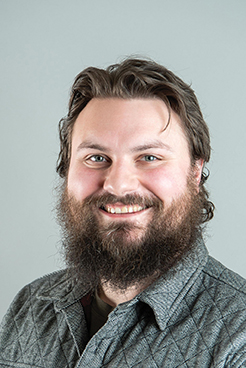
(Courtesy/Nathanael Reams)

How similar is determining compliance with Haines Borough code to contract compliance in the private industry? 

That’s a question Nathanael Reams could soon answer if elected to a term on the planning commission. 

The geological engineer who moved to Haines in 2023 said he’s been considering how closely the two are linked since he was asked to consider running by resident CJ Jones earlier this year. Her description of what a planning commissioner does, reminded him of his job as a project engineer which requires a lot of knowledge of contracts and keeping projects on track to meet the requirements of federal or state law. He sees parallels there with code interpretation and the process planning commissioners follow to determine if projects should receive permits. 

It’s a challenge he’s looking forward to taking on as he’s been looking to take on a more active role in community building since he and his wife Rebekah Reams (née Green) moved to Haines. 

“I have a kid, we live here, I’m passionate about this place. I love the natural setting. But, you can’t just say you love it – you have to find some way to take action on the things that are needed to keep it functioning effectively and efficiently,” Reams said. 

Outside of his foray into local politics, the Kenaitze tribal member said he has a passion for supporting the work of Alaska Native tribes. Currently, he works for Brice Incorporated, which is a subsidiary of Alaska Native regional corporation Calista Incorporated.  It’s a job he describes as a lot of travel to remote Alaska communities working on infrastructure projects.  

He also grew up traveling around the state, including in Gold Creek, a village near Talkeetna, Soldotna and Kasilof on the Kenai Peninsula and Fairbanks before moving to Haines. 

And, while he’s interested in taking a more active role in helping to shape the community, Reams said he’s less interested in the politics involved – though he realizes that might be difficult in a community like Haines. 

While he enjoyed his conversation with Jones about a potential planning commission run, Reams said he was still skeptical of getting involved in an elected role. But then, he had a conversation with another local, David Thomas, who helped convince Reams that he could do the job objectively. 

“I’m not naive enough to think that by making an objective decision that somebody won’t put me in a political bucket or another,” he said. “I just don’t want to play political games. I don’t want to pander to one side or the other or label myself as one side or the other, I just want to do a job.” 

Reams said he feels strongly about the economic future of the Chilkat Valley and wants to take an active role in shaping it for his young son. 

“I want to live here and living here is hard for a lot of people,” he said. “It’s a difficult challenge that is multifaceted, in my opinion.”

The two problems that stand out to him are the affordability and availability of housing and the availability of jobs that pay enough for people to buy, or rent. While he’s not convinced that the planning commission can tackle all parts of the affordability problem – he said he’s looking forward to figuring out how it can work to address some of them. 

And while he’s not yet experienced in the processes that planning commissioners must follow to do their jobs effectively, he said he’d bring a solid set of skills to the group. 

For one, he’s interested in learning specific land-use codes and zoning laws. But, he’s also not afraid to talk things through. 

“I’m not afraid of people’s opinions. I feel like I’m a pretty balanced individual,” he said. 

Reams said he enjoys the process of collective decision-making, particularly when it comes interpreting legal language and code. He’d like to work with other, more experienced members of the planning commission on a collective process that – by its nature – helps to counter personal bias. 

“That sounds super interesting to me,” he said. “Professionally, going back and forth and coming to a conclusion as a collective.” 

Rashah McChesney is a multimedia journalist and editor who has reported and edited newsrooms from the Deep South to the Midwest to Alaska. For the past decade, she has worked in collaborative news as the...