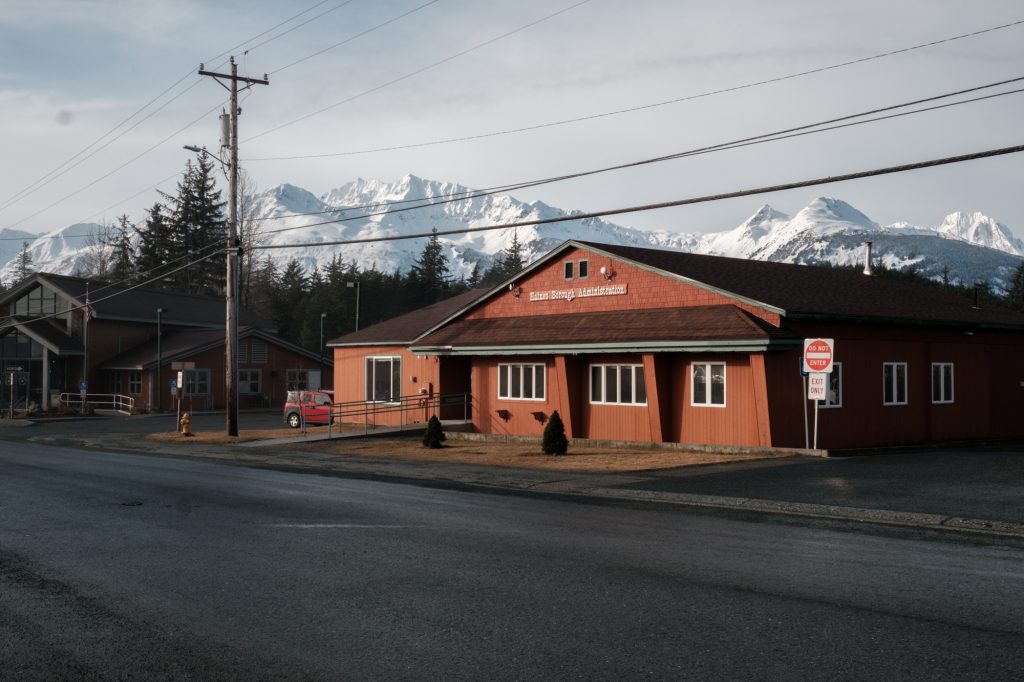
The Haines Borough Administration Building, March 3, 2025. (Will Steinfeld/Chilkat Valley News)

Lutak Dock frustration

The assembly once again had lengthy discussion on the Lutak Dock rebuild without taking concrete action. 

The consensus among assembly members who spoke on the issue was that they hope to move forward putting the project out for bid, moving away from current contractor Turnagain Marine. There was no timeline discussed at the meeting for the project going out to bid. 

“I expect we will go back out for a design/build contract but we have not done it yet,” Fullerton, who participated in the meeting remotely, wrote in an emailed response. “We are still working with our attorneys.”

There was no timeline for this process discussed at the meeting, though Fullerton said assembly authorization would not be required for the project to go back out for bid. 

Fullerton declined to say if there were any steps planned, or required, before the borough starts looking for a new contractor. There is also uncertainty about what design, if any, would go out for bid. 

Fullerton said she believed sticking with a recent Turnagain design, encapsulating five dock cells, would move the fastest. 

“The five-cell Turnagain design is within (the existing Environmental Assessment) footprint and there is already some permitting complete on that design,” Fullerton told the assembly. 

But as pointed out by Forster, and confirmed by Fullerton, Turnagain currently owns that design, not the borough, though that could change if the contract between the borough and the contractor is terminated. 

Other assembly members spoke in favor of changing the design, including Thomas, who brought up the possibility of encapsulating the front face of the dock, rather than each cell individually.

There are plenty of opinions swirling, but not much clarity. 

Partly in response to Thomas, Fullerton said major dock user Alaska Marine Lines has recommended cell encapsulation. But when asked for more details by assembly members, Fullerton said the recommendation was not made in writing, and she was not immediately able to say who at Alaska Marine Lines had given the verbal opinion. Fullerton said she plans to have the opinion from the company in writing at a future meeting.

Assembly member Kevin Forster tried to focus on broader goals. 

“In other communities, if you asked people about the design of the municipal freight dock, they would look at you with a thousand-yard stare,” Forster said. “I don’t care about what the design is, personally. What we want is a functional municipal dock.” 

Besides just the design, there’s also a question of how much money the borough has available for what could essentially be a new project, if put out for re-bid. 

Smith cited what he said was an assembly commitment at the start of the year to build the dock for a guaranteed maximum price of $25 million, “and nothing over,” he added. 

But other borough officials pointed out that money has already been paid out for services like permitting.  

The borough has been awarded $23 million in outside funding for the dock. But for the most significant chunk of that, a federal RAISE grant, no grant agreement has been signed and the money is not yet guaranteed. 

The borough submitted an application this week for a further $12.5 million in federal dock funding.

Letnikof cruise proposal

American Cruise Lines (ACL) has proposed paying the borough for long-term use of the Letnikof Dock. 

According to documents provided by the borough, the proposal is to secure 20 years of “ priority docking rights” at Letnikof, with two options to extend for another ten years each. That would allow ACL to submit a docking schedule at the start of each year. Each boat on the schedule would be guaranteed dock space. In return, the company would pay the borough $2 million towards the current Letnikof Dock rebuild. The proposal doesn’t appear to offer further payment for the 10 year extensions. 

It also calls for the borough “to provide coach and delivery truck access to the dock.”

During public comment, multiple residents expressed reservations about any possible deal.

“If the new (Letnikof dock) design is similar to the old one, it was barely adequate for the needs of the subsistence and sport fleets, not to mention the commercial fleet,” said resident and commercial fisherman Karl Johnson. “With a 200-some foot ship there, locals aren’t going to be able to use the dock.”

Lee Heinmiller spoke about what he thought large ships could do to the structural integrity of the dock. 

“If you’re going to count on (Letnikof Dock pilings) to hold a 200-foot ship in place, it’s not going to happen,” Heinmiller said. 

Fullerton said after the meeting that ACL’s ships are small cruise ships, with 100-170 passengers each. There is, however, no specific mention of ship size in ACL’s written proposal. 

Sales tax revenue drop 

According to numbers provided by borough chief fiscal officer Jila Stuart, the borough saw a significant drop in sales tax revenue last year. 

In the 2025 fiscal year, which ended in June, the total sales tax take in the borough came in 3% — a total of $136,781 — below the sales take revenue for the previous fiscal year. Excluding the height of the COVID-19 pandemic, it’s the first time “in recent memory” sales tax revenue hasn’t risen year-over-year, Stuart said. In last year’s budget, sales tax revenue was projected to increase.

Stuart said she’s trying to figure out why last year’s revenue came in below expectations. One factor, she said, was likely a drop in the cost of fuel.

But sales tax, she noted, was down across many sectors, not just on fuel purchases. That included a significant drop in lodging tax, down 7.6% from the previous year. Assembly member Gabe Thomas said he saw that as possible evidence supporting a drop in Canadian tourism as the culprit. 

Heliski Regulations

The assembly voted to amend proposed heliski regulations to change a fee schedule for additional helicopters. 

As written, heliski operators would have been allowed to run two helicopters, with the possibility of 14 days use of a third helicopter, if granted by the borough manager. Operators would have paid $3,000 for use of the first helicopter, $5,000 for the second, and none for the third. 

As amended, operators would pay $3,000 for the first, $4,000 for the second, and $4,000 for the third. 

“It makes sense to leave the barrier to entry lower, particularly for an industry that is volatile because of weather,” Forster said. “But going beyond that, it seems like if (operators) have the clients, they can pay for it.” 

Will Steinfeld is a documentary photographer and reporter in Southeast Alaska, formerly in New England.