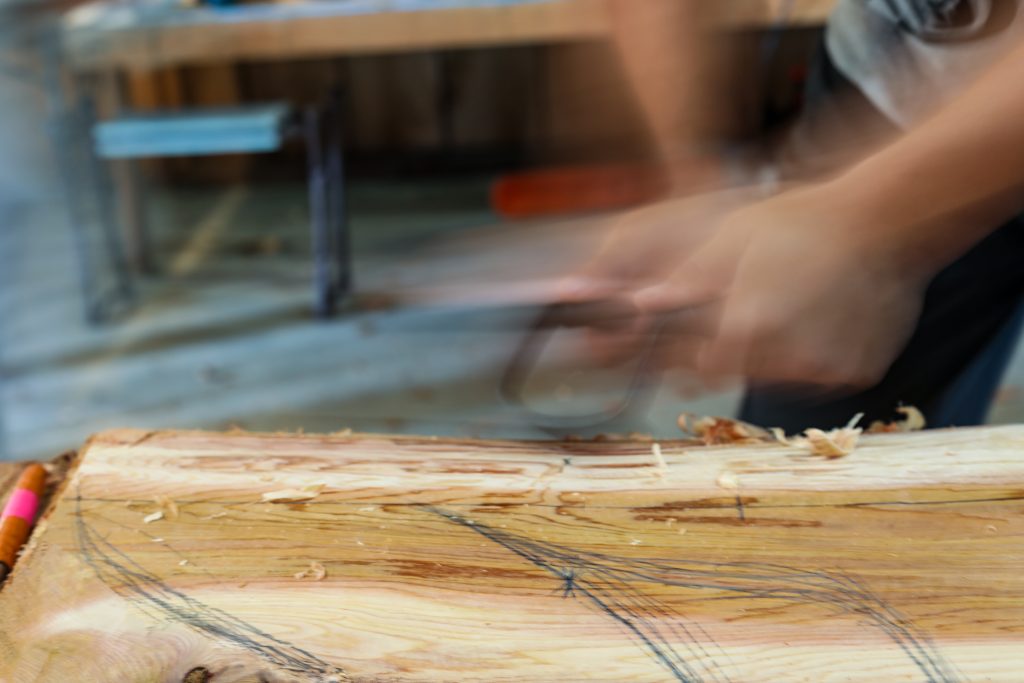
(Rashah McChesney/Chilkat Valley News) James Hart smooths a red cedar log with a carving tool called a scorp as he works on a replica of the Friendship Totem on Tuesday, August 5, 2025, in Haines, Alaska.

The smell of red cedar lingers in a repurposed shop where Haida carver Sgwaayaans TJ Young, and local Lingít artists Rob Martin and James G̱ooch Éesh Hart worked for more than a week. 

Three red cedar logs are on blocks in the space. The trio work hard on the largest of them — a 31-foot behemoth. The features of a familiar local totem pole emerge with each chainsaw cut,  scrape of the chisel, and strike of the adze. 

With Young looking on, Martin makes a series of shallow, vertical cuts along the side of the log. 

They’ve been roughing out the design. Now the idea is to smooth the carving out. 

“This is just an easier way of taking the meat off,” Martin said, pointing to the cuts. “It breaks off kind of fast. It also gives me an image of what to follow.”   

He pauses occasionally to check in with Young to make sure he’s on the right track. 

Martin makes jewelry and knows Northwest coastal art, but said this is his first experience working with wood and carving at this scale. 

“It’s monumental. James and I are both artists, but TJ is the master here,” Martin said. “He’s the one with the vision, guiding us.” 

“You’re being modest, and you’re making me blush,” Young retorts. 

The three laugh at each other and then turn back to their work. 

Martin hunches over a section of wood and works at just one tiny piece of a larger carving that will take months of hard labor to finish.  

Young said that’s kind of the point. 

He tells the story of learning to carve as a teenager with his brother in Hydaburg. 

They didn’t have a professional teacher. Much of what they learned was through trial and error.  

He went on to apprentice with master carvers and crafted dozens of totems and canoes throughout the region. 

“What used to kind of paralyze us in the beginning was not having a process. So now that’s what I’m teaching,” he said. “I think that’s what slows down a lot of people, ‘what do I do first?’  I’m literally breaking it down into little cuts.”

The trio work from a series of pictures they took of the pole they’re replicating – but there were some mysteries. 

“It’d help a lot if we knew what some of these figures were,” Martin said Tuesday. “The totem poles are basically just stories. If you know the story, you can understand what’s going on. Knowing the story of the pole can really help with the execution of the carving.”

Lee Heinmiller’s dad helped carve the Friendship Pole, which the trio are working to replicate. Heinmiller said the next day he was headed out to the shed with a 4-foot model of it for their reference. 

This particular pole is unusual as it is one of the few totems in Southeast that includes crests of both eagle and raven moiety. It also has faces representing white people carved into it.  

“The original was done by a carver in Klukwan,” Heinmiller said. That carver was Jim Watson. 

There are three replicas of it. The first is the one Young, Martin and Hart are working on replacing. One is at the Haines School and another sits in the atrium of the state office building in Juneau. 

Heinmiller described a wolf, and an eagle coming out of the mouth of a figure at the bottom, and a raven diving at the top Its tail is up high, and its wings are on either side of the pole. 

Hart was trying to coax that figure out of the wood this week, working to sketch its face into a smooth, curved plane. He said he’s done some dugout canoes, but he hasn’t gotten to work on a totem pole in the past. He’s particularly interested in learning three-dimensional carving. 

It’s complicated, measuring from one side of the log to the other and lining up the raven’s eyes. Hart said he’s grateful for Young’s presence. 

“Having somebody who has been there, who has done it, and (who) without having to hesitate can go right into the next steps is special,” he said. 

The process of carving is intensely physical, and all three men said the soreness lingers.

“It really tests your body and muscles to keep pushing,” Hart said. “It definitely encouraged me to take care of myself a little more. It’s a mental game.” 

Young said he’s will travel to Anchorage in a few weeks and plans to bring back a set of pull-up rings for the shed ceiling so the carvers can take breaks and hang from them to help with back and shoulder soreness. 

The group is working five to seven days a week through September. 

Then Young will come back in the spring and they’ll get back to work finishing all three poles in April or May. 

Once finished, they will replace ones that stood in the Noow Hit tribal house at Fort Seward.  

The Chilkoot Indian Association has been rebuilding the clan house since 2022, when it acquired the Fort Seward parade grounds from Alaska Indian Arts. 

Chilkoot Indian Association project manager Zack James said the totem replication project is a collaborative effort between regional corporations and funds from the Rasmussen Foundation and the National Park Service. 

Sealaska donated the logs, which came from Prince of Wales Island, while the Central Council of the Tlingit & Haida Indian Tribes of Alaska provided housing and a location for the carving. 

Replacing the totems is one part of the clan house renewal project at Fort Seward. 

“We’ve taken control of it as a tribe. We really want it to be something that represents us,” James said. 

Once finished, the clan house will become a place for private gatherings and traditional practice for tribal citizens. Its location near the cruise ship dock also makes it a key part of the tribe’s larger cultural tourism efforts. 

“We want to open it up, you know, to people from all over,” James said. “We can educate people about who we are and in a way that reflects our values. We control the narrative.”  

In the carving shop, Martin works toward that vision with each piece of cedar that curls toward the floor as he scrapes it off the log.  

The chance to apprentice to a wood carver is an answer to a dream he’s had since he decided to focus on being an artist. 

“That is originally what I wanted to do, was learn how to carve, but nobody was teaching,” he said. 

That’s an issue throughout Southeast Alaska. 

In 2020, the Sealaska Heritage Institute surveyed more than 220 Northwest coastal artists and 82% of them said they wanted to train in monumental wood artwork, but just 6% said they’d had mentorship abilities in the field. 

James said there has not been an open call for totem carving apprentices in Haines since at least 2009. 

“Klukwan has done some stuff since then, but here in town, it has been years,” he said. 

While the larger goal of the project has been to restore the tribal house, he’s focused on providing a learning opportunity for local carvers. 

“There’s not a lot of people carving totem poles in town anymore,” he said. “Not anyone young, below 60. So I thought that the primary aim for the totem carving was to train young carvers. I’m really glad that we were able to provide an educational opportunity. They’re here and they’re going to stick around too so that knowledge will be able to stay in the community.” 

Rashah McChesney is a multimedia journalist and editor who has reported and edited newsrooms from the Deep South to the Midwest to Alaska. For the past decade, she has worked in collaborative news as the...
