

The administration of Gov. Mike Dunleavy has signed a $28.5 million contract for work on a new ferry terminal north of Juneau, days after an oversight board said the state had not proved that the project is economically viable.
Dunleavy administration officials say the new terminal at Cascade Point, located 30 miles north of an existing terminal in Auke Bay, will cut ferry time from Juneau to Haines and Skagway by two hours.
But the chair of the Alaska Marine Highway Operations Board — which was created by Dunleavy four years ago — says the department hasn’t shared “some kind of business plan or feasibility study” to establish that the terminal is necessary and economically viable.

“The Alaska Marine Highway System has been plagued for 50 years with one-off projects that get foisted upon it, that create operational challenges, that then the system and the users have to deal with,” said Wanetta Ayers, chair of the board, during a Friday meeting.
“This is another one of those situations where it’s going to get foisted upon the system and we’re going to have to cope with it for 20 or 30 years until somebody admits it’s not going to work,” Ayers added.
The Cascade Point ferry terminal is planned on land owned by Goldbelt Inc., a Juneau Alaska Native corporation.It has been under consideration since Dunleavy took office in 2019. In May, his administration announced its intention to seek bidders for the first phase of the project.
After receiving two bids, the transportation department signed a contract Monday with K&E Alaska Inc., an Oregon-based company with an office in Sitka. The contract, which has a 2027 completion date, covers engineering and environmental permitting, a bridge over Cascade Creek, a gate, site preparation and retaining wall construction.
The contract does not include any funding for the ferry terminal itself, which is set to cost tens of millions of dollars. The state expects to pay for the terminal using primarily federal funds.
Ayers said Friday that the Dunleavy administration had not provided answers to board members’ previous questions, and she is troubled by “the pursuit of this project in what is a very unconventional process, where design and now construction are way ahead of operational feasibility and customer service.”
Katherine Keith, a deputy transportation commissioner, said during the Friday meeting that the department had commissioned an independent economic analysis of the project, but it was still in “draft form” and had not been released. She did not provide any specifics on when it would be available to members of the board or the public.
“We continue to believe that this is a strong benefit to the state, to the system and the public, which is why we’re moving forward with expenditure of public dollars, but understand we haven’t communicated that in a complete narrative document to make it more accessible and comprehensive,” said Keith.
Keith pointed out that the Cascade Point project had been recommended in 2020 by a marine highway reshaping working group commissioned by Dunleavy.
Ayers, who served on the working group, said that report and its accompanying recommendations “came together on a wing and a prayer at the last minute to meet the governor’s deadline.”
“To stand on it as a justification for Cascade Point is, to me, a pretty big stretch,” said Ayers.
One of the primary reasonings provided in the working group report for the new ferry terminal was that it would “avoid the need to modify the new Alaska Class ferries to add crew quarters” by allowing for trips between Juneau, Haines and Skagway to last less than the 12-hour crew day mandated by the Coast Guard.
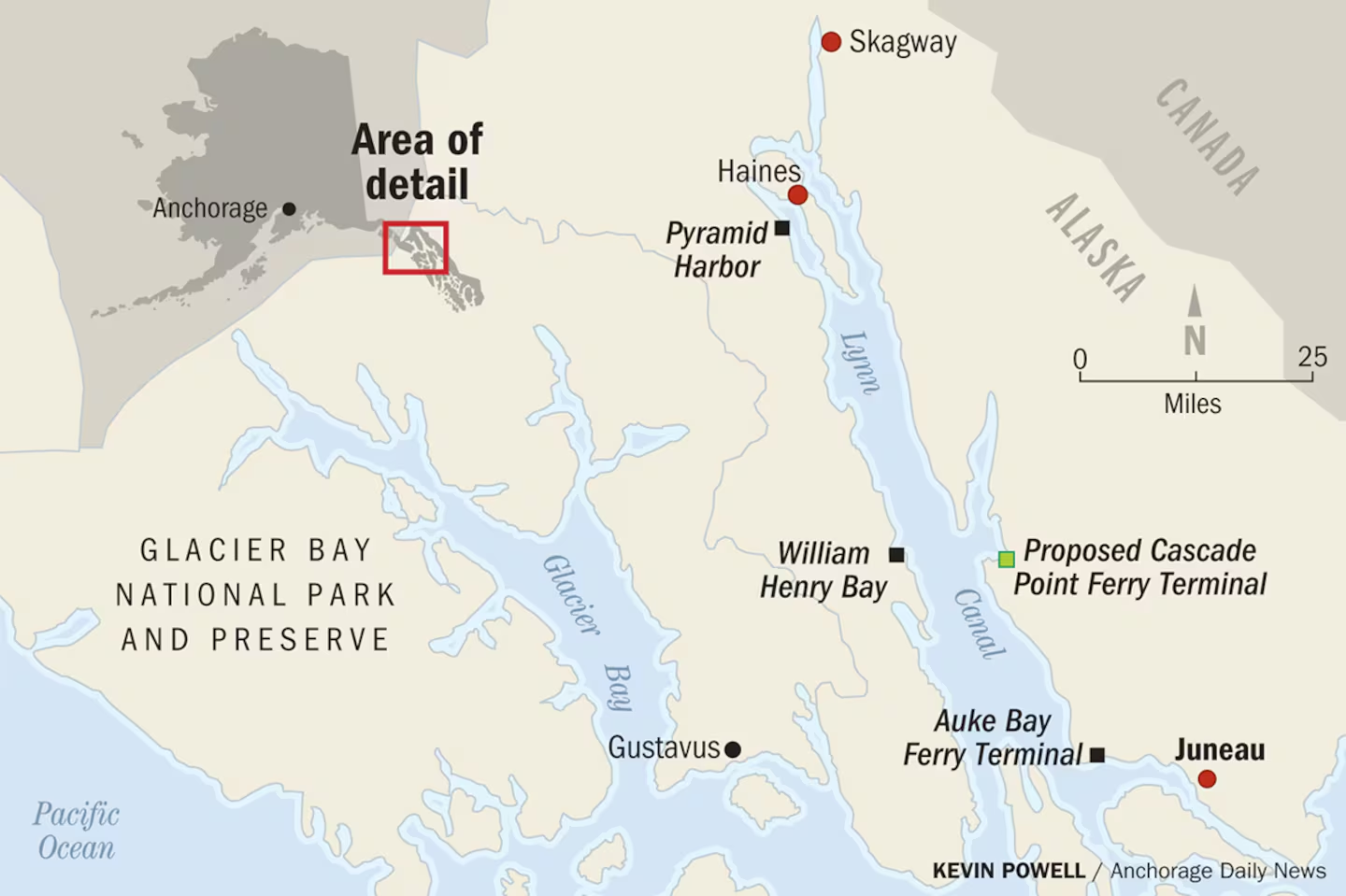
But that reason is partially moot because the state has already committed to retrofitting the Alaska Class ferries with crew quarters, at a cost of roughly $30 million, and because the route length between Cascade Point, Haines and Skagway exceeds the 12-hour crew day, according to Marine Highway spokesman Sam Dapcevich.
The trip from Cascade Point to Haines and Skagway, as envisioned by transportation planners, would run up against the 12-hour work limit for crew, “requiring full staffing and accommodations,” Dapcevich said in an email last week.
“A more efficient service model,” which wouldn’t necessitate crew sleeping onboard, would require ferry trips from Cascade Point to go either to Haines or to Skagway, rather than visiting both communities on a single trip, Dapcevich said. The Marine Highway System would then have to use a yet-to-be-constructed “shuttle” ferry between Haines and Skagway.
‘Standing on a cliff’
Ayers wasn’t alone among board members to raise concerns about the process used by the department to advance the Cascade Point project.
Board member Paul Johnsen, a former Marine Highway engineer, said it seemed that the board was “being ignored” by the transportation department. Member Bob Horchover, who was appointed to the board by Dunleavy, agreed.
“I’m against this until we have more information,” said Horchover. To move ahead with the project “without even a reason for doing it is, to me, a boondoggle,” he added.
Anthony Lindoff, vice chair of the board, said the department had not provided enough information for him to form an opinion of the project.
“I certainly don’t have enough information regarding Cascade Point to be unequivocal, one way or the other,” Lindoff said. “I’m just eager for more information.”
While the Dunleavy administration is moving ahead with the Cascade Point project, it is also working simultaneously on a study of a possible new road-and-terminal project on the west side of Lynn Canal.
A $2.4 million study of the project is set to examine multiple options, all of which are predicated on the existence of the Cascade Point ferry terminal, according to a service agreement signed in May.
Keith told board members that the study, with initial findings expected in January, is set to examine connecting Cascade Point with new ferry terminals and road stretches on the west side of the canal, to better tie Juneau to the Alaska Highway. Keith said the “Chilkat Connector,” as the Dunleavy administration called it, would include construction of one or two new ferry terminals on the west side of the canal, along with several miles of new road.
Some board members said it appeared that Cascade Point would only be economical if paired with west Lynn Canal infrastructure, but with those infrastructure projects yet to be studied, moving ahead with Cascade Point was premature.
“If it was part of a larger infrastructure plan to build a road up the west coast of Lynn Canal, then that might have some more impact and be worth investing in that kind of a facility,” said Horchover.
“I’m a little concerned that we’re standing on the cliff and saying, ‘Why not? Let’s jump,’ ” he added.
Juneau Access
The Chilkat Connector study, like the Cascade Point ferry terminal, is funded using appropriations made by state legislators nearly 20 years ago for what is called the Juneau Access Project, a decades-old effort by the state to improve transportation options to the state’s capital that has been reimagined under each new governor.
Former Gov. Tony Knowles in 2000 nixed the idea of a 90-mile road north of Juneau toward Haines, saying its price tag — in the hundreds of millions — was too high. Former Gov. Frank Murkowski revived interest in the plan, and state lawmakers in 2006 approved $45 million for the Juneau Access Project, under a vision for a road from Juneau to the Katzehin River, allowing for quick ferry shuttles from there to Haines and Skagway and on to the mainland road system.
Former Gov. Sarah Palin paused the plan while she was in office, only for her successor, former Gov. Sean Parnell, to revive it, at a projected cost of more than $500 million.
The Parnell administration spent $5 million extending the Glacier Highway to the Goldbelt-owned land at Cascade Point. More than a decade ago, Goldbelt considered constructing a dock to transport Kensington Mine employees from Cascade Point to the mine. That hasn’t happened.
When Gov. Bill Walker was elected — and oil prices crashed — the Juneau Access Project was shelved again. Then came Dunleavy, who turned from the longer road to the Katzehin River to a plan that involved constructing the new Cascade Point terminal.
In 2023, the Dunleavy administration agreed to work with Goldbelt to study the feasibility of a terminal on land owned by Goldbelt. Members of the Alaska Marine Highway Operations Board wrote last year that “with the current information available to AMHOB and the public, we cannot see the merit of the proposed Cascade Point project.” The Dunleavy administration did not provide any further information to the board in response to their letter, members said.
A draft of the 20-year long-range plan for the Marine Highway System signed by Transportation Commissioner Ryan Anderson in February contains no recommendations regarding the Cascade Point terminal. It states that a feasibility study for the terminal was ongoing as of the time of the report’s publication. But department officials said this month that there is no ongoing feasibility study.
‘Rearranging the deck chairs’
Dunleavy vetoeda move by state lawmakers in May to reappropriate Juneau Access Project funding toward other transportation plans, stating the funds had already been obligated.
Since then, both the Skagway and Haines borough assemblies have formally expressed their opposition to the Cascade Point terminal.
“It is difficult to understand why the State is choosing to invest in the construction of a new marine facility rather than rehabilitating existing terminals, many of which — including those serving northern Southeast Alaska — are in urgent need of repair,” Skagway Assembly members wrote.
While Haines and Skagway leaders have bristled at the news that the Dunleavy administration is moving ahead with the terminal, one mining company celebrated the announcement.
Grande Portage, a Canada-based company with a plan to build a new gold mine near Juneau, said in a press release that it has an existing agreement with Goldbelt to cooperate on building a barge terminal at Cascade Point for transportation of ore.
Though the barge terminal is not contingent on the ferry terminal, “having the ferry terminal proceed first is highly advantageous as it would result in the development of infrastructure that will also be necessary for the ore terminal, particularly the new access road and bridge. This reduces the time and cost required for future ore terminal development,” Grande Portage wrote in its press release.
The work on Cascade Point comes as the Marine Highway System is wrapping up its work on a 20-year long-range plan. Ayers said work on that plan, and renewed focus on the system’s efficiency, have allowed it to move away from “just rearranging the deck chairs on the Titanic.”
“Here we are, spending lots of time and resources about planning and being strategic, and yet, the other hand is going to deliver us a one-off carbuncle,” said Ayers. “I feel like it’s undoing a lot of good progress.”
This story was originally published by the Anchorage Daily News.