

- Judy San builds a house
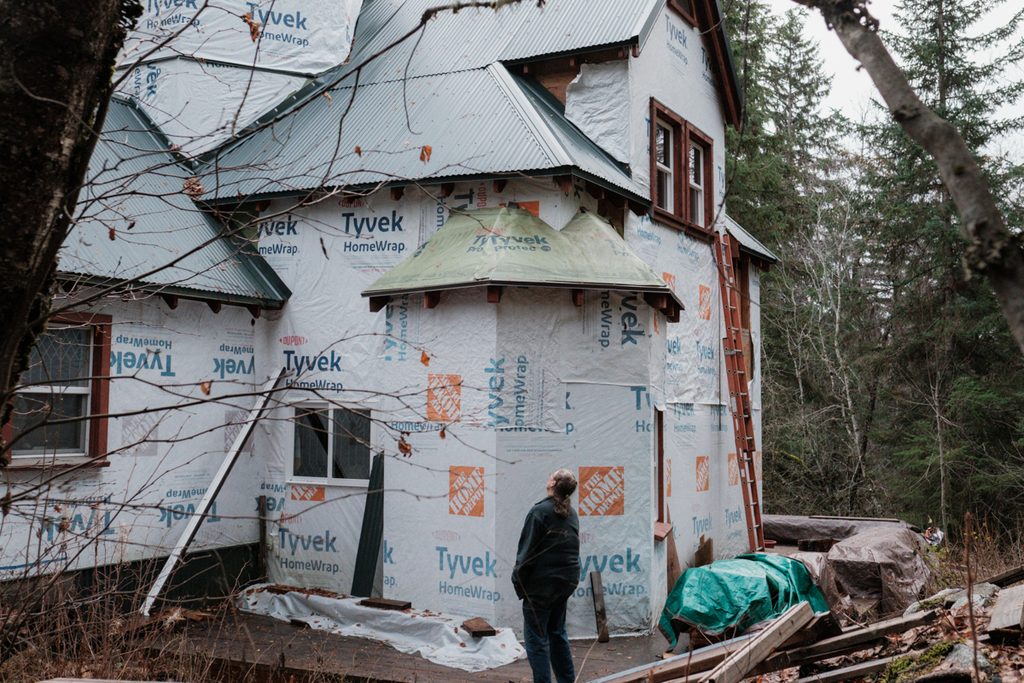
If you go up a side road by 18 Mile, then around a couple bends, then over a couple more “blocks,” as Judy San describes the sections of washboard dirt track that could only be demarcated into blocks after some time and great familiarity — eventually after that, you get to San’s house.
The house is of a style she calls “rustic Victorian.” It has one section shaped like a gingerbread house. Another section has a bay window at the bottom, a series of gables above, and then a tower with a spire at the top. With the all-white of the Tyvek-clad exterior, the whole thing looks somewhat like a Bavarian castle, if a Bavarian castle ran on a diesel generator and had a truck and a tractor parked out front.
Given its size and complexity, you might not guess that the bulk of the house was built by one person. You almost certainly wouldn’t guess that person, for a good chunk of it, had only a chainsaw, a screw gun, and a set of batteries she charged at the public library.

And finally, you might not pick Judy San out of a crowd as the one who did it — the one who’s still doing it, going on nine winters.
San is quick in conversation. She makes lots of jokes and many of her sentences end with a “hah!” But at 75, she isn’t, or doesn’t appear at first glance to be, some kind of a superhero, at least physically. When she lifts heavy things, she breathes hard. She takes her time going up stepladders, and sometimes places a hand on a railing or a table for support as she moves past. That’s all normal, but it’s not so normal given that she’s raised a three-story Victorian home out of an empty square of brush.
“I should’ve done this 40 years earlier,” San says, with a laugh. “This is really a lot.”
The whole house-building saga started when San purchased the 18 Mile property a decade ago. She had just retired from her job overseeing facilities at a sort of summer camp ranch in Northern California (where she “kept 82 toilets running,” in addition to many other things, she says). At the time, the only thing on the lot was a small trailer she lived in during the warm months. In those summers in the trailer she dreamed up a home, drawing maybe 20 different iterations of it on paper, she estimates. All the while, she was felling trees and preparing the site. She measured out her own topographical map using a big bucket of orange spray-painted rocks. At one point she ran into a “Volkswagen-size” boulder right where her kitchen was supposed to sit.
“Heaven knows how deep it goes,” she said on a recent afternoon, sitting by a Toyo stove somewhere on top of that boulder. “There was no way I was going to move it.”
So she adjusted the plans, fitting the basement around the rock. When cold rain came in the fall, she would pack up and move into town for the winter.
Something that’s relevant here: San hasn’t ever built a home. She doesn’t go into much detail about her professional past, but she went to nursing school, then she “did all sorts of other professional things.” At various points, that included bits of foundation work, some framing and finish work; some drywall and a little bit of plumbing and electrical. But never what she’d call professional construction.
“I knew how to do it, or at least how I was supposed to be doing it,” she said. And, she added with a smile, she “watched a lot of television — This Old House, things like that — held the end of the board for my dad.”
Nevertheless, she’s confident in her work, saying things like “it hasn’t fallen down yet, and I don’t think it will,” undeterred by any possible jinx — though she does knock on the wood that theoretically won’t be falling down.
In some ways, she makes the process sound simple, say, for your average non-professional diving into a decade-long build of their own dream home, off-grid, on the sloping base of a 4,000-foot ridge.
How do you think about designing a home?
“Well, you just draw a box, and go from there,” San says.
Isn’t it intimidating actually starting on something like this?
“Well, if you have a pair of clippers, you just start, you know?”
I point out that most people have clippers; few have built a home, much less this home, at her age. “Well,” she starts, trailing off, before changing the topic to some of her favorite design features.
San has gone with a phased approach. She first built a shop space with a dormer on top, now serving as winter quarters, so she doesn’t have to live seasonally in the trailer.
In her first construction season, she set the footprint of the house, one section 24 feet by 24 feet, another roughly 24 by 10. The next season, she started to frame out the building and got the shop floor and walls done by October.
The steady progress happened in the face of some significant obstacles. For one, she didn’t have a driveway yet, or the tractor she has now.
When Mosquito Lake lumberjack David Hertel would deliver local spruce to her, she’d drag it by hand down through the brush.
She also didn’t have much in the way of equipment, not even a chop saw, and she didn’t have power, either. It was only her chainsaw and screw gun that stood up the shop she lives in now, which looks like any other sturdily built home.
Her solution, in those early days, was to head down to the public library to charge her batteries. Or, sometimes, over to her neighbors’ homes for power. Surely, it would have been easier to have power right there. The library is a half-hour from San’s home. But those things — the library, knocking on neighbors’ doors — in some ways, she said, that was why she came to Haines.
Years before, San discovered the Chilkat Valley as a cruise passenger. She had stopped in Skagway, taken the fast ferry down the canal, saw Speedy the bear at Chilkoot Lake. The lake was great, she remembers, but she took special note of the places in town she imagined being able to meet people.
“It felt like a place you could be a part of things,” she said.
California hadn’t felt that way, for her, in a while. She had settled in the 1970s in Point Reyes Station, a little community up the coast from the Golden Gate Bridge. She and her neighbors rented small cabins; each winter they’d swap around in the hopes that someone else’s cabin was less damp inside. The grass was never greener, she said, but even amid the mold, they loved where they were, and they all helped each other out.
“If you had a problem, you’d just call up your neighbor,” she said. “Just like here, I can just call up my neighbor and have him help me do a big beam or something.”
But as Silicon Valley grew, Bay Area money moved north, buying up the cabins and knocking them down. Rents went up, and San moved farther north into the redwoods. Even after the move, she said, things never stopped getting more expensive. It also felt hotter each year, and in her new home, she didn’t know any of her neighbors.
“There wasn’t anything in that town at all,” San said. “There wasn’t much keeping me there. When I left, I was looking for community.”
She’s found that in Haines. “There’s a lot of very powerful women here. Plus a lot of artists,” she said. She names Donna Catotti, Sharon Svenson, people she says she admires earning a living, year after year, making art.
San says her father used to tell her being an artist wasn’t practical.
“I got that stuck in my brain,” she said. “That I couldn’t be an artist; I had to just piddle around and have fun with it.” Hence, nursing school. “Of course, I’ve gotta take care of everybody,” she jokes, sarcastic.
Now, in her retirement, she’s constantly producing work: stained glass, furniture finishing, taxidermy, a mosaic that hangs in what someday will be her new kitchen.
“This was one of my dreams,” she said, looking around at her living space packed with art in progress, art for the future, art already completed. “Having a shop to just go crazy, to have fun with.”
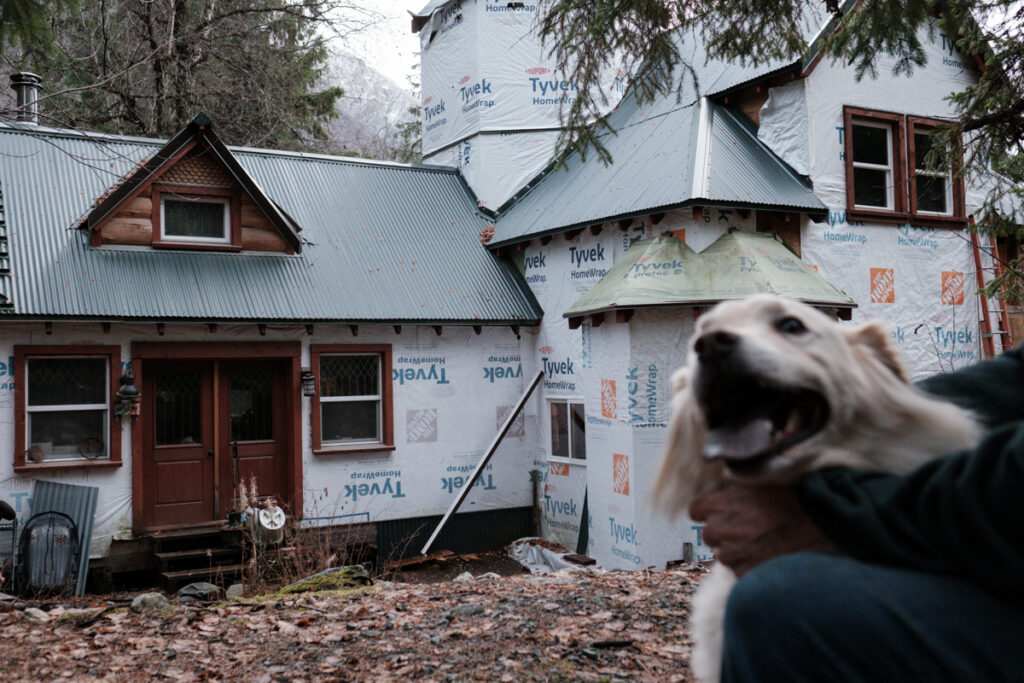
The fact that San now definitely considers herself an artist proper makes sense, when you start asking about the plans for the building.
A non-exhaustive list of features in the home not yet discussed: double stud walls, with offset studs meant to improve insulation; a space in the tower designed for reading and watching the northern lights; a powder room placed next to the sleeping area due to poor experiences living in mobile homes requiring an overly-long walk from bed to bathroom in the middle of the night; nail-free construction, only screws and joinery; a “non-boring roofline”; solar panels to power the house; a plan to put a skeleton in one of the walls (“just because, you know”); potential secret doors, which, if described, would no longer be secret.
The primary constraint San seems to observe is style. She’s had to reject some of her “weirder ideas” because they “just won’t fit the style” of the structure.
But otherwise, she says, the house has come into being essentially how she imagined it. She chalks that up to the fact that she’s already built each section before, first in her head, then in a series of small models, then in full.
“A lot of times, when I get scared about doing something, I’ll rebuild and rebuild and rebuild in my head,” she says. “So by the time I get there, I’ve already built it, and I just have to follow the steps.”
It makes sense that the skills of an artist would translate. But you think about how many years San has been at it, building this thing, and you imagine that much of it must have been not so glamorous. You can only draw plans for so long; at some point, you have to start lifting beams.
That part, though, San is proud of too. Asked what people in her life think of her building a house, she says a lot of them are living vicariously through her project. “They think I’m a badass, I don’t know.”
“Just what I always wanted to be known as.”
She doesn’t pretend it hasn’t been hard. She jokes that she’s probably single-handedly keeping the chiropractors in business, along with Hertel up in Mosquito Lake. She has to haul water to her house, and there’s limited plumbing still.
That’s the other thing, besides style, she seems to worry about — the feeling that she’s “slowing down.”
“I mean, I’m 75. So yeah, I’m running out of poop,” she said. “It has taken a lot.”
But the work, she believes, is also what keeps her going. “It’s use it or lose it,” she said. “It’s why I don’t mind having stairs. If I have to go up and down those stairs even once or twice a day, it’s going to keep me going.”
When it’s especially hard, she just tries to do something. Even if it means just grabbing a broom, to sweep — something that will get her out of her chair and moving. “If I get out there to do anything, I’m happy. Even if it’s just getting my shoes on, that can be a big step.”
She’s designed the house to be compatible with a live-in caretaker, and a resident who can no longer climb stairs.
But as of now, she keeps on sweeping, lifting, hauling.
This was the year she thought she might be able to really move into the house. Now, come November, she realizes there’ll be a ninth construction season.
“I thought it was going to be done this year. Hah! Not quite,” she said, laughing.
Will she be sad when the building is done? She answers instantly with a hearty “no,” talking about all the other projects she wants to do. But later, when asked if the building ever will be done, she acknowledges that maybe the answer to that is a “no” as well.
“Well I don’t want to be bored!” San said. “Everybody should have a retirement hobby. Otherwise, you just sit there and get old, and die, basically.”
On a recent morning, that hobby of hers meant climbing up into the eaves to fight a battle against the wind. The barometer in her kitchen was in freefall, and an incoming storm was already gusting down from the ridge. After stapling down Tyvek around the tower, she went back to the first floor, but left her tools in place.
“A house isn’t some kind of solid thing — I think, I don’t know. There’ll always be wallpaper or paint to change. I still have roofing material to put up, then it’s Sheetrock and insulation. Then there’s also wiring and flooring. Oh, and I have to put a new window in.”
She laughed, looking around the shop and the jumble of projects inside. “Just a few more little things.”
This article is part of a series called Works in progress about how various residents are spending the cold months. Got ideas? Reach out to Will ([email protected])