


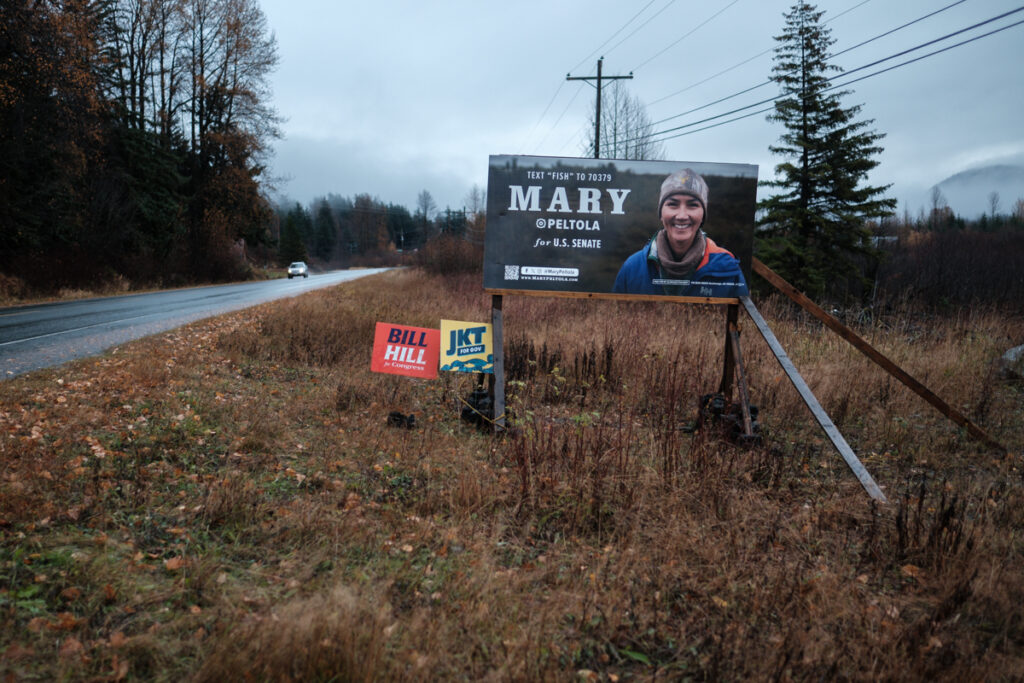
Updated unofficial results shows three closely watched races in Alaska are likely headed to ranked-choice tabulation on Nov. 18 as no one candidate has more than 50% of the votes.
In the U.S. Senate race, Democrat Mary Peltola has a narrow lead of just 626 votes over incumbent Republican Sen. Dan S. Sullivan. Also in that race, Dan J. Sullivan, a retired Petersburg teacher, has 1.68% and Republican Gerald Heikes, has 2.25%.
In the lead up to election day, Peltola faced criticism after New York Times reporting connected her campaign to an effort to run a second Dan Sullivan in the race as a spoiler.

Voters at the polls in Haines brought up the reporting, but were split on whether they saw it as a knock against the candidate. Some called it cheating; most Peltola supporters interviewed said they saw the campaign’s support of second Dan Sullivan as normal political maneuvering.
Peltola voter Sue Libenson cited the 2014 election in which now-incumbent Dan S. Sullivan first won his seat. Elsewhere on the ballot was a third Dan Sullivan, a former Anchorage mayor running for Lieutenant Governor.
With 394 of 401 precincts reporting, Alaska’s U.S. House race results show incumbent Republican Rep. Nick Begich leads with 49.51% of votes, and independent Bill Hill behind at 40.34% of the votes. The lone Democrat in this race, Eric Hafner, is in federal prison. He has 7.28% of the vote, while Jim McDermott, a Libertarian, has 2.71% of the vote.
Democrat Jonathan Kreiss-Tomkins is still in the lead in the governor’s race with 49.01% of the first-choice votes. If elected, Kreiss-Tomkins would be the first Democratic governor in Alaska since Tony Knowles left office in 2002. Bernadette Wilson has 29.12%, Dave Bronson 14.14% and Treg Taylor trails at 7.43%.
These results are first-choice results only. Any candidate who gets more than 50% of the votes outright will win and races where no candidate reaches that mark will go to ranked-choice tabulation on Nov. 18. In each of these races early and absentee votes remain to be counted, meaning results could change.
On Ballot Measure 2, which would repeal the open primary and ranked choice voting, voters are narrowly choosing to keep the current system with 51.85% voting no. That ballot measure would also repeal a law that required third-party political donors to disclose the source of their funds.
Nearly every voter interviewed at Haines’ ANB/ANS Hall polling site on election night named Ballot Measure 2 as a top concern, both in favor of and against.
Proponents on the no side — advocating to keep ranked choice voting — said they believed it gave voters more choice and rewarded bipartisanship.
“I think ranked choice voting brings things to the middle,” said Haines resident and borough planning commissioner Nathanael Reams. “I like to think of myself as a middle of the road guy, and open primaries let me do that. I want to choose people who are effective at what they do, regardless of labels.”
Rodney Hinson agreed that the system might favor candidates closer to a political middle. He said he believed it was being “pushed by candidates it benefits,” like Senator Lisa Murkowski.
Hinson, however, said he opposed ranked choice voting, partially because he opposed Murkowski, but also for deeper reasons.
“The Constitution says you get one vote,” he said. “With ranked choice voting you get more than that, and to me it feels unconstitutional. Mostly, it just doesn’t feel right.”
Some have criticized the provisions of Ballot Measure 2 requiring funding disclosures from third-party political donors. One voter, Nicole Holm, said she was more concerned about getting rid of ranked choice voting than any possible negative impact to campaign finance transparency.
“You see those No on 2 ads talking about dark money, but then at the bottom of the screen, the ads say they’re paid for by Outside money,” Holm said. “Politics is dirty business.”
On ranked choice voting, Holm said she wanted to return specifically to partisan primaries. “It feels like you should have a face of the Republican Party, or a face of the Democratic Party,” she said. “Instead, now you have people in the same party competing with each other. It’s confusing.”
Ballot Measure 3, which changed the state’s voter qualification language, asks voters whether to change language to add the word “only” so state law would read “Only a person who is a citizens of the United States…may vote in any election.” That is on track to pass with 69.64% of voters in favor of adding the language.
Voters also appear to be choosing to retain First Judicial District Superior Court Judge Marianna Carpeneti, who is up for her first retention election. Her retention vote was unusual as the Alaska Judicial Council chose not to recommend whether voters should retain her. Previously the council had recommended for or against retaining judges. Currently 66.58% of voters have chosen to retain her, with precincts reporting.
Chilkat Valley voters also weighed in on the retention of Superior Court Judge Daniel Doty, who has 70.14% voting yes, Superior Court Judge Katherine Lybrand who has 72.74% yes votes and Supreme Court Justice Jude Pate with 58.53% voting yes.