
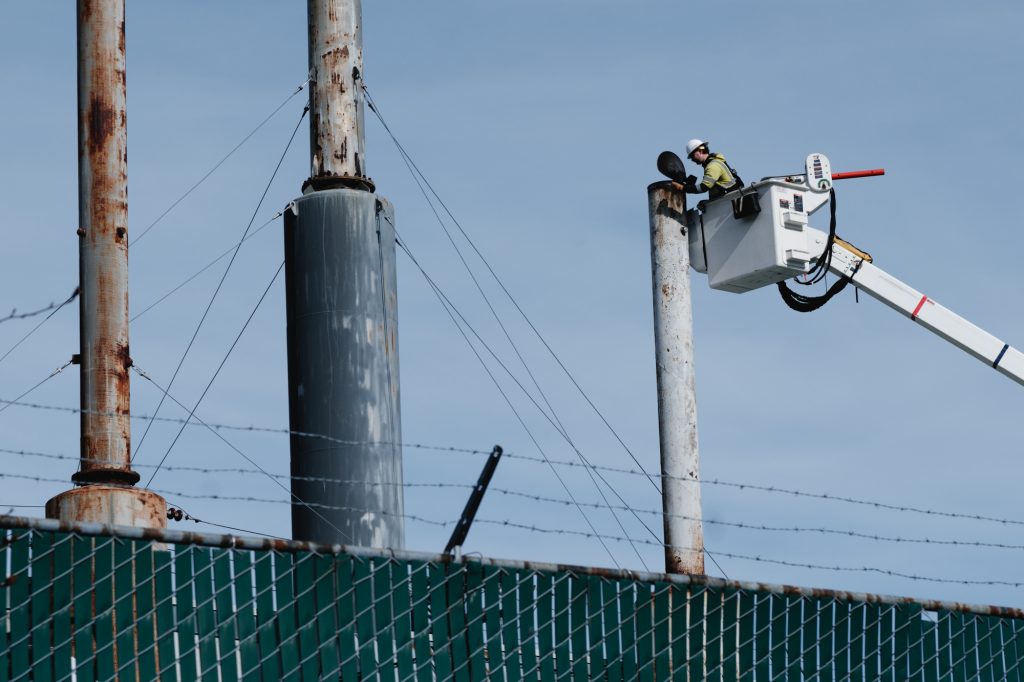
An Alaska Power & Telephone worker inspects an exhaust stack after an explosion on March 27, 2025, at its power plant in downtown Haines. (Will Steinfeld/Chilkat Valley News)

After a unionization effort in the Upper Lynn Canal collapsed last year, a new group of Alaska Power and Telephone employees on Prince of Wales Island has voted to unionize. 

It’s the third time in just over a decade that workers at the Southeast Alaska utility have tried to organize and join the International Brotherhood of Electrical Workers. 

Power crews in Haines and Skagway and Tok said the company has put them on notice that they may have to head to Prince of Wales and work if that crew decided to strike, said IBEW assistant business manager Jesse Young. 

The Chilkat Valley News has tried to contact company vice president of development and spokesperson Jason Custer for several days via phone, email and text. He did not respond to requests for more information about the unionization efforts and if the company intended to weigh-in publicly on what it is doing in response. 

The Prince of Wales vote comes after five linemen and one power plant operator between Haines and Skagway voted to unionize in November of 2024. They were looking for better benefits, healthcare, and training that covers Alaska-specific hazards and scenarios. Another group of four telephone combination technicians asked to join as well, and the company chose to add them as a second, separate bargaining unit in late December of that year. 

But before negotiations could begin, Young said it seemed like the company divided people and broke them down. 

Two telecommunications workers were laid off, two others in Skagway were transferred to non-union positions and another lineman left for a different job, leaving just three linemen and two telephone workers between the two communities waiting to negotiate contracts with the company. 

“That effort fizzled out and, as a union, we agreed to walk away because that’s what the majority of the potential members wanted,” he said. 

That same day, an AP&T worker on Prince of Wales called Young and asked about organizing. 

“The crew down here was keeping an eye on what was happening up north because they wanted to get in and they were hoping the [Upper Lynn Canal] crew would get a contract,” Young said. 

On Feb. 5, 2026 eight out of 10 eligible power division employees on the island voted for a labor union.  

That includes Jacob Hoppe, of Klawock, who has been with AP&T since 2004. He’s a journeyman lineman. It’s a good-paying job that, he said, started with a company that felt like a family. 

“They would have company picnics,” he said. “In one instance, we had a coworker whose father had a heart attack and he had to go down south. His water froze up. The vice-president of the company …  sent a couple of guys over to his house to get it fixed. In my mind, right, wrong, or in-between, that told me that the company I was working for would take care of me.”  

But over time, Hoppe said, the company has taken away benefits and flexible scheduling that were good for employee morale and saving customers money. He said the company also changed its sick and vacation time policy and cut the amount of time newer workers were accruing. 

This isn’t the first time Prince of Wales AP&T workers have tried to unionize. In 2013, a group organized and Hoppe said the company fought back. 

“They brought up a bunch of union-buster speakers. We had both power and telephone [staff] who had to sit in on these mandatory speeches and they’d go two to three hours,” he said.  “You had to listen to this gentleman speak about how bad the unions were.” 

At the time, Hoppe said the potential union members and AP&T argued over who should be allowed to vote. Hoppe remembers that the company took the stance of saying that its superintendents should be eligible to vote. 

“They were vocal about not wanting to unionize so the company pushed for them to vote,” Hoppe said. 

Eventually, 20 people were classified as eligible to vote and in 2013, just five of them voted to join the union according to National Labor Relations Board records. 

Now, the company has reversed course and is contesting the vote of two superintendents during the 2026 election, arguing that because they’re supervisors they should not be part of the bargaining unit. 

“This time around, we have a superintendent who … has been vocal about his pro-union position. Now the company’s stance is that they don’t want superintendent votes to count,” Hoppe said. 

After the vote was taken, the company changed the job class of two of the newly-unionized Prince of Wales workers. 

“They were offered a substantial pay cut or termination,” Young said. “They’re claiming those positions don’t exist anywhere else. But they are basically doing the same job they did before but with a pay cut.” 

But AP&T did that without consulting with the union first and when the union staff reached out to note that any changes should have been done at the bargaining table, he said they were told “we have the right to do whatever we want with our workforce.” 

He said it’s very similar to what happened in the Upper Lynn Canal. 

“A lot of companies do it because it drags things out and busts morale,” Young said. “It’s a common corporate playbook move, and the reality is the system often gives employers more leverage than workers. 

The two workers chose to accept substantially lower pay and the union has filed an unfair labor practice complaint, but Young said the financial penalties to the company are minimal and it could take the National Labor Relations Board a substantial amount of time to take up the complaint and make a ruling. 

“It could be a year before they get a decision,” he said. “Then these guys are out $20-$40k a year. That’s a substantial amount of money.”

On Prince of Wales, Hoppe said he understands why the company would fight a unionization effort. 

“It’s taking control from them. They have all the control right now and they can do these things,” Hoppe said. “They can take somebody who, yesterday their job was important and needed, and reclassify them and say we’re dissolving that position but you can go over here. That person asks ‘do I have to perform my same duties’ and the answer is ‘yeah, but for less money.’ To me, that’s not ok.”   

Former Upper Lynn Canal AP&T lineman Jordan Frost said he is also not surprised to see the company fighting a union. Frost was part of the Upper Lynn Canal organizing effort. He said in Haines and Skagway, workers were elated when the vote was successful. 

“We were excited for the changes,” he said. “We were going to get a voice. The company was going to have to sit down with us and discuss wages, training and safety.” 

But then when two of his coworkers were let go in the middle of winter, with no similar job prospects in Haines or Skagway, Frost said, morale hit an all-time low. 

“I felt responsible for that. I was the one pushing it, telling these guys we’d be fine and the company can’t do anything and it turns out they can,” he said. 

Frost quit his job and moved to Oregon, but has been following the Prince of Wales unionization effort. 

The post-vote job reclassifications and pay cut are familiar, almost a company playbook to avoid having to negotiate with a union, he said. 

“I’m not surprised. But it’s sad to see that they do this to these people. Without the guys they’re doing this to, they don’t really have a company to run,” he said. 

Frost said from his perspective, what workers need in both the Upper Lynn Canal and on Prince of Wales is community support and for people in the communities to push the company to go to the bargaining table. 

“I felt like it was more hush, hush in the canal. There were a lot of mixed reviews in the community,” he said. “And as soon as two guys ended up without jobs in the winter, I don’t think they were nearly as interested in seeing what could happen to the other workers. It’s a scary thing.” 

Hoppe said he’s not sure how supportive the communities on Prince of Wales would be to the idea of a union. But they are supportive of the workers themselves. 

“Our response time for outages here has been, in my opinion, incredibly fast. In the past during big storms or wrecks, people have come out and brought us coffee and have taken care of us,” he said. “I would expect to see the same thing during this time. Some people might look at unions in a negative light. But we wouldn’t have gone this route if the management or administration hadn’t pushed us in this direction. I feel like they painted us into a corner.” 

There are some signs of community support for what the workers are trying to do. On Tuesday, the company posted on social media about its newest hire, Laura Desmond. She’s the new vice president and chief employee services officer. She’s to help emphasize a “holistic, employee-centered experience” and create an environment where employees “feel supported, heard, and empowered to do their best work.” 

The first, and only, comment is from a woman who said she hopes Desmond helps AP&T realize they need to put their employees first and start by working with the union. 

Desmond also did not immediately respond to a reporter’s phone inquiry.

In the Upper Lynn Canal, Young said, workers in a job class which voted to join a unionize in 2024 could still be included in this latest effort. 

“They could be worked into this organizing drive on Prince of Wales. Same with Tok as well,” he said. “If these guys wanted to join IBEW and be part of one large group, there are ways to do that.” 

Rashah McChesney is a multimedia journalist and editor who has reported and edited newsrooms from the Deep South to the Midwest to Alaska. For the past decade, she has worked in collaborative news as the...