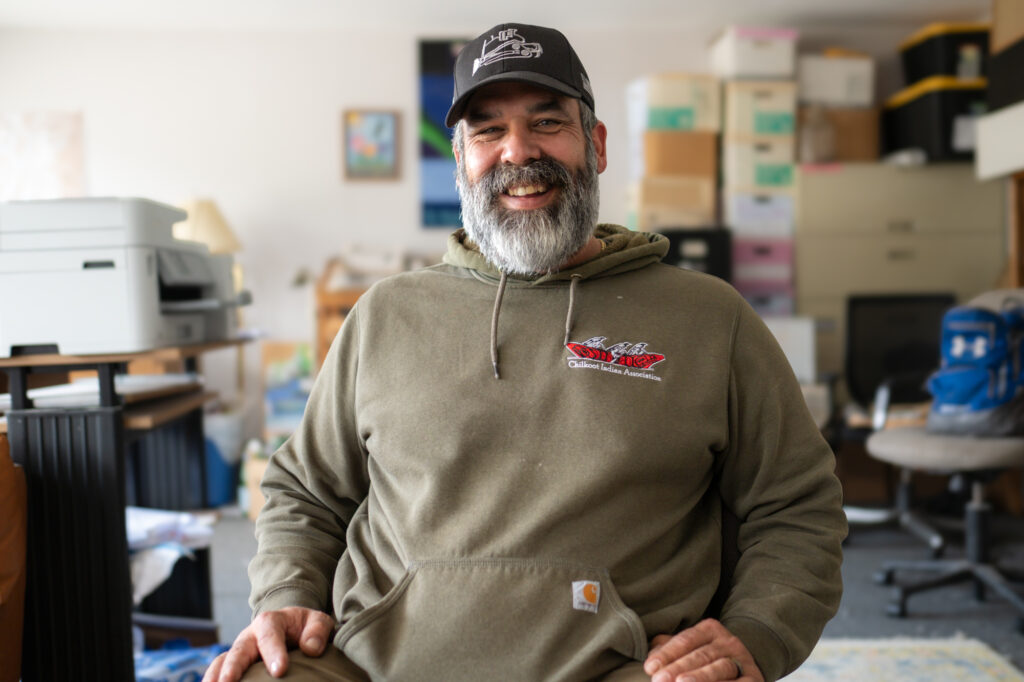
Assembly candidate Gabe Thomas in the Chilkat Valley News office, Sept. 11, 2025. (Will Steinfeld/Chilkat Valley News)

Gabe Thomas, whose six years in office currently make him the longest serving borough assembly member, is running this year for another three-year term. His motivation is unfinished business.

Thomas recalls first running in 2019 with hopes of finishing the Lutak Dock rebuild. That’s obviously a big portion of the unfinished business, though not the entire list. 

“I just want to finish something,” Thomas said, pointing to aging borough facilities and a slow-moving process for replacing the borough public safety building. 

Moving those projects forward looks to be a tall task — one that many candidates this year have highlighted as a priority. 

As for how it actually gets done, Thomas had a number of suggestions, but also a message of realistic expectations. 

That’s the case on the dock project, where Thomas credited Kevin Forster for an idea he brought up at a recent meeting. 

“Kevin nailed it, being open and forthright with the (Chilkat Valley’s) tribal governments right away,” Thomas said. 

If reelected, he would push for scheduled regular meetings with the Chilkoot Indian Association and Chilkat Indian Village regarding the project — though he cautioned it’s an idea he’s already pushed for in the past, with mixed success.  

“I do feel like we can be better about it, I just don’t know how,” Thomas said. “We need to have a set schedule with them that they agree to.” 

But in general, part of what Thomas said he’s learned during his time in office is how difficult it is to find broad solutions. “When I first got into office, I had all these grandiose ideas about how I was going to change the world, and then I got to the assembly and started going to meetings, and then it all stops.”

Deliberation and public process slows things down, he said. 

In the absence of obvious fixes, Thomas is pitching voters on his experience and know-how. 

“I know the systems, I know how things work,” Thomas said, pointing to his experience with the mechanics of borough taxation and spending. It’s something he’s picked up over the years, and could be a steep learning curve for a less experienced assembly member, Thomas argued. 

“There’s no learning on the job. The work piles up quick.” 

Thomas hopes that knowledge will pay off when it comes to immediate challenges, including another looming budget shortfall in the next fiscal year. This past year, the assembly was only able to find small cuts on borough equipment purchases. Thomas called that “low hanging fruit,” which he doesn’t expect to be there again this year.

“We’re going to have to cut at some point and it’s not going to be fun,” Thomas said. “But there are essential services — you can’t cut the police, can’t cut the fire department, can’t cut school stuff.” 

Thomas was less sure about a process for figuring out what to cut and what to prioritize if elected to another season of budget building. 

His suggestion was to make use of executive sessions — exceptions to the state open meetings act that in very specific instances allow the assembly to deliberate in private. 

“People hate the word executive session,” Thomas said. “But it sometimes lets (assembly members) speak more freely.” 

“Some people don’t want to make their friends mad,” Thomas said about other assembly members. But part of his pitch was that he was different — partly because of his experience.

“I’m at that point now where it’s not about friends, it’s about the community. I vote how I vote,” he said.  

Having that freedom has allowed him to find a middle ground, Thomas said.

“I’ve made some votes that I know got the right very angry,” Thomas said. One recent example he pointed to was a vote to put a seasonal sales tax on the ballot. Even though he didn’t support the principle of tax increases, the need for more borough revenue was too significant in his mind to ignore. 

Even acknowledging that across six years his votes may have angered some, Thomas said he has few regrets. Asked if there was anything he wished he could have done differently in his most recent assembly term, Thomas pointed only to broader assembly personnel management.

Losing former police chief Heath Scott was one regret, Thomas said, though he didn’t take responsibility for Scott leaving. Losing former manager Annette Kreitzer was another. 

“Maybe we didn’t guide (Kreitzer) as much as we should have,” Thomas said. “I thought she was doing great as far as a lot of the policy stuff.”

“But at the same time, we have Alekka now, so I’m way more happy,” Thomas added. 

Since Thomas was last elected to the assembly, he was the subject of a long-term protective order served in 2023 by a Tlingit and Haida Central Council Tribal Court judge after a petition from his now ex-wife. 

The order stated that “the court finds by preponderance of evidence that the respondent committed domestic violence against the petitioner.”

Thomas said he has filed a grievance with the court regarding the decision. But otherwise, he said, he has put it behind him. 

“I don’t have much to say to other people about it. I try not to bring it up. It’s in the past, I can’t change it, so why dwell on it,” he said. 

Thomas said those events have made him “a little more closed in.” He’s also tried to draw stronger boundaries between public and private life. For instance, he avoids talking to constituents about controversial issues while out with his family.

But still, he said, he remains open to the full spectrum of the community.

“I’m not shy,” Thomas said. “I’m not like some people who boycott Mountain Market or boycott the Fogcutter. I’m open to anybody that wants to talk to me.”

Will Steinfeld is a documentary photographer and reporter in Southeast Alaska, formerly in New England.