

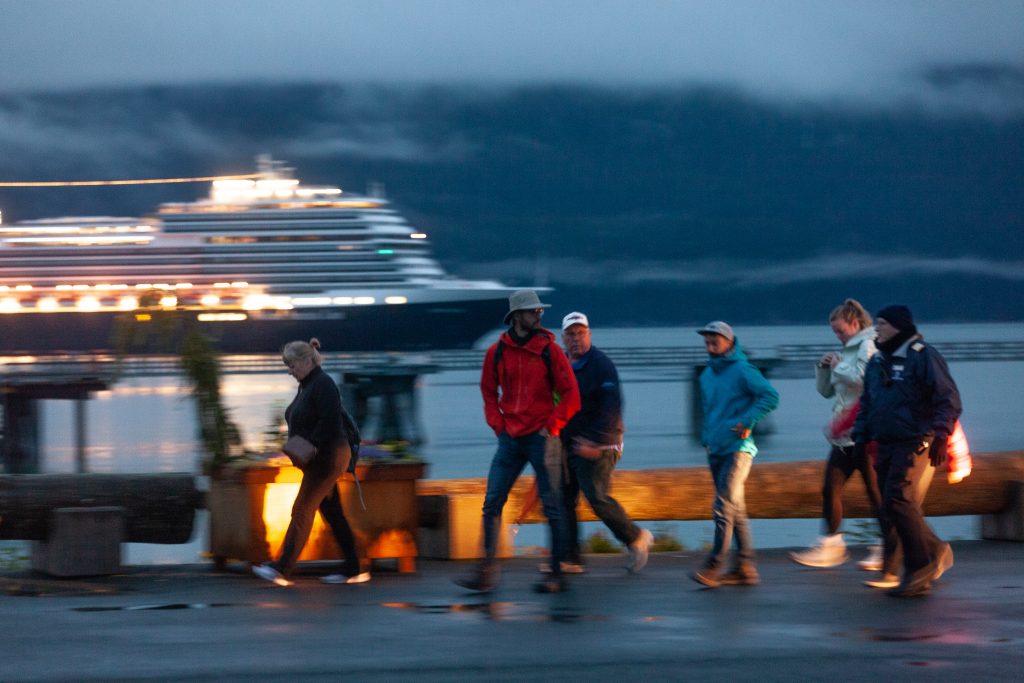
An active cruise-dock management bid in Haines is just one Alaska venture for now-familiar Global Ports Holding. The company’s other regional business could give it the means, and incentive, some say, to bring more passengers to Haines.
Through the last year, as Global Ports has been in talks with the Haines Borough, the company has been sponsoring a study on a new cruise port in Bellingham, Washington.
The company inked a written agreement last fall with the Port of Bellingham to “explore the feasibility” of running cruise ships out of the Bellingham Cruise Terminal.

Right now, the Bellingham facility, despite its name, isn’t really used for cruise ships. Rather, it’s best known as the southern terminus of the Alaska Marine Highway System. Outside of that, there’s a trio of small, local passenger operations at the terminal, but nothing approaching the week-plus cruises that operate in Southeast Alaska.
The written agreement for the feasibility study pitches a market opportunity: using the Bellingham Cruise Terminal as a “homeport” for such Alaska-bound cruises — a turnaround point for ships that might otherwise homeport in Seattle or Vancouver.
In a social media post from last year, Port of Bellingham business development manager Matthew Cress wrote that Global Ports would “begin the engineering review and business development process to determine the market interest for cruises bound for Alaska,” and that “the Port of Bellingham is interested in homeporting.”
Cress and other Port of Bellingham officials did not respond to further questions in the last two weeks.
The study is expected to be completed at some point between now and the end of the year. If it shows promise, the company would still have to work out a separate management deal. The agreement wouldn’t necessarily grant a deal to Global Ports, but the company would receive a “period of exclusivity.”
If Global Ports does end up with management in Bellingham, it would give the company a new port in the Alaska cruise market. And, potentially, bring the company closer to controlling a new itinerary’s worth of regional ports.
As it stands now, cruise ships in Alaska generally follow a roughly similar itinerary, save for a number of small, specialty ships with different requirements.
Three ports and a glacier is how Chilkat Valley tourism pioneer and Chilkat Guides founder Bart Henderson describes the basic recipe.
Most sail through the ports of Ketchikan, Juneau, and Skagway. Those ports see by far the highest volume of passengers each year. All of them handled between 1.3 million and 1.8 million total passengers in 2025, according to a study by the McKinley Research Group. For comparison, the next largest cruise port by volume was Sitka, at 582,800 passengers.
South of the big ports, ships generally stop off in at least one British Columbia port due to federal regulations on foreign-flagged ships. Then, passengers disembark at homeports in Vancouver or Seattle.
But right now, there’s significant demand from cruise lines for that itinerary, and only so much of it to go around.
It’s a sharp contrast to lower demand markets. In Gulf cities of Houston and Mobile, municipalities fronted tens of millions of dollars of public debt for new dock infrastructure in the hopes of enticing new cruise traffic. Later, they were left saddled with that debt, with little new traffic to show for it, wrote one cruise ship infrastructure expert, Dr. Wendy London, in a highly-cited 2014 paper. London is a researcher at the University of Otago, Dunedin, New Zealand.
In contrast, Alaska ports haven’t had to put up public money in recent years for new infrastructure. Rather, cruise lines themselves have poured in funding, like Norwegian Cruise Lines, which bought a $20 million Juneau downtown waterfront property in 2019 and then donated it to Huna Totem Corporation in 2022. Huna Totem Corporation is now building a cruise facility at the site.
What the cruise lines purchase with those kinds of investments is guaranteed berth space and preferential access to port services — a way around over-demand and corresponding berth scarcity, London said in an interview last month.
Regional experts have had similar assessments. “Overall there’s a very limited amount of berthing capacity in Southeast,” said former Holland America senior vice president Joseph Slattery in June. “For a new entry, a cruise line adding capacity, you can’t just come up with an ideal itinerary and expect to be able to operate that.”
Notably for Global Ports’ Bellingham venture, one of the chokepoints may be in homeports. Seattle and Vancouver’s cruise infrastructure is just about at capacity, former Skagway mayor Andrew Cremata said this spring. Cremata has been contracted this year as an advisor by Global Ports Holding.
With additional homeport capacity in Bellingham, new ships could theoretically enter the market. But still, they’d need room further north — the rest of those three ports and glaciers — to sail to. That’s where Haines could come in.
Global Ports, which calls itself the largest cruise port manager in the world, has for years tried to enter the Alaska cruise market, most recently in Haines.
The port infrastructure the company owns and manages has largely been centered in Europe, Asia, and more recently in the Caribbean. But in the last decade, the company has bid on at least two major Alaska operations. In 2020, the company was in the mix for management of a dock in Ketchikan, the state’s second largest cruise port. And two years before that, they made an offer for ownership of the White Pass railroad and dock in Skagway — a major revenue generator and port infrastructure owner in the state’s third largest cruise port.
In Ketchikan and Skagway, the company was vying for a stake in two key columns holding up the standard Alaska cruise itinerary.
Neither of the company’s bids panned out. Ketchikan’s city council opted to maintain public management of its dock, and in Skagway, a joint venture between Carnival Cruise Line and Survey Point Holdings — which also bid on Ketchikan’s dock — won ownership of White Pass.
But the company’s more recent attempts seem to be making more headway. And the more recent attempts have come outside the main cruise ports in the region.
The company first officially entered the Alaska market with a management deal in Prince Rupert, British Columbia.
“Prince Rupert Cruise Port (PRCP) marks another first for us, as GPH enters a new region of Alaska in North America,” wrote Mike Maura Jr., the company’s then-regional director, in a 2022 press release.
The Canadian cruise stop sits roughly 80 miles south of Ketchikan, which places it between the southern end of Alaska’s Inside Passage and the larger ports of Vancouver and Seattle.
That’s a position made valuable by a federal law called the Passenger Vessel Services Act. The law bars foreign flagged ships from transporting passengers directly between United States ports. That’s significant, given that most medium and large cruise ships sailing in Alaska are registered outside the United States.
To circumvent the restriction, foreign-flagged cruise ships must make at least one port call at a Canadian port during any given itinerary. For instance, if you sail on the Queen Elizabeth to Haines, you’ll stop in Victoria, British Columbia, before docking back in Seattle. Other ships depart from Vancouver, for the same reason.
In Prince Rupert, Global Ports now manages one of those key foreign stops that the bulk of the fleet must stop at.
Now, in Haines, the company also proposes an expansion. If it wins management of the municipal dock, company representatives have floated plans to increase passenger volume up to five-fold.
Between Haines, Prince Rupert, and Bellingham, the company’s management would stand to increase available berth space and passenger volume outside the Alaska market’s traditional itinerary: stops in Juneau, Ketchikan, Skagway, Vancouver, Seattle, and Victoria.
“In big ports you can’t break in and get 20 straight weeks of a Tuesday berth. Ports like Haines are trying to break in and offer an alternative — Prince Rupert is another one in that category,” Slattery said in the interview this spring. “It’s an avenue for a new entry to construct a quality itinerary.”
Reached last week, Global Ports regional head of business development said he would not comment in detail due to the ongoing bidding process in Haines. But he said the Bellingham study and the Haines bid “are not necessarily viewed as connected, other than in the general sense that they are in the same region.”
However, in Henderson’s eyes, control of a range of key stops could give Global Ports more tools to increase passenger count in Haines.
Ships going through traditional ports are scheduled by Cruise Line Agencies of Alaska, a subsidiary of Survey Point Holdings.
According to Henderson’s theory, Survey Point has incentive to push passenger volume towards the infrastructure it owns and profits from, including White Pass facilities in Skagway, Henderson said.
Global Ports, with enough infrastructure to do its own scheduling, and infrastructure to profit from in Haines, would have reason and means to bring traffic to the community, he argued.
Said Henderson, “it’s nothing against (Cruise Line Agencies). They’ve had a long time now to fill this port if they really wanted. But there’s no incentive for them to work for Haines.”
Global Ports has also been somewhat reticent to say exactly whether it plans to schedule ships through Cruise Line Agencies of Alaska should it win management in Haines.
This month may offer answers. Proposals for Haines’ cruise port dock management are due to the borough on Sept. 14. One of the borough’s requirements for those proposals: how respondents plan to schedule ships.