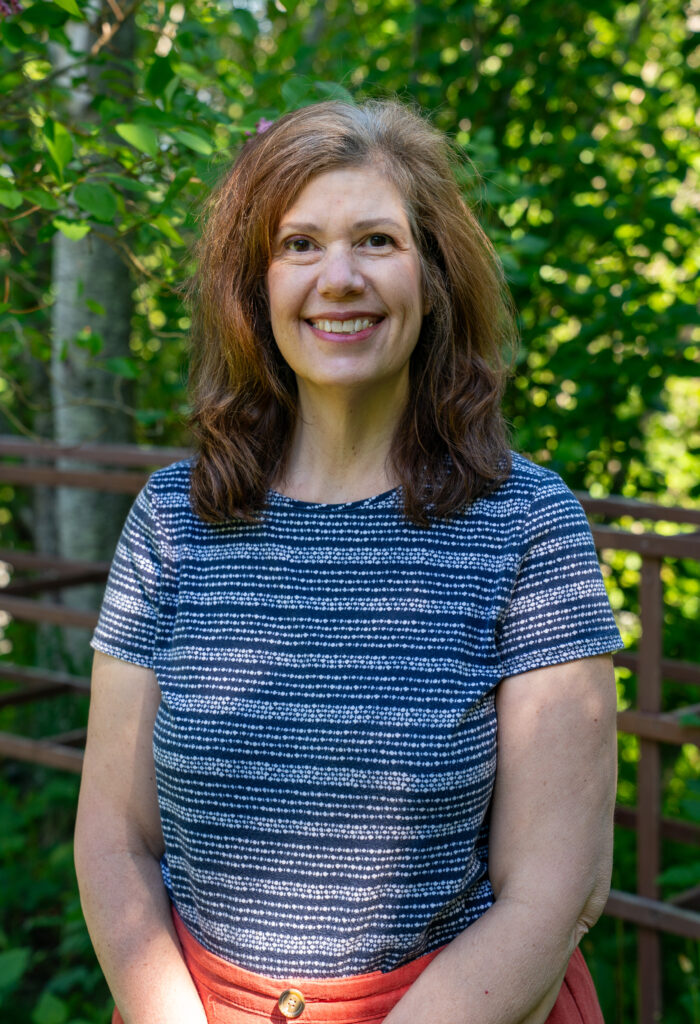
Lisa Andriesen, Haines middle school language arts and social studies teacher, retired in May after being a teacher in Haines for 35 years, seen on June 19, 2026 in Haines, Alaska. (Lizzy Hahn/ Chilkat Valley News)

As teachers closed down their classrooms in preparation for next year, some longtime teachers like Lisa Andriesen packed up their rooms for good. 

Andriesen’s route to the Chilkat Valley started with a grandmother who always talked about wanting to come to Alaska. That motivated Andriesen to attend a job fair in Anchorage where she met the Haines Borough School District superintendent at the time, who later reached out and encouraged her to apply. 

Andriesen said she didn’t know where Haines was when she applied to be a middle school teacher, but she still got the job and took the ferry up to Haines 35 years ago, fresh out of the University of Michigan in Ann Arbor with her teaching certificates in hand.  She was 21 years old. She said she figured she could do anything for one to two years. 

Thirty-five years later, most if not all, Haines middle school students had Andriesen as their language arts and social studies teacher.

Andriesen was not only a middle school teacher, but also the homeschool correspondence coordinator for almost 15 years. Andriesen said there were two language arts and social studies teachers in the middle school when she first started. Now, with fewer students, there is only one. 

She said one of the reasons she stuck with the job for so long is that the staff she worked with were driven and motivated. 

“So many people that they [school district] hired have been so dedicated, wanting to do the best for the kids, and just great, fun people to work with and teach with,” Andriesen said.

Haines Borough School District superintendent Lilly Boron said over the five years that she was the principal, the school lost a lot of core teachers.

“We’ve had about 40% turnover rate,” Boron said. Boron mentioned that because of the current state funding environment in Alaska, teachers are having to do more with less. She said Andriesen is one of the core teachers in the middle school and for the homeschool program that the school depends on for their institutional knowledge. 

She also blamed, and thanked, Andriesen for pushing her into leadership positions. Boron said Andriesen recommended that Boron attend a principal program, which ultimately led to her stepping into an administrative role in the district. Not only was Boron a colleague of Andriesen’s, but her twin daughters were also students of Andriesen.

Looking to the future, Andriesen said she thinks artificial intelligence will drive a big change for education. 

“We’re just starting to learn how to deal with it, what to incorporate, what to ask from the kids.” Andriesen said.. She encouraged her students to use the Quizlet AI tools, which allowe concepts to be explained in new ways and give new examples. 

But, she said, it’s an adjustment for teachers. She gave the example of teaching students for three years in middle school, so she becomes familiar with their writing styles. 

A few of her students have tried to use AI for their writing but she could tell it wasn’t their style of writing. Andriesen anticipates that this may become more common.

As the coordinator for the homeschool program, Andriesen oversaw the curriculum, checking work samples and plans that parents would send in. Andriesen said that there are currently around 25 students enrolled in the Haines Borough’s homeschool program, which spans K-12. During the COVID-19 pandemic, the program had 80 students enrolled.

Andriesen said that a challenge in education is the never-ending new techniques. It’s a balancing act of knowing what works for the students and incorporating new methods. Andriesen said she changed a lot in her teaching over 35 years.

Other challenges arose with new administrators who were not familiar with Haines and trying to acclimatize them as well as maintaining programs through reduced staffing. Andriesen said that with staff reductions, teachers took on more responsibilities and got more creative with their schedules to be able to fit in the additional programming.

“I’ve really been proud that we’ve been able to keep our art, music, P.E., … industrial arts and everything.” Andriesen mentioned that it would be easier to move to a smaller schedule, but then the students wouldn’t have access to the vast amount of programs.

“We want them to get everything that they can have,” Andriesen said.

As the social studies and language arts teacher, Andriesen said she would find ways to connect history, civics, novels and readings with public speaking and research. She especially enjoyed working on hands-on projects and simulations to simulate various real-world situations.

Jeanine Ward was a student of Andriesen’s around 21 years ago. She said she still remembers a stock market activity that students participated in. Ward said they learned how to trade stocks and all created something that had never been created before. She created edible glue to put cakes back together. Students recreated the rise of the stock market and eventually saw its fall – something the students never saw coming, according to Andriesen.

Andriesen worked with grades six through eight for two hours a day.

“You get to know them [students] pretty well,” Andriesen said. Sixth graders have a lot of energy and are easier to cause to laugh compared to the more serious eighth graders, who would finish her sentences. Andriesen said that a middle schooler’s mind changes more than a two-year-old’s mind. “Middle schoolers are fun. You never know what to say, they’re super funny.”

The middle schoolers, she said, kept her on her toes. “They’re so silly and goofy… they don’t really care. That’s like their personality, that’s the fun part.”

Although she was teaching in the same position for 35 years, Andriesen said that every year felt different. While she was teaching similar things, the students are what made each year unique, with each class having their own group personality. A few of her students this year were the children of students Andriesen had during her first two years teaching.

When the elementary and middle school moved to join the high school building, Andriesen picked her classroom when it was still cement. She has been the only teacher in that room since it was built. Over the past school year, Andriesen was able to “slowly kind of say goodbye to things.”

Now that she has retired, Andriesen said that she is looking forward to not having to pack a lunch anymore. She will be traveling to go see the location of the Battle of Verdun in France. After teaching about World War I for years, Andriesen said that while it is a sad site, she is looking forward to being part of and near to  something that she has taught for so long.

Replacing Andriesen to teach middle school social studies and language arts is Shannon Jeter. Jeter is moving to Haines from Maryland and has experience teaching middle school. Jeter will be one of the two new middle school teachers, in addition to the science teacher. There are still three positions waiting to be filled: two special education instructors and a kindergarten teacher.

“Ultimately, the students that pass through her classroom door were stronger and better for her instruction,” Boron said.

Lizzy Hahn is a reporter and photographer from Nome. She has worked in newsrooms across Alaska including the Anchorage Daily News, Nome Nugget and UAF Sun Star.
