
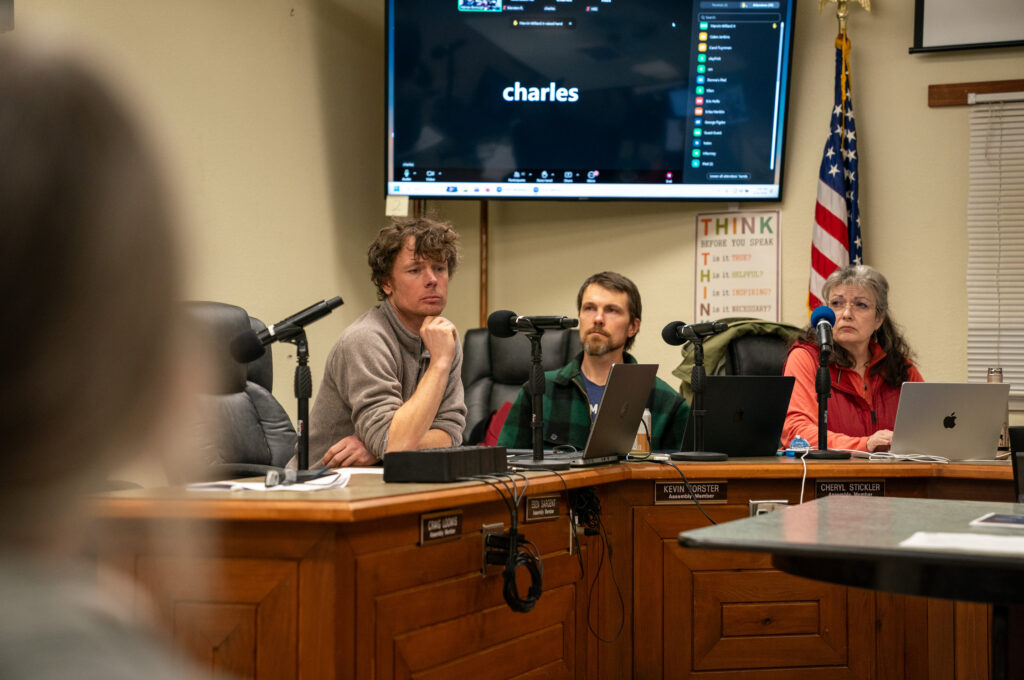
Three weeks ago, the Haines Borough Assembly, in a vote momentous enough to draw applause from the audience in the room, chose a new design for the Lutak Dock project.
But now, one borough advisor is contradicting key information that informed the design selection — information that came from another borough contractor — leading some assembly members to say they’re considering revisiting their vote.
The dueling advice surrounds permitting for the dock, a potentially time-consuming step in a process short on time.
Impending deadlines have high stakes: The borough must sign a grant agreement with the federal government by Sept. 30, 2027. If it misses the deadline, $20 million of funding will likely disappear, borough officials have said.
That grant agreement cannot be signed until major permitting is complete, making permitting a key lynchpin in the effort to successfully rebuild the municipal dock.
So when the borough’s advisors with engineering firm Moffatt & Nichol saidthat one specific dock design, an encapsulated design, would be the easiest to permit, it was an attractive proposition.
But in a May 11 meeting, two weeks after the design vote, a different borough consultant — one specializing in the permitting process — said the opposite: that the encapsulated design may in fact require fresh starts on a whole host of major permits.
That’s a major cause for alarm for some decision makers.
“All along we’ve said listen to the experts, but right now the experts are saying drastically different things,” assembly member Kevin Forster said earlier this week.
The new information contradicts advice the assembly has been receiving for months from borough staff and Moffatt & Nichol engineers.
The encapsulated design, frequently referred to as option one, shares construction techniques with a previous dock design that was scrapped last year, but only after much of the permitting was already completed.
Borough manager Alekka Fullerton has said over the last year she believed because of the shared construction techniques, a smaller encapsulated design might be able to retain some of the previously completed or advanced permits.
Moffatt & Nichol engineers have repeatedly supported that idea.
During an April Ports and Harbors Advisory Committee meeting, Moffatt & Nichol’s Paul Wallis characterized the encapsulation option as “far ahead” of the other two designs in terms of risk exposure, largely due to easier permitting, he said.
“My specific question to Moffatt & Nichol at one point was, is it correct that we have a lot of the permitting already in place for option one,” said assembly member Cheryl Stickler on Monday. “And they said, ‘Yes, that’s correct…’ When I was really in favor of option one, it was largely because of the cost-saving measures of that pre-existing permitting.”
But last week, a second borough contractor delivered the opposite opinion during borough staff’s weekly Lutak Dock meeting.
Robin Reich, of Solstice Consulting, said much of the existing permitting might have to be redone for the encapsulated option. Reich has history with the project, having worked on permitting for the previous, now-scrapped dock design as well.
Under the general umbrella of permitting, the project must get a whole slew of different approvals from different agencies, both state and federal. Major permits discussed by Reich include the environmental assessment from the federal granting agency, MARAD; an Army Corps of Engineers permit; permitting under the federal Endangered Species Act; and a Section 106 National Historic Preservation Act Review.
According to Reich, the Army Corps permitting was nearly complete and “going to be issued” for the previous dock design pending approval of permitting from other agencies. Now it “will need to be restarted for option one,” she wrote in a memo to the borough this month.
Reich’s memo listed three other permits that had been completed but will now need to be fully restarted, including Endangered Species Act permitting. According to Reich, that could be a major obstacle.
Reich said the endangered species permitting would take nine months. If true, that would move the borough close to its grant-agreement deadline, now 16 months away. To even start the nine-month permitting process, Reich said she needs engineering details that don’t yet exist.
“The information we need to start the (Endangered Species Act permitting) is how many piles you’re driving, how you’re going to be driving them, how much fill you’re placing, how much you’re going to be excavating, how you’re going to be doing it.”
“The nine months, we might be able to get it to eight, but we’re not going to be able to get it to less than that… it’s just the way it works,” Reich said.
As of three weeks ago, the engineering company had not yet included those details in their design concept. And at last Monday’s meeting, Fullerton said the borough “doesn’t know right now if there will be dredging or not. We’re not at that stage yet.”
Other option may have held permitting advantages
Another major permitting step that will likely have to be restarted, Reich said, is MARAD’s environmental assessment, often referred to as an “EA.”
“In our opinion, and I think the agencies will agree, this new option one is different enough from the previous proposed action that we will need to restart those permitting and consultation actions,” Reich told borough staff.
In fact, it was a different option, a proposal for a transfer bridge to load cargo over a rock-pile dock face, that could’ve retained progress on the previous EA, Reich said.
According to Reich, that’s because the transfer bridge — also known as a transfer span — was one of three alternatives that had been included in the prior environmental assessment.
“If we would’ve selected one of those three alternatives, I think MARAD would’ve said, okay, do a little extra work here on the Endangered Species Act, but you’re good, you probably could’ve turned this around a little quicker,” Reich said. “But we didn’t.”
A version of that transfer bridge design was in front of the assembly for their recent design choice.
But Fullerton said this week that version was different enough from the version in the EA that Reich’s comments about it potentially preserving progress for the EA wouldn’t have applied.
Confusingly, both the new transfer and the EA’s transfer span were known as “option three,” and both were transfer spans over rip-rap dock face.
Harbormaster Henry Pollan said the more recent option three was “derived from” the old option three.
Fullerton seemed to disagree with Reich’s overall assessment as well. She said Tuesday she believes “the EA is still going to be easier with option one,” though she said she wasn’t certain.
She also said she was more focused on the Section 106 process than other permitting processes, and said MARAD officials told her during her visit to Washington D.C. this spring they “consider the (Section 106) to be done,” though she said it hadn’t yet been confirmed by the agency’s lawyers.
Assembly unsure of path forward
Assembly members said that as of this week, they haven’t received any new information to evaluate who might be right and who might be wrong, given disagreement between the advisors and staff.
Stickler, after supporting encapsulation for permitting reasons, said she planned to wait for a clarification from Moffatt & Nichol before reevaluating her decision on design selection.
“I would need to hear a response from Moffatt & Nichol because they are the owner representatives,” she said Monday. “As our owner representative, I expect them to be able to come back with a more solid answer for us.”
Forster, who was a key vote in favor of encapsulation three weeks ago, also said he was waiting for clarifying information. But he said he “wouldn’t take off the table” the possibility of trying to reconsider the assembly vote and move to a different design if the encapsulated dock’s permitting woes turned out to be true.
“I have not once had this ‘riding for the brand’ attitude toward having a specific dock design,” Forster said Tuesday. “I just want a dock for the community that fits in the budget and gets built.”
Given the new permitting confusion, Forster said that if he was asked today, he would advocate for a different design — the so-called “third option” transfer span over rip-rap.
But Forster also said he was aiming for consensus from the assembly and hoped to avoid a “split vote” on possibly reconsidering the design choice.
Meanwhile, assembly member Eben Sargent is clear he wants to change designs. He was one of two who didn’t vote for encapsulation in the first place.
Sargent called it “super alarming” to hear Reich’s assessment of the permitting situation. “(Reich’s opinion) is in fact the opposite of how Mr. Wallis characterized her comments in advance (of the design vote)… I don’t see how we can make and stand by a decision made with such little information,” he said at last week’s assembly meeting.
“This Moffat & Nichol process, I think they’re excellent technical designers, but they’ve shown a number of specific ways they’re not able to manage the grant administration and project administration tasks here.”
In an interview Wednesday, Fullerton expressed frustration with Sargent’s comments about the process.
“Eben didn’t go to (Alaska Municipal League) and that’s what you learn there,” she said. “Once the assembly makes a decision, you get on board with that decision. You’re one of a group.”
Doing otherwise, she said, “foments distrust in the community.”
Sargent, for his part, sees his comments as part of an assembly oversight role. And, he maintains, the assembly should’ve been given more information before their vote — a view he expressed at the time.
“How much dock face will there be? Will there be a catwalk? What’s the project schedule?” he said Wednesday. “The answers to those questions might inform a different choice. Until we’ve answered some of these fundamental questions, I’m not giving up my ability to request information and suggest different directions.”
