
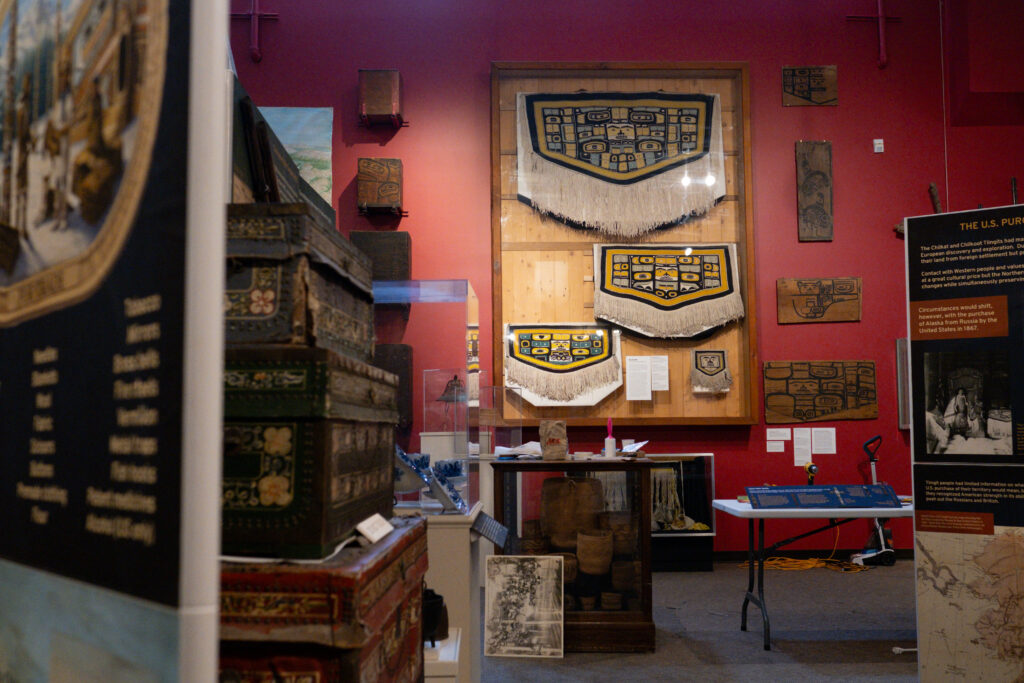
The main gallery of the Sheldon Museum has gotten its first overhaul in nearly a decade, and the new look debuts Friday.
Residents accustomed to the previous gallery exhibit will find a re-arranged space with a higher density of information and objects. Some large centerpieces remain, including a display case of Chilkat blankets and Eldred Rock lighthouse’s Fresnel lens. But most of the exhibit has not been on display, including a new collection on loan from Excursion Inlet’s cannery museum.
As for the space itself, the previously open-floor look has been replaced by standing panels arranged with an eye toward a more intentional flow, museum director Brandon Wilks said.
The new exhibit is the product of a year-and-a-half’s work from lead curator Andrea Nelson and Blythe Carter.
Nelson, an on-again-off-again museum contributor over the past two decades, said her goal was to “home in on what makes this place different from other places in Southeast Alaska, other places in Lingít territory.”
Nelson focused on the physical topography of the land and the trade routes that ran up corridors into the interior.
“I felt like (the exhibit) needed some kind of grounding narrative, instead of just peppering the audience with facts about the place,” Nelson said.
From the gallery entrance, viewers first see a large canoe carved by Wayne Price. The canoe is meant to orient visitors in a historical landscape before highways, where water-based travel was often the quickest and easiest route.
From there, visitors walk out into the center of the floor, which includes panels on Lingít trade empires, with porcelain originating in China on display.
“Even people who feel like they know Chilkat Valley history might not realize the extent of Lingít trade, that they had one of the largest trade empires in the Americas,” Wilks said.
Wilks and Nelson described the museum’s limited space as a challenge in displaying the valley’s historical breadth.
“Recalling history is a really botched process, no matter how careful you are,” Nelson said. “A story can be told in so many ways from so many different perspectives.”
Part of Nelson’s approach to that problem, she said, was to let the museum’s collection lead the narrative, “letting the objects speak,” as she put it. At the same time, she added, the approach introduces other challenges. For instance, the fact that the museum’s collection is determined by what can be acquired or donated, not necessarily what has the most historical significance.
For his part, Wilks said he invites visitors to provide feedback on the history and is leaving open the possibility of adjusting the exhibit in the coming months.
Alongside older art and archaeological artifacts, the museum will display a significant amount of work from renowned contemporary carvers, like Price and Ed Kasko, as well as a new retrospective on late Chilkat Valley painter Carol Clifton.
Wilks said the museum has hosted art students in the past year to see the work, including high schoolers participating in this week’s regional Art Fest.
The Clifton exhibit, curated by Donna Catotti and on display in the museum’s Elisabeth Hakkinen gallery, shows a range of Clifton’s local landscapes and portrait work. Starting Friday, the paintings will be up for silent auction, with 60% of proceeds going to the Clifton family and 40% going to the Haines Sheldon Museum.
