
Severance tax fails
A flurry of final votes on major legislation, all coinciding at Tuesday’s meeting, came at somewhat of an inconvenient time. As has become familiar in recent weeks, the assembly requires four votes — a majority of the full body — to pass legislation. That remains the case even with assembly members missing, which was the case Tuesday.
Absences from assembly members Cheryl Stickler and Kevin Forster left only four assembly members present, meaning a unanimous vote was the only way to pass any legislation. Functionally, that meant each assembly member had a veto, with any no vote able to derail any motion to pass, amend, or even postpone legislation.
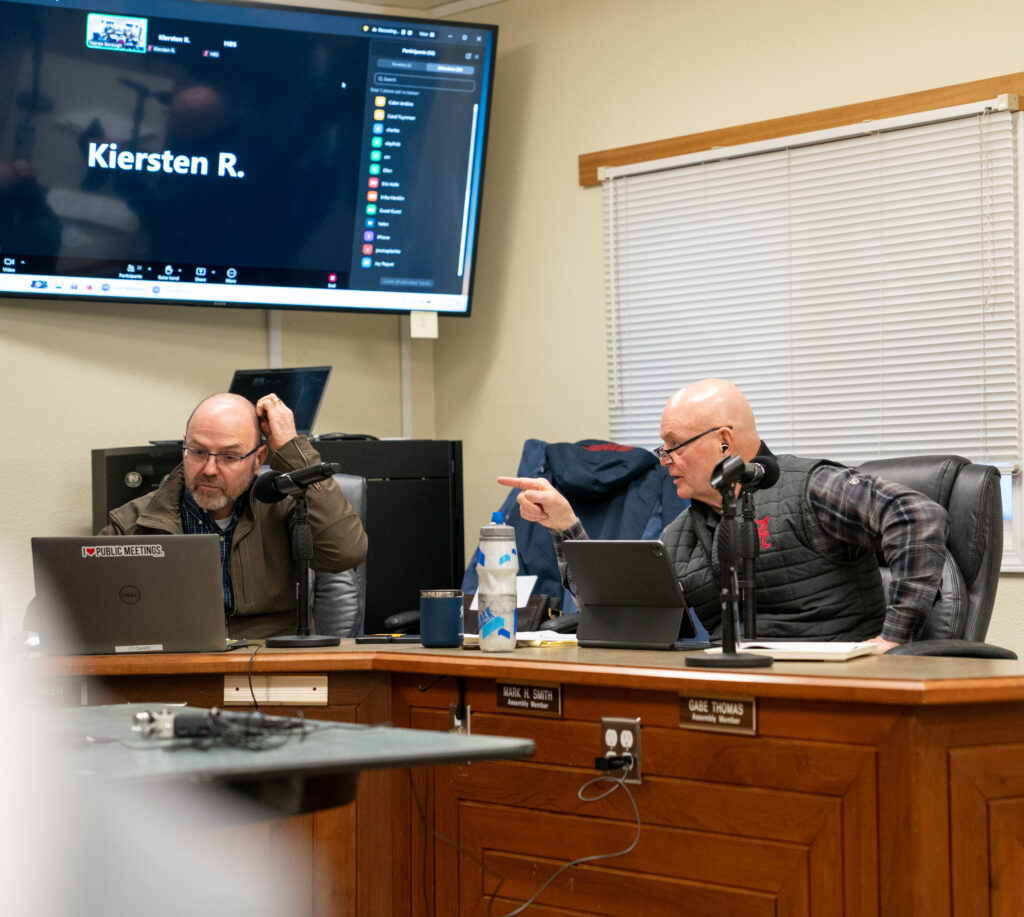
A severance tax was the first to fall, losing out in a 2-2 vote.
The proposal has been to tax the value of raw materials extracted in the borough but exported and sold outside — specifically mineral ore, timber, gravel, sand and coal. Exports up to $5,000 in value would have been exempted from the tax.
The idea has long been on the table, failing in front of multiple recent assemblies. Former assembly member Debra Schnabel spoke in favor of the tax during public comment, saying that she saw “no embarrassment in charging for a commodity we have that people need.”
“I’m disturbed by the idea that this tax is something that is going to hurt business,” she added. “The consumer is the one that pays the severance tax we’re talking about right now. We have a commodity people want, and it’s important to take advantage of that, especially in our time of need.”
Prior to the meeting, assembly member Mark Smith had submitted a list of objections to the proposal, namely that rates were set too high, the tax would not be legally defensible, and the borough would be better served with alternatives like a negotiated payment-in-lieu-of-tax, or PILT.
The legislation had been “vetted” by the borough’s attorney, borough staff said.
During the meeting, Smith proposed sending the severance tax proposal back to committee, but assembly member Eben Sargent objected, citing the months it had already spent in committee.
Smith then moved to take a final vote, which failed with him and assembly member Gabe Thomas voting no.
Bulk-ore containerization postponed
The severance tax was the lone-member of the most significant ordinances to make it to a final vote. The rest were put off, including a vote on new ore-handling regulations in the borough.
Those regulations, put forward by Thomas and Forster, would require mineral-ore containers to remain sealed within borough boundaries, even as they are loaded onto ships. In theory, that would assuage concerns about environmental contamination, in the event of an active Chilkat Valley mine, similar to that of Skagway’s ore terminal.
But rather than make a final decision, assembly members Tuesday decided to send the proposal to committee.
Sargent, who said he supported the intent of the proposal, argued committee review would ensure the intent was reflected in the actual language of the legislation.
“We’re dealing with big industry and big money and we need to be careful we don’t create loopholes or redundancies that will cost us money later,” he said.
ADU future still controversial, still uncertain
The accessory dwelling unit proposal has changed from last year, but the conversation around it remains just about the same.
The overall idea is to allow individual homeowners to build a small rental unit on a single-family lot, which some say could help cut into Haines’ housing shortage.
Sargent, who has led the charge on the measure, described it as a way to “unlock a quiet source of development capital and land.”
In other words, individuals who wouldn’t finance large new housing-development projects might be willing to spend a smaller amount to repurpose an existing structure or build on their own property to have an extra stream of income.
Allowing accessory dwelling units, often referred to as ADUs, wouldn’t be a significant change to existing regulations, at least on its face. Residents in single-family zones are already allowed to rent out garage apartments or units attached to their homes. The new rules would allow them to rent out slightly larger units and units on the property but not attached to the primary residence.
But the impact of that, some residents say, would be large. As has been the case at all public hearings on ADUs, many spoke out Tuesday arguing the change would increase crowding in single-family neighborhoods. Many objections came from Lutak and Mud Bay residents who had been exempted from last year’s version of the ordinance.
Compared to that previous proposal, the current version adds new restrictions in an effort to address density concerns. For instance, the proposal now requires lots must be of a certain size to have an accessory dwelling unit by right, otherwise the ADU permit must go through a stringent conditional use permit process, which includes the input of neighbors. It also requires lots to have a state-approved septic-system or borough sewer connection in order to host an ADU.
But still, Thomas described it as a “sweeping zone change” that “will not work,” citing the high cost of building an extra unit.
“If this doesn’t work, no ADUs get built and no one’s losing anything,” responded mayor Tom Morphet.
In the end, the four-member assembly voted unanimously to send the current version of the proposal to the planning commission for review. The assembly will then hold a third public hearing and possibly take a final vote at their next meeting on April 28.
Smith to write check
In perhaps the quickest resolution to a non-profit funding discussion in recent assembly history, Smith said Tuesday he’ll be signing over $10,000 of his own money to the Chilkat Valley Preschool.
Chilkat Valley Preschool had come to the assembly as a whole for funding Tuesday, asking for up to $10,000 to fund a new program for toddlers, including new equipment and licensing. That youngest age group currently has the biggest shortage of childcare providers in the valley, many, including childcare providers, have said.
After some initial discussion amongst the assembly, Smith interjected. His offer to the preschool: withdraw the request to the assembly and he’d write out a check after the meeting. Staff at the preschool quickly accepted.
High costs to get town hall meeting
Amid skyrocketing global fuel costs, over 500 Haines residents have signed a petition asking the assembly to cut the summer sales tax rate by 2.5%.
According to Delta Western spokesperson Di Do, the fuel-provider hasn’t raised Haines prices yet — last raising them March 13. But the global increases have already been seen in other areas, including a major increase to rates from freight company Alaska Marine Lines.
Across the board, assembly members on Tuesday seemed receptive to residents’ struggles with rising prices. The tougher question is what they’ll decide to do about it.
Borough finance director Jila Stuart has raised concerns with significantly slashing the sales tax rate.
“I think people are asking for a kind of relief valve from the rising prices,” Stuart said Tuesday. “I think taking (sales tax) from 7% to 4.5% is way more than a relief valve. It’s totally unraveling our sales-tax structure.”
According to her projections, the summer sales-tax cut could result in a loss of over $1 million in revenue for the borough, roughly 2% of the annual operating budget.
There’s also a question of legality: the seasonal sales-tax rates were passed by voters at the ballot in October, and the assembly is not allowed to immediately overturn a vote from residents. The more clear solution would be to hold a special election, allowing voters to pass the temporary rate change, Morphet said.
But there are other options for temporary price relief, including some suggested by Stuart. Stuart’s ideas included temporarily eliminating tax on electricity bills or exempting groceries. Those proposals would have a smaller impact in terms of total dollars, exempting roughly $100,000 and $400,000 of tax, respectively, over four months, Stuart said.
They may also favor residents over tourists more than the overall sales-tax rate cut by targeting services more heavily used by residents.
Smith also brought to the meeting an idea to temporarily eliminate sales tax on “all fossil fuels.”
No decisions were made, and the assembly has scheduled a town hall on April 22 to hear residents’ concerns and ideas for price relief.
“I’m living on tuna fish now,” Morphet said. “I think it’s incumbent on us to hear how badly people are hurting. It’s important information.”
Plastic bag ban get canned
Plastic bags at Olderud’s have been a persistent topic in the assembly, coming up against a plastic-bag ban that is theoretically on the books in borough code.
The ban had been originally championed by a sixth-grade class. Two members of that class, now graduated, spoke at a January assembly meeting encouraging the assembly to enforce the ban.
One of those Haines High graduates, Willa Stuart, spoke about the class’s plastic-bag efforts in her valedictorian speech last year.
“This is about whether we honor our own laws and honor our young people who say, ‘you said you were going to do something and you don’t do it,’” Morphet said at that January meeting.
On Tuesday, new legislation was up for introduction that would have clarified the existing ban by adding a specific plastic thickness threshold, something Sargent said was common around the state.
Smith, however, said he wouldn’t vote for it, saying he was “against any law that can’t be enforced.”
Smith’s lack of support, plus Thomas’ later when it came to a vote, meant the legislation failed to be introduced.
“Not taking action on this ordinance doesn’t make (plastic bags) legal,” Sargent said. “This was a good faith effort to make it super clear. This was created by school children. Although it’s probably the most realistic lesson that if you put something into code it’ll probably be cheated, that’s not the lesson I’d like to teach in this room.”
“I get the whole kid thing,” Smith responded. “That’s not serious in my world. There’s a reason they’re not in Congress.”
AMG tour permit
The assembly approved a tour permit for Alaska Mountain Guides to operate a boat to Eldred Rock Lighthouse. An AMG application to run boat tours in Lutak Inlet remains undecided.
The Lutak Inlet tour faced some opposition from area residents due to concerns over boat noise, crowding, and disturbance to wildlife.
AMG owner Sean Gaffney said the tours would have a beneficial effect on the area, easing concerns of congestion following new state-regulations this year banning large tour buses. The large-bus ban may increase the total number of vehicles in the state recreation area — something that would be helped by putting tourists onto the water, Gaffney said. He did not specifically say
Gaffney also said the tour would be limited, spending only 30 minutes in Lutak Inlet twice a day when cruise ships were docked in town.
By only approving the uncontroversial Eldred Rock route, the assembly is asking Gaffney to resubmit the Lutak Dock tour as a separate permit for consideration.

