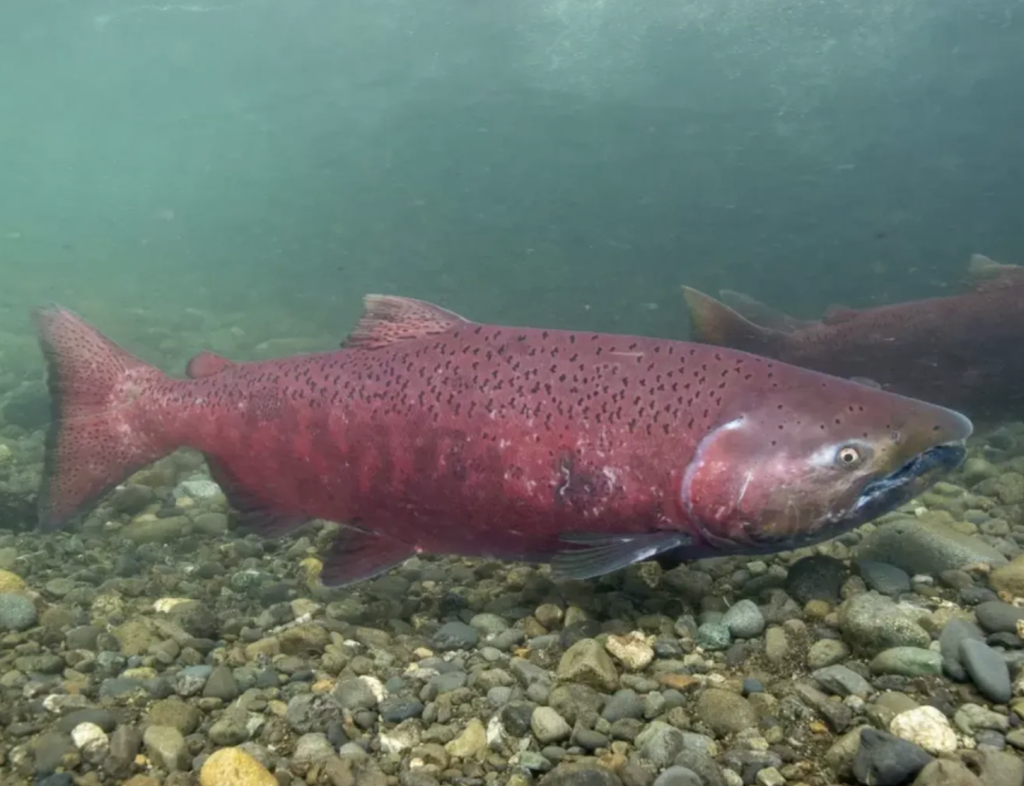
A king salmon swims underwater. (Courtesy/Ryan Hagerty,U.S. Fish and Wildlife Service)

Haines’ king salmon sport fishery is once more open to anglers, even as state fish forecasters project a smaller run of Chilkat kings this year.  

For nearly a decade, sport fishing for king salmon has been shut down in the Upper Lynn Canal — a response to historically low returns. 

From 2011 to 2018, the number of kings spawning in the Chilkat River came in below the state’s sustainability goal — also known as escapement — all but one year. 

This year, beginning on June 14, Alaskan anglers in the Haines area may catch two 28-inch or bigger king salmon per day, with no total limit for the season. 

Non-resident anglers are limited to one large fish per day and three total through June 30, then limited to one total after that date. 

The past decade of restrictions on fisheries have been effective in pulling the Chilkat run out of its decline. Whereas about 20% of the run annually was being harvested 10 years ago, the harvest in recent years has been about 5% of the run, said Alaska Department of Fish and Game biologist Brian Elliott last year. Now, the run has made escapement seven of the last eight years.

Last year’s return of 4,054 spawning-size Chilkat kings exceeded the top end of the escapement range and the pre-season forecast of 3,000 fish. 

Nevertheless, some continue to worry about the run’s long-term health.

Longtime angler and gillnetter Stuart DeWitt this week questioned the decision to reopen the sport fishery without an annual limit. 

“A run that’s been closed for so long, why wouldn’t you err on the side of caution?” DeWitt said. “I want to be able to (catch kings), I’ll take any opportunity to do it, but three fish per person for a family in a year — that’s plenty of meat.” 

The first indication of run strength will come from tagging in May, said Daniel Teske, Fish and Game’s Juneau-area sportfish biologist. With that data, he said, managers may still consider in-season restrictions, particularly on non-resident anglers.

But overall, Teske pointed to last year’s return and the recent run of higher-escapements as evidence of a run that can support this year’s opening. 

As the Haines-area sheds the stringent restrictions of the past decade, the fishery is now mostly in line with the rest of the region. 

The daily- and season-limits are the same as the general Southeast king salmon sportfish regulations, though the start of the season in Haines is delayed to June 14. This year’s two-fish daily limit for kings in Southeast doubles last year’s one-fish daily limit. 

The June 14 start date means fishing will only open toward the tail end of traditional run-timing, Elliott said, which Fish and Game hopes will minimize over-harvest.  

The new sport fish regulations follow the January release of Fish and Game’s annual preseason forecast. According to the forecast, state biologists predict the Chilkat will see 2,650 spawning-size king salmon. That number — calculated assuming zero-harvest — falls well within the escapement range, but is lower than both last year’s return and last year’s forecast. 

According to Elliott, that’s not a cause for worry. The largest proportion of spawners in the Chilkat run have been 5-year old fish, and last year’s 5-year old age class was particularly large. The forecast still exceeds the specific point goal within the escapement range of 2,200 spawners, Elliott said, leaving room for some harvest. 

On the commercial side, management is expected to “remain conservative” this season, with restrictions remaining similar to past years, said Fish and Game’s Haines commercial fisheries manager Nicole Zeiser.

Will Steinfeld is a documentary photographer and reporter in Southeast Alaska, formerly in New England.