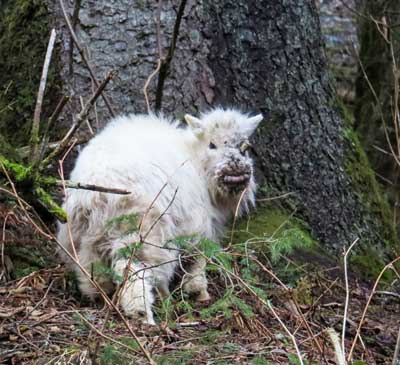
It has been 15 years since Haines had a reported case of a highly contagious skin infection in local mountain goats.
But state wildlife officials are raising the alarm in neighboring Juneau, which has seen three dead mountain goats and at least five reports of animals showing the disease since the beginning of winter.
Alaska Department of Fish and Game area management biologist Carl Koch said that while contagious ecthyma is “not as much an issue in Haines,” it is something to keep an eye on while out hunting.
The viral disease contagious ecthyma is sometimes called CE, sore mouth, or as local hunters referred to it “orf.” It can affect other species besides mountain goats, like dall and bighorn sheep and muskox. It can also infect domestic sheep and goats and is spread through contact with other infected animals.
Koch said that goats can be carrying the disease without showing “observable outward signs.” The symptoms are not always severe and can sometimes be just a small sore.
“I’ve seen some with just like red rings around their eyes, and then others were like, you’re surprised to think and eat and breathe properly because the face is so infected,” Koch said.
Koch said he thinks reports of contagious ecthyma in the region date back to the 1970s or 80s.
Local hunter Kevin Shove remembers shooting a goat prior to 2011 that “looked like it had scars on its face” when he went up to dress it. He said that the scarring looked similar to the images he had seen of contagious ecthyma.
In severe cases, the disease can cause lesions around goats’ orifices like their mouth, nose, ears and hooves. For goats with weaker immune systems, the lesions can get infected and swollen to the point where it impacts the animal’s ability to feed, see and hear.
Kevin White, a goat researcher at the University of Alaska Southeast, said generally “its immune system can respond to it and then the symptoms will pass.” Adult animals tend to survive; it is generally the youngest and oldest animals who are most vulnerable, White said.
While working as a wildlife research biologist with the Alaska Department of Fish and Game, he took the blood samples of over 500 mountain goats in four different areas of Southeast. He was screening for many diseases, one of them being contagious ecthyma. He found that around 5% of the population had an immunity to contagious ecthyma.
“It was interesting that it was widespread” and was found in almost all of the different populations and subpopulations that White tested. “It means that it was occurring in all these areas at some point.”
But even with that wide spread of animals with the disease, in all of his time gathering samples, White said he never saw any instances of animals with outward signs of it.
And local guides, like Larry Benda, who owns Alaska Fair Chase Guiding, said in his 30 years of hunting and guiding, he has never seen a mountain goat with it. Third generation hunter Donald Hotch also said he’s never seen it or heard about the disease.
White recently conducted an aerial survey to estimate the mountain goat population that covered Davidson Glacier, up through the Chilkat Valley, over towards Skagway until Creek Pass. White estimated a total of about 1,400 mountain goats over the more than 1,158-square-mile area.
And, while the disease hasn’t been seen much by local hunters, Koch warned that carnivores can get it and spread it to other carnivores.
“If a goat’s dead and it’s infected and an eagle, scavenging on it, and it was to fly away, it’s probably low likelihood but if it’s carrying the dead cells, it could transfer them somewhere else,” Koch said.
According to Koch, severe winters drain the goat’s immune system. This in combination with the disease took a toll on the goats who ended up dying. The goats who died, he said, “didn’t look that bad months ago.”
Humans can get contagious ecthyma but according to Koch, it does not get worse than a blister in the human cases he has seen.
“I wouldn’t rub my face if I touched a goat, but we don’t get those horrific-looking things that sometimes the goats get.”
Koch suggests that “anybody cleaning any game animal – because this isn’t the only disease out there – should be wearing gloves and cleaning up and then cooking the meat” to 160 degrees Fahrenheit. Koch said that cold does not kill this virus but heat does. It is still safe to eat the meat of an infected animal; one just has to cook the meat to the proper temperature.