
(Rashah McChesney/Chilkat Valley News)
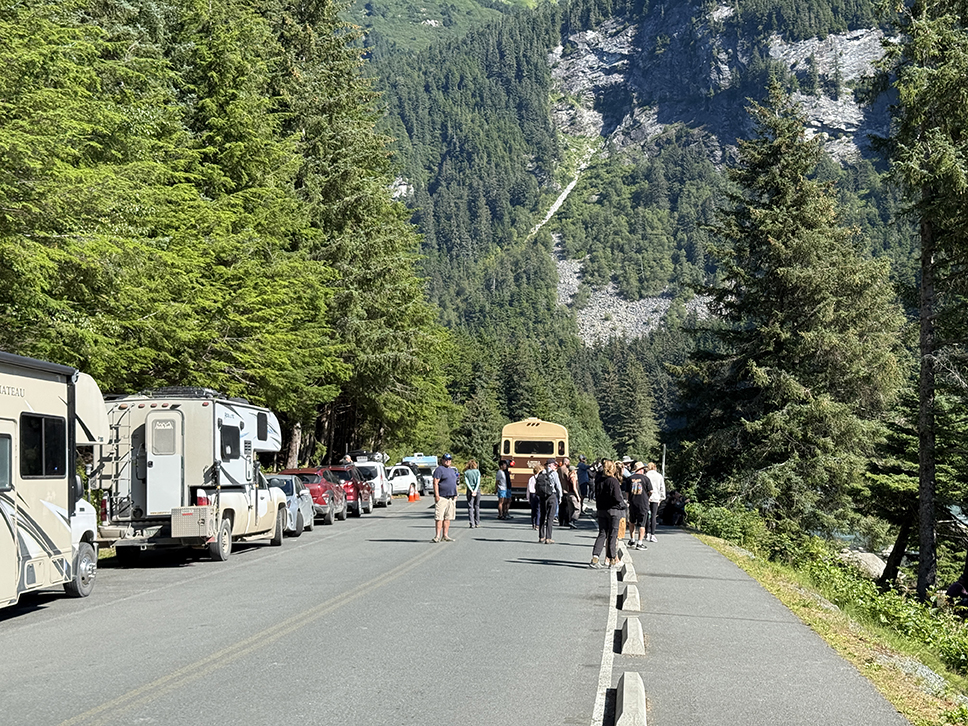
After a tour bus parked in the street, a crowd gathers in the road along the Chilkoot River to watch a sow and her four cubs on Sunday, August 24, 2025, near Haines, Alaska.

Alaska Division of Parks managers will enforce a tour-permit regulation prohibiting large buses in the Chilkoot Corridor this year. 

The change dates back two years, when the Alaska Division of Parks announced a new commercial tour-permit regulation prohibiting buses with capacity over 15 passengers in the Chilkoot Lake State Recreation Site. 

Regional parks superintendent Brady Garasky said this week that state parks told permit holders the enforcement would begin in 2025, but decided to extend the sunset period an additional year because of  “feedback from operators.” 

That meant last year, tour operators like Alaska Mountain Guides and the Chilkoot Indian Association’s Alaska Nature Tours could continue to run school buses through the popular tourist destination, with the understanding that in 2026 the vehicles would be prohibited.

Garasky said all commercial operators were notified of the initial permit stipulation and of the extension. 

The Chilkoot area has long been a point of contention with multiple user groups, both local and tourists, vying for limited space. 

The corridor, from the bridge at the mouth of the Chilkoot River up to the lake, is also a popular, but unofficial, bear-viewing area. 

Last summer a sow with four cubs drew big crowds, including instances of tour buses stopping in the road to let passengers out for bear-viewing, which Garasky at the time said was a permit violation. 

The stated rationale for the change, however, isn’t just about bears, Garasky said, and the goal won’t be to lower the overall number of visitors at the park. Rather, state parks staff hope requiring smaller vehicles will disperse visitors along the corridor and ease congestion issues. 

Large buses dropped off big crowds in concentrated areas, and the vehicles themselves took up multiple parking spaces and area on the road. In some instances those vehicles blocked access for other users like anglers, who were unable to find parking, Garasky said. 

Parking could yet be a challenge if tour operators replace buses with multiple smaller vehicles. 

Large bus operators have not said what their plans are. 

The Chilkoot Indian Association’s Zach Wentzel, who heads CIA’s tourism initiative Discover Deishu, said he would not talk about the permit stipulation or plans for the Alaska Nature Tours vehicle fleet. 

Alaska Mountain Guides also declined to comment. 

Other local tour operators said they would be unaffected. Karen Hess said she and her husband Duck would no longer be operating tours, and Joe Ordonez of Rainbow Glacier Adventures said all of his company’s existing vehicles were below the size limit. 

In addition to the congestion challenge, the change is also being pitched as a benefit for the road infrastructure itself, which Garasky said was not built for heavy vehicles and shoulders and culverts are showing signs of wear. 

The large-vehicle ban only applies to commercial tour permit holders. Non-commercial users can still drive personal-use large vehicles into the recreation site. 

Garasky said that for the time being, the large-vehicle ban is likely to be the only major change to area regulations. 

“This is a fairly significant change to the commercial operating stipulations so we want to give it time to monitor it and see if it has the intended impact,” Garasky said. 

Will Steinfeld is a documentary photographer and reporter in Southeast Alaska, formerly in New England.