
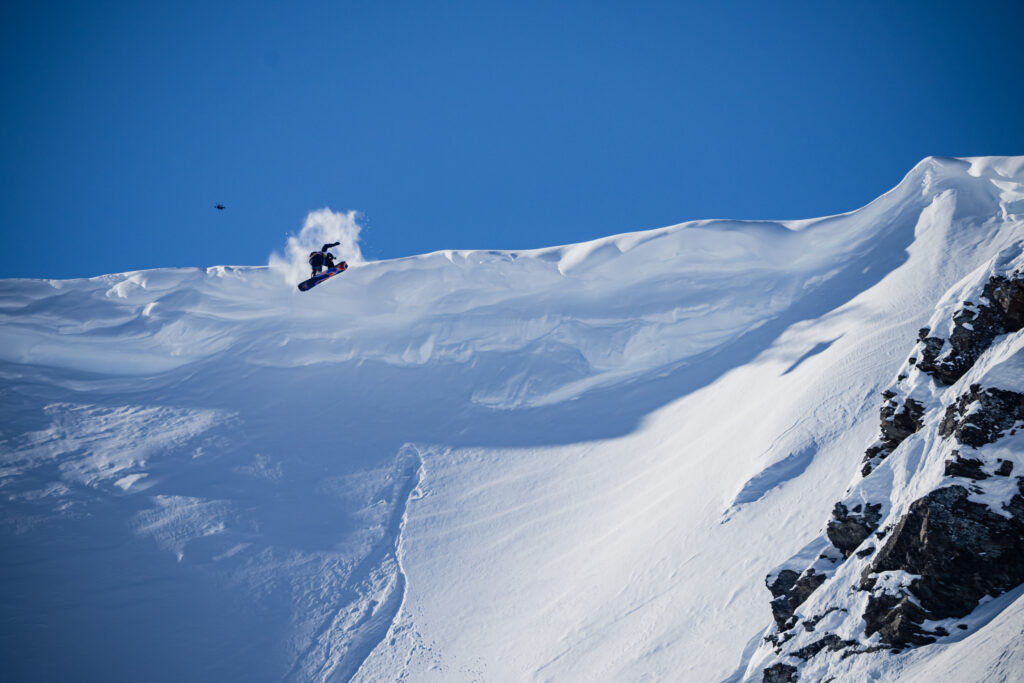
Californian Ross Tester has made a career hurtling off mountain faces across the world. Standing above the Chilkat Valley’s Little Jarvis Glacier Friday morning was something different.
From the starting gate of the 27-year-old skier’s Freeride World Tour run, Tester said the steepness of the pitch meant the mountain “rolled over” out of sight below him, meaning he was dropping in mostly blind.
“A little scary,” is how he described it afterward.
“A lot of the time we’re skiing stuff that’s a lot more low-key, whereas around here it’s such sustained, steep pitches. It’s very, very different from what a lot of us normally ski.”
Down below, Craig Loomis watched the run at the Harbor Bar, where a TV showed a helicopter shot of Tester — just a speck and smudge of powder on the otherwise blank mountain face.
It made Loomis emotional, seeing on the international broadcast the peaks he grew up on, around places like Big Boulder, Little Boulder and Muncaster creeks. As a kid, Loomis said he’d crawl on his stomach to look over the edges of the alpine spines. Never did he imagine people going over on skis and snowboards.
It was Loomis who, late last winter, kicked off the start of a long chain of events: Stopping into the Fogcutter to practice for the Aaron Nash memorial pool tournament, he got to talking with someone who introduced him to a Freeride World Tour executive who also happened to be in the bar.

Some time down the line, after communication between the Loomises and Freeride CEO Nicolas Hale-Woods and negotiations back and forth with the borough, freeriders were dropping in a couple thousand feet above the Klehini River.
Of course, it wasn’t just the pool-table brokering. Freeride and Hale-Woods had reason to come back to Haines after last holding the world tour in town in 2017. Hale-Woods this week called the Chilkat Valley’s terrain “some of, if not the best, mountains in the world.”
Another ingredient in Freeride’s return was $75,000 Haines Borough residents paid in borough funds to the company, making it financially viable for it to stage an event in Haines. Still, according to the budget in the company’s contract with the borough, it expected to take a loss on the event.
The borough’s payment has prompted questions about what kind of return residents might see on their investment. Some during the watch party at the Harbor Bar expressed frustration while watching the event.
“Look at this,” resident Suzanne Vuillet-Smith said, pointing at the shots of the terrain on the broadcast. “We don’t need to beg people to come here.”

It’s true, many of the freeriders said, that they did not need to be begged to come. The existing skiing fame of Haines throws some doubt into the idea that the event might be impactful marketing for winter tourism in Haines.
Tester said he had been hearing specifically about the skiing in Haines since he was 10 years old, and called finally making it a “dream come true.”
Chris Volkmann, a non-Freeride heliskier in town and a ski-patrol member at Alta in Utah, said he didn’t imagine the competition would be a big increase in exposure, at least in the big-terrain skiing community.
“Everyone who does this knows Haines is the best,” he said.
There was also an idea that Freeride would arrive with an influx of cash. Last year, in materials sent to borough officials, the world tour estimated it would add $416,000 in local spending the week of the event.
Some businesses in town reported hot weekends, like Pioneer Bar and Bamboo Room owner Christy Tengs-Fowler, who said the weekend “helped pay the bills in the middle of a tough month.”
But Freeride’s stay was shorter than expected, with competition happening two days early to catch a short window of clear weather, and athletes quickly left town afterward. Many said they were eager to get home after months of constant travel.

While hard economic numbers aren’t yet available for this year, the last time Freeride came to Haines in 2017, direct spending appeared minimal: sales tax revenue from the month of the competition was lower than the same month the following year, without any ski and snowboard competition.
But some say the benefits go beyond just heliskiing or short-term dollar amounts. That includes Loomis, who sees the tour as a symbol for the type of tourism economy he’d like to see grow in the Chilkat Valley.
“I guarantee you, people watching this right now are going, ‘How can I get there? What do I have to do to see this pristine place?’” Loomis said. “As long as we don’t ruin it, as long as people want to see raw wilderness, this will last forever.”
Likewise, borough tourism director Reba Hylton pointed to positive social media posts from Freeride athletes she said would help market Haines as an adventure travel destination.
Loomis, an assembly member, is a vocal opponent of industries like large-scale logging and mining. In his mind, Freeride, and tourism focused on wilderness, bolsters that argument.
“To me, it’s unfathomable that we as humans don’t want to protect what we have here,” he said. “All the gold, all the timber, that’s nothing compared to what these (skiers and snowboarders) are feeling.”
The heliskiing industry has long had conflict with some conservationists in the area. But this weekend, it wasn’t just Loomis who pitched Freeride as a symbol for conservation in the valley.

The Chilkat Indian Village’s Chilkat Forever initiative, which campaigns against local large-scale mining, posted on social media about what they said was the potential for the Palmer Project — a local mine exploration — to threaten “favored ski terrain.”
Chilkat Indian Village tribal council president Kimberley Strong spoke at a Saturday night banquet for Freeride athletes and staff and delivered a related message.
“When you were flying down those mountains … I was thinking about how when we look up at the mountains around us, especially when I’m in Klukwan, I was told that what we’re living in is a food bowl,” Strong said to the assembled competitors. “And you could see, all around you, the mountains that protect us and give us strength and courage to continue our way of life in the Chilkat Valley.”
It’s not a consensus that Freeride is a symbol of an anti-heavy industry stance. Executives from the mining project were also in the banquet audience, and mine owner Viszla Copper’s logo was prominently featured on Freeride event branding after it contributed $25,000 to Freeride.
But between mining and anti-mining, tourism and natural beauty, there did seem to be agreement that Freeride in some way symbolized what the valley was worth.
Tengs-Fowler at the Bamboo Room talked about the different languages she heard flying around on the weekend — Italian, French, Spanish — all gathered at tables in her restaurant.
When Freeride came to town in 2017, Tengs-Fowler’s son, Marty Fowler, worked for the competition as a photographer. After the event, Freeride asked him to stay on for the next competition in Verbier, Switzerland.
The Fowlers then went on to Verbier, where Marty Fowler was with a camera on top of a peak in the Swiss Alps. Tengs-Fowler, meanwhile, was down below in the town center, surrounded by multi-million dollar chalets, she said, and a screen showing the competition.
All of a sudden, on that screen in Switzerland a story or two tall, Tengs-Fowler remembers, a familiar sight popped up: “I’m standing there watching, and guess what comes up on the screen? The Pioneer Bar,” she said. “I got chills.”
“Haines is definitely featured over there. I feel really lucky that people think of Haines that way and want to be here.”
Same sentiment with Loomis: “I get emotional about being raised in this part of the world, about being an Alaskan. People envy us,” he said during the competition. Then he pointed at the helicopter shots panning up the long alpine spines. “People envy this.”
The pride will likely remain for some time, but what comes next?
Freeride CEO Hale-Woods said whether the tour returns next year remains up in the air.
“We would definitely like to come back. We’re going to debrief, check the return on investment for the borough and the media numbers, and the borough assembly will decide.”
Editor’s note: The Chilkat Valley News’ Rashah McChesney partnered with the Harbor Bar to host the Freeride watch party. She did not take part in reporting on or writing about Freeride events as a result.

