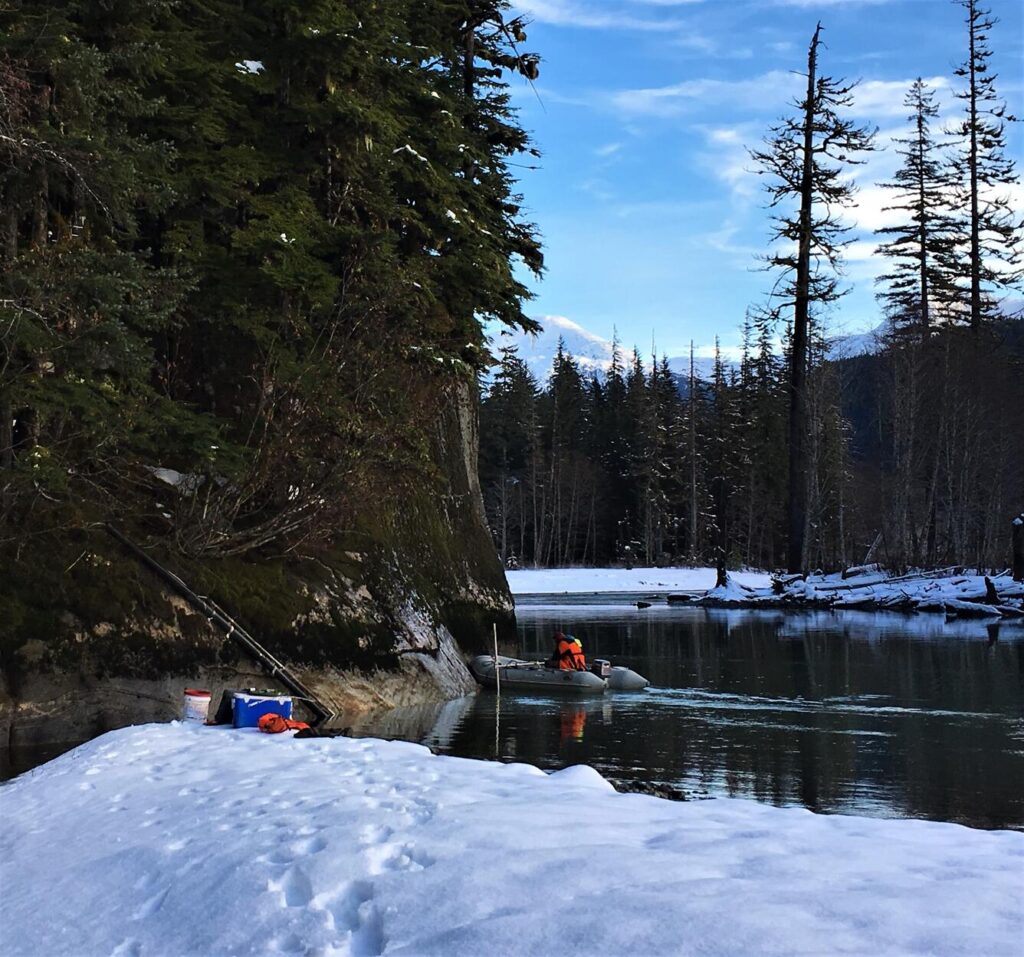
USGS hydrologist monitoring water quality and collecting samples at USGS Station15015595 on the Unuk River, Alaska. In 2019, the USGS began studying the baseline water-quality of selected transboundary rivers in Alaska. These studies are designed to characterize current water-quality conditions to facilitate future assessments of potential impacts related to upstream mining activities. (Courtesy/Jamie Pierce, Alaska Science Center)

The owner of the Eskay Creek mine, about 75 air miles east of Wrangell, in British Columbia, is targeting spring 2027 to reopen the gold and silver mine which has been closed since 2008.

The entire operation would cover more than 22 square miles and would be operated as an open-pit mine. 

The project, owned by Skeena Gold + Silver, received its last provincial and federal permits Feb. 3, a week after it received an environmental assessment certificate from the province.

The Vancouver, B.C.-based company expects about 1,000 construction jobs and more than 700 operations jobs at full production.

The project is located above the Unuk River, which flows into Alaska near Ketchikan.

Eskay Creek, a former Barrick Mining asset in B.C.’s so-called Golden Triangle of mining potential, was once touted as the world’s highest-grade gold mine.

A 2023 feasibility study for Skeena Gold + Silver, which took over ownership of the property in 2017, outlined an estimated 12-year mine life with average annual production of 320,000 ounces of gold-equivalent.

At current gold prices of more than $5,000 an ounce — more than double the price from two years ago — that annual production would be worth more than $1.6 billion.

The company has reported it will need to spend more than $500 million to reopen and start initial production.

“Eskay Creek is renowned for being one of the highest-grade and lowest-cost open-pit precious metals mines globally. Additionally, estimated silver by-product production will surpass many primary silver mines,” the company said.

Skeena has reported the site “is a high-grade volcanogenic massive sulfide deposit,” previously operated as an underground mine from 1994 to 2008.

The B.C. government partnered with the Tahltan Nation to approve the mine. The agreement marks the first time the province has partnered with a First Nation to make a joint regulatory decision on a major resource project, according to CBC News reports in Canada.

“Today shows what can be done when we do things together in a really good way,” Tahltan Central Government President Kerry Carlick, said after the Feb. 3 permits announcement.

The Tahltan have a unique agreement with the province to consent-based decision making on Eskay Creek — one of the first of its kind in Canada — which means the project could not proceed without their approval, the CBC reported.

“We have always governed ourselves. What makes it different is the truth is now being formally recognized in a new way, one that is grounded in respect, partnership and shared responsibility,” Carlick told the CBC.

In a referendum after weeks of heated debate, members of the Tahltan Nation in December voted overwhelmingly to approve a deal with Skeena Gold + Silver to reopen the mine.

The deal includes an impact benefits agreement with the company.

The specifics of the agreement have not been made public, but Tahltan officials have said it guarantees benefits worth more than US$1 billion over the life of the mine, mostly in cash but also in contracts and wages.

The vote came after the Tahltan Central Government negotiated an additional upfront payment from the company.

The deal calls for an upfront payment from Skeena — intended to be distributed to individual Tahltan members — at about US$7,250 each, according to Tahltan officials. And the agreement reportedly gives the First Nation government some environmental oversight over the mine.

The nation backed the deal with support from more than 77% of the roughly 1,750 Tahltans who voted in December, according to the Tahltan Central Government. Payments are expected to go out to members in 2026.

On the Alaska side of the border, however, a tribal commission has strong concerns about reopening the mine.

The Southeast Alaska Indigenous Transboundary Commission, a consortium of more than a dozen Tlingit, Haida and Tsimshian Nations, has consistently questioned the project.

“We are the tribes that will be impacted if anything catastrophic happens,” Commission President Esther Aaltséen Reese told APTN News, an Indigenous news service in Canada. “This is our way of life that we’re talking about.”

Reese said Alaska tribes downstream of the mine believe they’re not getting equal treatment. She said Alaskans have major concerns about the potential environmental impacts on shared cross-border rivers, especially relating to subsistence harvesting on the Unuk River.

Around 25 miles of the river is in Southeast Alaska. Reese said any kind of environmental failure at the mine would affect Alaska tribes downstream.

The province reported that Eskay Creek is among the three mine permits it has approved this year, with six in total over the past 12 months as the government moves aggressively to approve new resource projects.

Geoffrey Moyse, a lawyer who specializes in Canadian Aboriginal law, constitutional law and public law — including the United Nations Declaration on the Rights of Indigenous Peoples (UNDRIP) — wrote in a recent commentary for the Fraser Institute, a pro-market public policy think tank, that the Tahltan agreement illustrates how British Columbia’s UNDRIP-aligned policies are changing the terms of mining deals.

Moyse described the Tahltan-Skeena arrangement as a “consent agreement” enabled by B.C.’s Declaration on the Rights of Indigenous Peoples Act, according to reporting in the Canadian Mining Journal last month. He said the pact covers a broad consent area that includes some of Canada’s richest gold and silver deposits and argued the province’s approach treats Tahltan claims as ownership rights requiring consent for resource projects.

Moyse framed the deal as an early example of a “pay to play” dynamic under the province’s Indigenous Peoples Act.

This story was originally published by the Wrangell Sentinel.