
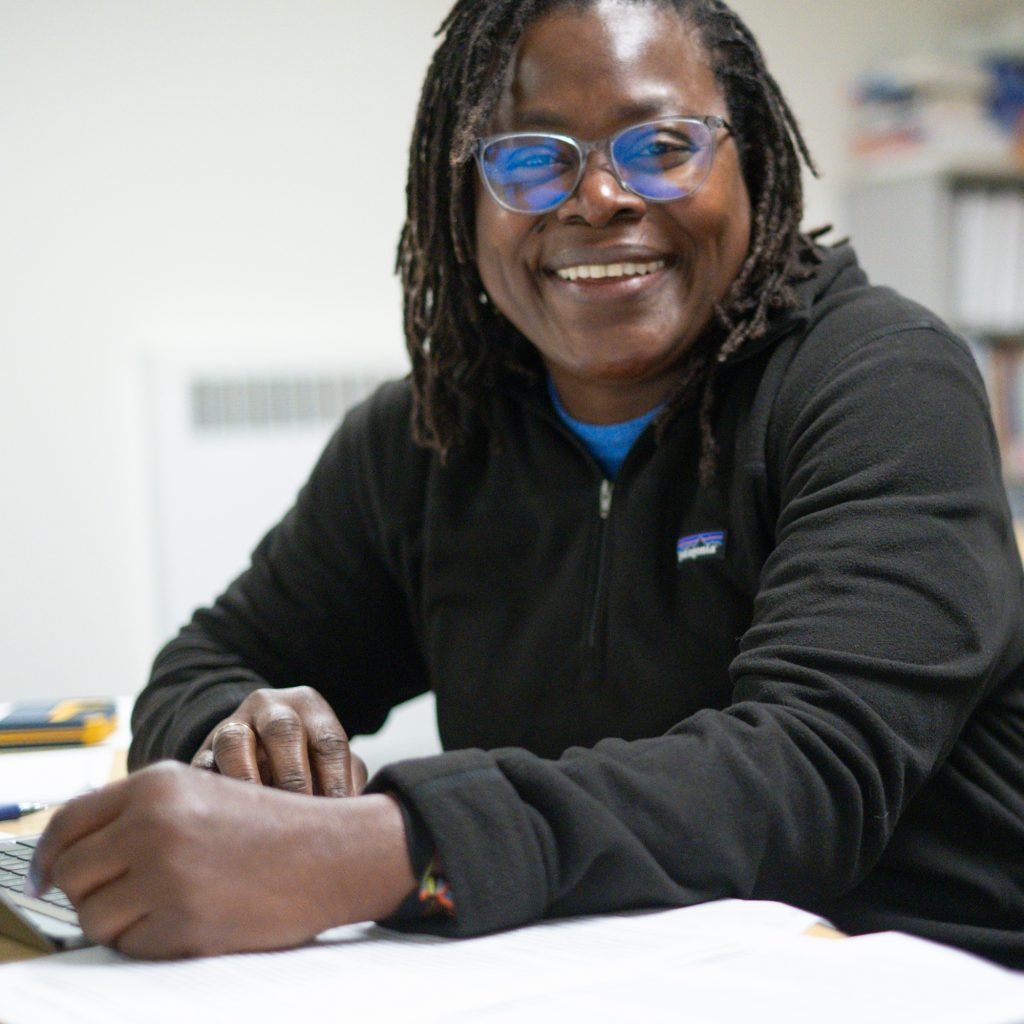
Haines special education teacher Stacey Spencer will fly to Trinidad and Tobago this weekend, after she lost her legal status and was given a March 6 deadline to leave the country.
Spencer, who was born in the Caribbean, was in her first year teaching in Haines. She had been teaching in the United States for 15 years — the last six with an H-1B visa. The visa grants legal status to foreign workers with specialized skills, a category specifically defined to include educators when President George W. Bush signed the program into law.
But in the last year, obtaining an H-1B visa has become far more difficult. Early this fall, President Donald Trump instituted a $100,000 fee for any employers sponsoring H-1B visa applicants — in this case the Haines Borough School District.
With Spencer’s H-1B status set to expire in December, the school district worked on alternate legal statuses that would have allowed her to remain, including an O-1 visa application. Spencer said this week that in addition to the district working on her case, U.S. Sen. Lisa Murkowski’s office had called her offering help. Murkowski spokesperson Joe Plesha confirmed this week the senator’s office had been in direct contact with Spencer regarding her case, but would not provide further details.
Recent weeks have been filled with uncertainty for Spencer, who said she was only informed of her deadline to leave the country last week. She had been in Texas at a family member’s funeral but planned to return this week to Haines, largely, she said, to fulfill a promise.
Spencer had been coaching Lady Glacier Bears basketball, and had committed to being at Senior Night. “It was a risk to come back here, but I promised them I was going to watch their last home game,” Spencer said.
At last weekend’s senior night Spencer said heartfelt goodbyes and thank yous from students and community members were a reminder of what she had accomplished in Haines — but also her confusion about why she had lost her legal status.
As Spencer and the district worked this fall on alternate legal pathways for specialized workers, she said she was asked by federal authorities to show proof of merit.
“They wanted to see articles in the newspaper, were there boards I had sat on that could attest to my work, did I win any awards,” she said. “To achieve what I’ve achieved in the past six years, to me, is commendable. But according to them it wasn’t enough.”
In an interview this week, Spencer recounted a story of getting into teaching over two decades ago by happenstance, but quickly finding purpose.
As a child, she was deeply traumatized by the death of her mother. “I didn’t speak much from age 8 until 28 when I was working on my degree,” Spencer said.
But while working on her graduate degree in criminology, she started working in a classroom to fill time and found kids that reminded her of herself, that she felt she could help.
Now, teaching for her has become “like an oxygen mask,” as essential to her as breathing, she said.
The improvement of her students, she believes, should be qualification enough for even visas requiring specialized or extraordinary skills.
“I was told my group was at a second- or third-grade level. Now they’re excelling to fifth or sixth, able to clearly analyze information in a way they couldn’t before,” she said. “Kids come with so much. When you have a teacher who is able to not just see the “so much,” but to see the human being, and reach the human being, isn’t that extraordinary?”
“You don’t (teach) for the money,” Spencer added. “You do it because you want to make a difference. Not everyone can be a doctor or a lawyer. Someone has to teach the doctors and the lawyers. And it’s not easy.”
With her time in Haines cut short, Spencer still hopes to return.
When she flies to Trinidad and Tobago this weekend, she’ll be flying back to much of her extended family, and also home-cooked food on the beach, she said. But she also isn’t credentialed to teach in the country. And, she said, she found something unique in Haines.
“I felt lost and alone.” Spencer said. “But when I came here, I was seen, I was heard, I felt loved. I got to fish, I got to coach. And hopefully soon I’ll be back.”
