
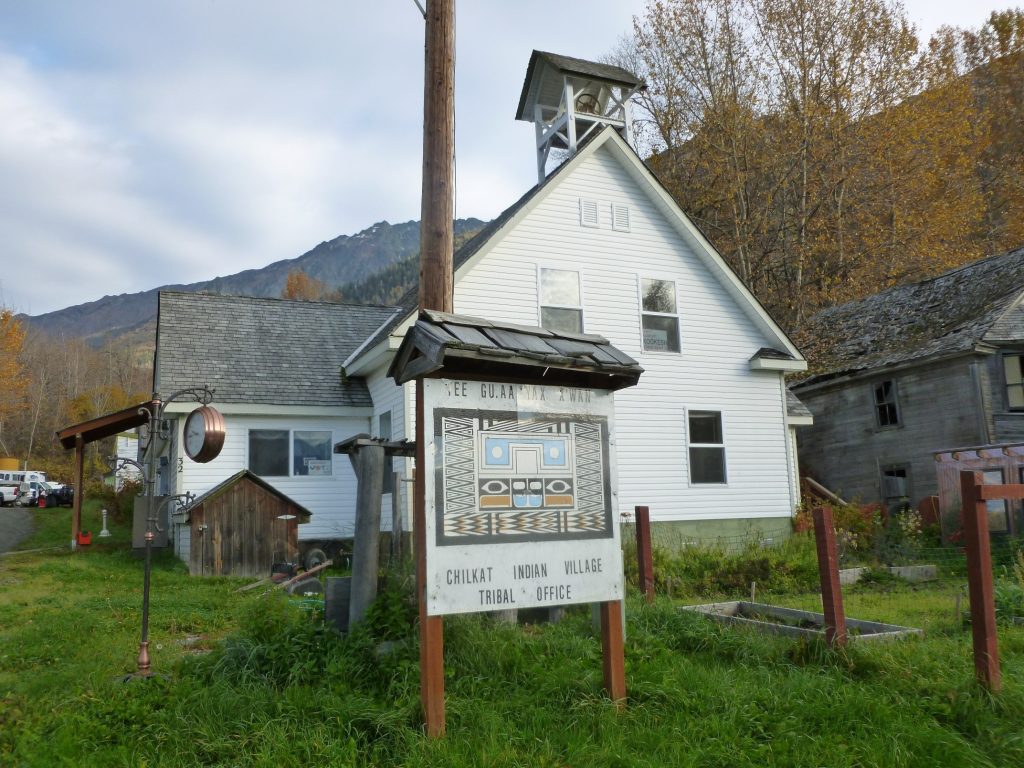
The Chilkat Indian Village is pushing back against the idea that it was stalling the Lutak Dock project during its consultation with the U.S. Maritime Administration over the particulars of the repair and replacement project.
After 2.5 years of that process, the federal agency and Klukwan’s tribal government still disagree on the federal agency’s finding that the area it had defined as potentially affected by the project would not be negatively impacted.
While Haines Borough staff, MARAD, and the Chilkat Indian Village appear to agree that there has been a delay, they do not agree on the cause.
A reviewer with the federal Advisory Council on Historic Preservation, which oversees the U.S. law requiring federal agencies consider the impact of projects on historic properties, commonly referred to as a Section 106 review, blamed MARAD, saying the federal agency had combined several steps in the process without notifying the public, tribes or the state.
Borough staff, in a Port Infrastructure Development program grant application earlier this year, wrote that a tribal government’s concerns about the potential future use of the dock as an ore terminal had contributed to the lengthy Section 106 process. But also the borough “respect(s) the consultation requirements and remain(s) committed to working constructively with all Tribal governments.”
The Chilkat Indian Village, in a Tuesday press release, pointed to an ongoing dispute between the Haines Borough and its former contractor Turnagain Marine as causing delays, as well as the company’s premature $10 million steel purchase that led to the dispute.
In background conversations, some current and former assembly members have said they believe consultation has delayed progress on the project. That sentiment has also come up in public comment at the Haines Borough Assembly.
Resident Fred Gray told assembly members last week he was surprised that Klukwan’s tribal government had been “throwing up roadblocks talking about culture.”
Gray, who sits on the Ports and Harbors Advisory Committee, said it perplexes him that Klukwan has been so involved as “there’s always been kind of an unwritten cultural rule, 13 mile [of the Haines Highway] north is the [Chilkat Indian Village]. 13 mile south, [Chilkoot Indian Association].
The village government, and other Section 106 experts in Southeast Alaska, say the historic review is not an impediment to the process, but rather a key part of any project to ensure it follows federal law and addresses impacts on both contemporary cultural and historic resources before construction moves forward.

“It is our responsibility, as tribal governments, to exert our sovereignty over traditional lands and waters through continuous and meaningful consultation with all federal agencies engaging in activities impacting our lands, waters and Tribal citizens,” tribal council president Kimberley Strong writes in the tribe’s press release.
Strong did not agree to an interview for this story. But others in Southeast with knowledge of the Section 106 process spoke about the challenges tribes often face when engaging in them, and the factors that can make them successful.
Anthropologist Chuck Smythe is an expert on Section 106 reviews, having trained National Park Service staff in the Northeast Region how to do the formal consultations for years. Smythe has also worked on consultations in Haines and was given a name, or adopted, by the Lukaax̱.ádi clan.
He said there have been good examples in the Chilkat Valley of times when government-to-government consultation through Section 106 has worked well and impacted the development of projects.
He gave the example of a decade-old project on the Haines Highway where the Federal Highway Administration and state Department of Transportation got a plan approved to straighten curves and widen the roadway.
Initially, the plan was to blast into the hillside of G̱eisán /Ripinsky near the airport in order to straighten a bend in the road.
“But there’s an [important site] up there,” Smythe said. “Generally, it’s something the tribe doesn’t want to talk about, but they did while in consultation with the [Federal Highway Administration] person at the time they were engaged in consultation.”
The result was that the agency shifted the route of the road and instead filled in a portion of the Chilkat River to accommodate the change in the roadway at that location.
Smythe said there are misconceptions about the Section 106 process, particularly at the state and local government levels, because they are often not involved in those conversations between tribal and federal governments.
“I think to people – like in the Haines Borough – it does seem like sort of an imposition and they don’t understand it,” he said. “People in Alaska don’t understand tribes very well. They don’t understand the position of tribal government under federal Indian law and police, and the government-to-government relationship between Indian tribes and the federal government.”
That understanding can vary between federal agencies too. “The last time I was up there, I was consulting with the Chilkoot Indian Association and the Federal Aviation Administration on the Haines Airport,” he said. “FAA understands it really well.”
One common misconception, he said in a phone interview, is that the tribe and the federal agency it is consulting with must come to a consensus.
“Federal agencies have a hard time seeing what consultation means, he said. “They think that they have to agree with the tribe. They don’t have to agree, but they do have to take into account the tribe’s perspective.”
Another misconception is what Smythe called an “outdated misunderstanding” that the Section 106 process only concerns effects to historic properties, such as archeological remains.
“For many years, it was the practice that historic properties had to be 50 years or older in order to be considered historic, hence they did not relate to living people and communities,” he wrote in an email.
That problem was supposed to have been corrected decades ago when the concept of “traditional cultural significance” was introduced into federal historic preservation. “This term refers specifically to a property (place) that has ‘ongoing’ historical, cultural, or religious significance to a people or group,” Smythe wrote.

Tribal council vice president Jones Hotch Jr. brought up one such use in the tribe’s Tuesday media release. “One of our main food staples is the hooligan – we had it on the Chilkat side and the Chilkoot side at one time,” he wrote.
He linked the decline in the Chilkat River hooligan run to the construction and expansion of the Haines Airport and to widespread traditional ecological knowledge that the species is sensitive to noise disturbances. The tribe notes that one design of the Lutak Dock would have required eight months of pile-driving activity during the spring hooligan runs in Lutak Inlet.
“Should something like that happen in Lutak Inlet, we are looking at the great possibility of not having hooligans in this area. I don’t know how our minds and bodies could adapt to that,” Hotch wrote.
Rosita Kaaháni Worl, president of the Sealaska Heritage Institute, is a Lingít anthropologist who lives in Juneau. Her clan house is in Klukwan.
Worl said there is often tension between preserving what existed in the past and sustaining tribal traditions and ways of life.
“We initially thought that ‘historic preservation’ was key to our cultural survival,” Worl wrote in an email. “But it has to be more than just preservation…stewardship of our land is critical.”
That means, she wrote, that development can occur “if it does not have adverse impacts on our environmental and natural resources.”
Additionally, Southeast Alaska Native people have adapted and changed their culture over time, she said.
And, in order for federal agencies to better account for that living heritage, Worl said they must be educated about different world views, culture and practices and integrate indigenous science into agency studies and decision making to protect the culture.
“Our history shows that we have fought to maintain ownership and access to our homelands and have waged political and legal efforts to protect our subsistence, which is the underlying basis of our culture and relationship to our land,” she said.
She said tribes have survived in this region for millennia, through climate change, the advance and recession of glaciers, sea waters, and governmental and Christian suppression of their culture.
“Our cultural values have been the basis of our cultural survival for more than 11,000 years,” she said.


