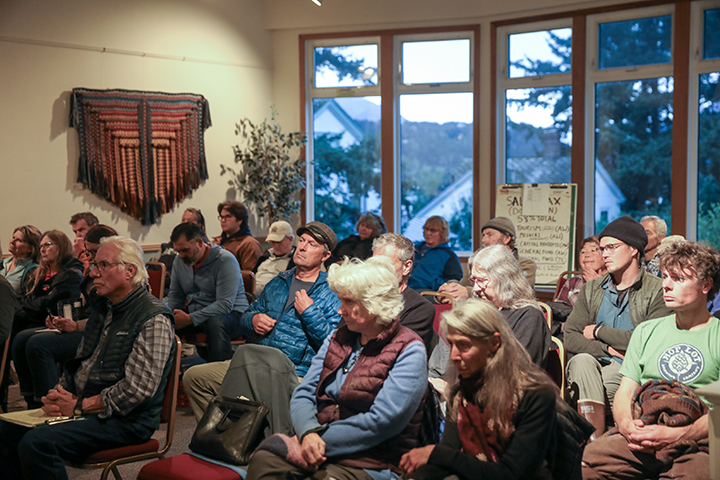
(Rashah McChesney/Chilkat Valley News) Audience members listen to candidates for the Haines borough planning commission answer questions on Friday, Sept. 26, 2025, in Haines, Alaska.

The Chilkat Valley News and KHNS hosted a live candidate form on Friday, Sept. 26 in the Chilkat Center.

Moderators Will Steinfeld and Melinda Munson questioned four candidates for two open assembly seats for about an hour.

The Chilkat Valley News has profiled each of the candidates and they’ve also answered questions readers submitted.

Editor’s note: The following transcript of the assembly forum has been edited to include just the questions and candidate answers.

We’ll give you each a minute to introduce yourselves, and then we’ll jump into questions.

John Norton: Thank you, Melinda. I’m going to just go by the old saying about a kindergarten teacher can tell everything about what you’re going to be as an adult, and I’m going to tell you a little bit about my years when I was a kindergartener, and I’ll help you to make a judgment as whether that’s right. So I grew up in a family of modest means, working, working class family, you might say we had a family of nine children. So we did everything. All the kids did everything they could do to help our family. I worked through newspapers on the lawns when it came to chores around the family. I did all kinds of things to help my mom, my dad, I have to tell you, I wasn’t I wasn’t a choir boy. You know, I was one of those kids that every so often got an opportunity to see my dad take his belt off, and my mother was really good with a hairbrush, and the nuns at the school taught my knuckles what the use of a ruler was all about. So over the years, you know, I’ve done my best to go ahead and bring you know, do the best for my family. 

Eben Sargent:  I’m running because I have chosen to live here, and like a lot of members in my generation that made that choice, it took a lot of and is still taking a lot of time and money investments, and you know, we didn’t make those investments because we saw a community that was dying or deflating. We see a lot to like here, but we would like to see our government step up a little bit and help continue to thrive and help address some challenges that weren’t here in the past. And I think that we need to do a little better job in our government of stepping away from fights and focusing on the areas where we have the most to gain together for the most people, and I think my temperament and life experiences could help move the needle just a little bit in that direction. 

Gabe Thomas: Gabe Thomas, born and raised here in Haines, grew up commercial fishing, and I’m in the assembly right now, and I’m running for my third term, because I’m experiencing the same problems a lot of people are. I have a lack of housing, lack of daycare, and jobs. It just kind of seems to be the same thing, and I’m trying to stand up and fight for it one more time. This is my if I win, this is my last time, I promise everybody.  But no, born and raised here and plan on staying here and being buried here.

Richard Clement:  I’m Richard Clement. My wife reminded me that I have run for three offices in the last three years, so there’s been a lot in the press about me, so please read the Chilkat Valley News and listen to KHNS, which I support. And also, I feel like I owe everyone and. Apology. I’ve been a bit distracted lately. We have a dying pet at home. My wife is at home taking care of it. We’ve had the little cat for 16 years, and right after the election, I’m going down to a memorial for my brother who died of a heart attack, and I apologize if I’ve been distracted and haven’t been able to pay 100% of my attention to all the matters in front of me.

Our first question for you is, if you could change one decision the assembly made this year this past cycle, what would it be?

John Norton: Oh, that’s a pretty simple one. For me, I would not have chosen to put that $100,000 in the hands of Red Bull. I think there’s just so many things the community has needs for that that putting that money into a company that’s just got incredible assets, it just didn’t make sense for me, and especially when we read that thing about, you know, the difficulties of being able to bus our students from up Valley into the school, and we were short of money to to be able to pay for those services. And so that’s, that’s the best example for me and and I want to tell you, I love Red Bull. I watch their stuff all the time. You know, I love all those guys in the squirrel suits. And, you know, Haines is so well known for our mountains. Everybody in these films that I watched, they all go, oh yeah, Haines is the best. So I really don’t feel like that. That was a critical thing for us to do to be able to build a demand in that field. 

Will Steinfeld:  Are you talking about the Free Ride World Tour?

John Norton: Yeah. 

Eben Sargent:  In one word, it’s the budget, more specifically, the lack of focus on the right areas early enough. You know, in the winter, there were a lot of fights on, you know, clawing back money that was given to nonprofits in a previous assembly. And there’s wasted ordinances on, muzzling the mayor a code of conduct, selling the mosquito Lake School, which was, you know, isn’t probably going to happen, but it sure is a waste of a lot of staff time. And a lot of staff time and stress in the community. And really, there were some surprises this year of the budget, for sure, but many of those things could have been seen coming. And I think, you know, I’m hopeful on the assembly, we can start to start the budget process earlier, identify things that have changed over the last year and build revenue steadily. There were a couple of revenue things on the table, like a severance tax at the beginning of the year that were dropped, and then by the time we realized what trouble we’re in financially it is too late to bring them back, and now we’re just hearing about them when it’s too late so close to the budget. 

Gabe Thomas: Which one there’s a lot of them? Specifically for me, the one I regret the most, and is what I told you in the paper was letting Chief Heath Scott go over a few thousand. I thought that kind of set a ball rolling within borough staff, that we started losing people, and we had a harder time trying to find stuff, find replacements, and thankfully, it seems like Alekka [Fullerton] now has that ship uprighted, and we’re starting to find key people that fit these positions really well. And I’m as much as I was sad to lose Heath, I’m glad that Alekka has been able to fill all these positions.

Richard Clement: I can’t think of many, because the assembly votes as a body, and that becomes the law. So we either stand up for each other, or we start arguing with each other and calling us them and us and things like that, so I support our assembly. 

Last year, the assembly said it wanted to formalize a relationship with the tribal governments in the Chilkat Valley. How big of a priority is that for you? And what specific steps would you take to work effectively alongside the other two governments in the valley?

Eben Sargent: You know, I think the saying that you’d like to do something is different than doing something. There actually has been no formal action taken yet. I hope to see that happen in the next year. I think it can happen a lot, one a lot of ways. One would be a formal statement of recognition of the sovereignty of our local tribes, which are really three these days, with Tlingit and Haida as sovereign governance governments, I think they should be treated the same way in tax policy that the state is. So should we charge taxes on their lodging? We should charge taxes for state parks and a campgrounds.  And I think we should work to collaborate where we can. There’s a proposal a couple years ago to hand the museum off to CIA, and we kind of stiff-armed them. I’m not sure what all happened with that, but and if they’re even still interested, but now we’re struggling to keep the museum financed. So the Chilkoot corridor is another area where there’s a lot of opportunity for economic collaboration and cost savings to taxpayers. 

Gabe Thomas: Most people probably know, I work for one of the tribal governments. I work currently for Chilkoot Indian Association. So I was tasked, I was tasked for that over a year ago, and along with Kevin Forster, the other assemblyman, and I was under the impression I would reach out to CIA. He was gonna reach out to CIV. Somehow, nothing really happened. I’ve reached out to CIA numerous times. I see Harriet almost daily, but as far as the tribal governments collaborating, I think in order for Haines to fund some of their projects that they have, such as Letnikoff, instead of going to a cruise company, why don’t they approach us? CIA. We have the ability to try and get funds that they can’t, whether it be subsistence or other stuff.

Richard Clement: This is not an area of my specialty. I listen to people like Gabe, who’s got, you know, seventh generation Chilkoot, and I listen to other native voices to hear how we can have a better relationship.

John Norton: You know the passage of Alaska lands act and all the things that have happened for our native corporations throughout the state have just been an evolutionary process. There’s a process of growing, and at this point, you know, it’s really exciting in town, because over the years, what we’ve found has happened is that the native corporations have become really powerful entities within our community, and they have a whole range of assets that they can access, because there’s been a recognition of how they haven’t been served for so many years, and so they’re finally getting that kind of opportunity to receive the kind of, I guess, support that they deserve. So I would find myself wanting to take any avenues I can to support the kinds of initiatives that they have to help their members of their community, and in terms of a relationship with the borough itself, I guess it’s, you know, the key thing is a respectful dialogue.

Each one of you has put forward a whole bunch of policy proposals for the borough. A lot of them have been discussed before but never implemented. I’m thinking about things like a head tax. You know, these are things that have come up before. We’d like you to pick one of these ideas that you’ve brought up, explain why you think it hasn’t already been implemented, and then talk about what you do differently to move it forward this time?

Gabe Thomas: That’s an easy one. It’s the seasonal sales tax. We’ve brought it up for 10 years or more that I remember. Every time we take a crack at it, we throw something together at the last minute and hope that it’s good the voters are going to buy into it, or buy it, buy it. This current one, I feel like we’ve worked really hard on it, and we tried to make sure that the impacts were as low as we can for the locals. But it still seems to me like it’s just not gaining the steam that we need for it to be able to get past but that would be one of them that I could think of right now.

Richard Clement: Well, one thing I’m hoping to be working on more is making money for the borough, because everybody else talks about spending money. So I’d like to see land sales. I’d like to see a land sales program now that we have a fully staffed administration. We’ve got a great planner. We should put a land sales program together, and that’s one of the big things. We had one going before the landslide, and then it dropped off the radar. And I’d like to see that continue. You, and that money, goes into the Permanent Fund, and we can draw three and a half percent per year, as much as we can put in there. It helps the next generations and takes the burden off of property owners.

John Norton: John, you know, it’s very difficult to just give yourself one thing you want to focus on. So what I’m going to do is I’m going to limit my view of the many things we could do to improve our finances here in the community, and I’m going to just talk about the one that’s right before us now, which is the seasonal sales tax. And so being the kind of quantified, quantitative person that I am, with my scientific background, when that proposal came forward, I was kind of like, ‘ah, you know, how’s this going to affect’ – I understand how it’s going to affect the town in a big number, how much money that’s going to come in from an additional sales tax estimated by Jila Stuart in our in our department, you know, budget finance department here. But I really want to make sure that it didn’t cause harm to individual people who are year round residents here. And so I sat down and I created a spreadsheet, and I said, ‘okay, just take a theoretical $1,000 that you’re gonna spend on hardware or whatever, and take $1,000 on groceries, run it through the different percentages over a period of a year. And does it make sense to do the seasonal sales tax?’ And the answer was, it makes sense. It’s not like we make a lot. You’re going to save a lot of money doing that as a yearround resident.

Eben Sargent: I’m going to go with any action at all on housing. We had a working group a number of years ago that resulted in a study that was not acted on and really disbanded. No further work. You know, land sales has been brought up as the policy de jure for some reason this year. If you do the numbers on land sales, they’re not a great budget option. Honestly, they help. We should do them. I’ve worked on them on the planning commission, but they don’t really close the gap in a big way. But what they could do is facilitate housing. We have the opportunity to owner, finance utilities and land to or to borough finance to younger buyers, and then, you know, we should pursue some of the things like an ADU ordinance have been tried in most boroughs or many boroughs, and I put forward from the planning commission this year, and was pretty disappointed to see, not only the ordinance wasn’t adopted, there wasn’t substantial work to make it better done by the Assembly or consider alternatives. 

There’s been debate over what kinds of services taxpayers should fund including nonprofit organizations and facilities like the Mosquito Lake school. How do you define worthwhile spending?

Richard Clement: That’s a tough one. There has to be broad-based support by the community. That’s what I look for, not just one faction that affects just one small segment of the population, but a broader effect across the community, but specifically for the Mosquito Lake School, I would really like to see a success come where they get what we they want, and the borough is no longer supporting them, and they can become self supporting. I’d really like to work towards that those people are Mosquito Lake a very impressive

John Norton: So there are services that are critical services for us in town that we fund as government services. And so you think of schools, you know, keeping our roads clean, things like that. You know, keeping the snow off the roads. And so you go, oh yeah, we gotta do those things. We gotta keep the water flowing and the sewers, so all that just kind of comes to the top of the list, because that’s what that’s what we all need. But really, what you see is there’s another economy in the community, which are these nonprofits. And I spent the day with Haynes, friends of recycling, you know, taking washing machines and dishwashers and putting them on a van to ship down south. And I could say SAIL, or I could say so many other organizations in town that we give small amounts of money, but they have so many, you know, volunteer hours that present an incredible, incredible asset to our community. And so I want to see us maintain those things. You know hospice. You know, if you’ve ever had a sibling die, you know hospice is really great.

Eben Sargent: First off, I guess I’d say if Richard’s such a fan of the Four Winds Resource Center, he should not have voted to sell it and waste a bunch of staff time and cause a lot of stress in that community. It’s definitely an asset that’s worth some amount of community support, even as we look for efficiencies. You know, in efficiencies, nonprofits can offer us a really cost effective way to do things, because we’re getting free labor, and so we should look wherever possible, to work with nonprofits on a contract basis, to do basic services, because there’s many things that don’t make sense to do cost effectively for the private sector here. But I do think that it’s still appropriate to have some amount of just general support, you know, because it’s hard to say something like art is, you know, valuable to all, that’s very subjective. But maybe if we do well in the budget, maybe in a bad year it’s $5,000 and in a good year it’s $50,000 or whatever the budget can support that seems appropriate to the taxpayers, and we could use Chilkat Valley Community Fund to reduce some of the time that was taken this year discussing the issue, and let them choose, since they know the nonprofit landscapes the best.

Gabe Thomas: Well, Richard wasn’t the only one who voted for that, but we didn’t vote to sell it. We voted to send it to the planning commission to look into selling it. The thing about Haines and how we’re passionate about stuff, right, everybody’s passionate. It’s why Haines is so politically divisive. Everybody is passionate about their way of Haines and what they want funded. And what I’ve learned in Haines and in the assembly is we fund a lot of stuff when people are squeaky wheels get greased, right? People that are the loudest in the boisterous and they show when they come to the assembly meetings, and they tell us, and they keep showing up. That’s how you keep the government in the know of what’s really wanted. You know, the quality of life aspects of it. As far as the Mosquito Lake school goes, I want to give it to them. I want them to have it themselves. I want them to be able to do it. Is it going to be tax free? Is it going to be free? Free? Probably not, but they’d probably do a better job with it than we can right now. And we did that with the museum. When we diversified from the museum, they started to do better. So sometimes the borough being invested in these things isn’t always great. They can do better without us. 

If you’re elected to office, who do you hope to represent, and what are your plans to actually get feedback from the community?

John Norton: You know, and going around the community, the thing I’ve heard a lot, and which resonates for me, is that I can best exemplify it by a story of friends who went to Japan, and they were on a bike tour, and they went to a community where all the homes and businesses were empty. And there was one fellow that greeted them as they came into the town, and he explained to them why the town was empty. He said, You can have any home you want, because everyone’s gone. And what had happened was that all the young people who supported a thriving community had left to go to the city. And so my perspective at this point is that anything I can do to help a vibrant community, both financially and culturally, that supports our young people. That’s where I’m going to put my efforts. 

Eben Sargent: Well, everybody usually answers this one as I represent all the community, and Gabe will tell you, the first thing everybody stands up in a comment and says is, you represent us, and you need to represent us. And you know, you’re generally presented with a long string of lose-lose decisions, or lose slightly less decisions, and so in many cases, unfortunately, and so I think, you know, as best as I’m able, I will try to direct the conversation to the areas that have the greatest impact to the community and the greatest range. And for us right now, that’s budget stuff. And you know, we have a really pressing problem with finance. And I think when you talk to people about sales tax, it’s actually encouraging, because everybody’s like, I don’t know what I think it’s, you know, it’s an issue that gets us thinking. And I think these are the kind of things we need to focus on working to find, you know, the most important solutions and stay away from those ones where the topics are split. 

Gabe Thomas: Eben nailed that for me, as far as ‘we’re supposed to listen to everybody.’ You know, when I first was elected, like I’ve said before, I came in thinking I was only supposed to listen to one side, because there was one side that I thought helped get me elected. But then it was after that, after I started working with Alekka, and I’m going to give her the credit for it, she started saying, ‘no, this isn’t big politics. This is a small town. You’re still going to see these people every day. We’re going to see them at the grocery stores, the post office, school events, all these places.’ So as far as having to reach out to them, they reach out to you. In Haines, that’s what’s unique, and that’s what’s unique about Haynes politics is we are available. We are your neighbors, we are your friends. We are right there next to you in most of these events and restaurants. So I think that’s also where sometimes the political divisiveness comes from, because people feel like maybe that you were too easy to get out to and too easy to be able to attack.

Richard Clement: Well, Alekka gives a class when you first run for assembly, and she teaches you as it should be, we all represent the entire community. And, a lot of the us-versus-them talk that I’ve heard is because we have elected people that do not understand that they need to listen to everyone, and they just listen to their small group of friends or something and vote according to that small faction of the population. And we really need to have an assembly that listens to everyone. And I know that sounds idealistic and all that, but you have to keep it in the back of your mind. We don’t have districts. We just have six people that make decisions. 

Is there any other candidate you’d like to ask a question of? 

John Norton: You know you’re planning to be a favorite here. The other folks are going to not be happy asking me twice in a row. To be first, I’d actually like to, you know, for me, one of the things that really defines a candidate is how

Melinda Munson: John, who was the question for? 

John: It is going to be Gabe. 

John Norton: What really defines a candidate is how you participate in the community and volunteerism. And so I’d just like to ask you if you could tell us a little bit about the ways in which you volunteer in the community and how you help others without, you know, being paid, and how you give yourself to help improve the town we live in. 

Gabe Thomas: Well, until recently, just about a year ago, I finally stopped, but I was at ugly for three and a half years. And I don’t know if you know anything about The Uglies, but they do a lot of stuff for the community, without borough funding and without borough help. They do all their own fundraising. They do donation drives for kids, and I was part of that for a long time. Recently, I’ve taken a break from stuff and kind of working on my own family and my own self. And, yeah, don’t I mean, I’ve donated, like, lots of stuff like that, but mostly The Uglies would be my first answer.

Eben Sargent: Could I throw this up to either of the incumbents? 

Melinda Munson: I think you have to ask a specific candidate. 

Eben Sargent: Well, I’m gonna go with Richard. So in January this year, the assembly took a vote to advance the particular design that we’ve had for several years in the Lutak dock in the contractor for another cycle. This is a resolution of support for the plan. Basically, there is certainly a lot of feedback from the community for reasons that this might not be a great idea. And some of, you know, other sitting assembly members suggested that, at best, we should just wait, and maybe this was actually counter to the process. And so I guess my question is, you know, knowing that all of our options on this project have, you know, a lot of drawbacks. You know, none of them are great options. And we all acknowledge that when taking that vote, what were the top, you know, four or five things that were in the back of your mind, of drawbacks and reasons that that vote might not be a good idea?

Richard Clement: My decision to support the Turnagain Marine Design was based on the fact that we had done years and years of research to define exactly what dock we wanted, and we signed a contract with the company for the. Design, the cost and the schedule. Drawbacks at that point in time were tremendous, because if we reneged on the contract, we would be responsible for lot of money owed to them, and also a contract is a legal document, and we had to determine whether or not there was an opportunity still with that company, and the company was very confused, because the assembly was sorry,

Melinda Munson: I’m sorry, Richard, your time is up. 

Will Steinfeld: Gabe did you want to jump in for 30 seconds?

Gabe Thomas: Well, a lot of it, too is there’s some stuff that happened in executive session that we can’t discuss, that I know that Richard would love to be able to, both of us would love to be able to tell the community some of that stuff. And it’s really really hard sometimes when those happen, and you can’t sit here and tell you guys exactly why some of those decisions were made. And this is where I agree with Rashah, sometimes executive sessions stink, you know, and I do agree that sometimes they’re great, but that was one of them that when we came out of an executive session, we were kind of at a point where we had to make a decision and it was legally based, and that’s as far as I’ll go.

Richard Clement: Eben, would you support a repeal of the senior tax exemption?

Eben Sargent: We are in a huge budget crisis, and there’s a number of legs to what changed within the last year. That is one of them. As folks know the assembly doesn’t make substantial tax policy. We can only curate a good list of options for the voters, and if we curate an option that isn’t supported by the community, it’s just kind of a waste of everybody’s time. One thing that has been done in at least one borough, we are tied for the highest senior tax exemption, which I think is concerning, and is to phase out their senior tax exemption. And I think it might be Kodiak. And basically, if you have it today, you keep it, but new people who might move here don’t get that exemption. And so that, I think, would address some of the concerns of people who have been here a long time and had their property values skyrocket while letting us gradually make a better revenue stream in the long term.

People living outside of the Haines town site are now receiving police service, and property owners in the town site pay for this service through their property taxes and some of their sales tax. Property owners who are receiving that policing who live outside of the town site pay only you know, through some of the sales tax they may pay in town. Is that fair?

Gabe Thomas: Well, everybody’s, everybody’s entitled to safety and public you know, public safety, that’s where one of our number one jobs as the borough. Now, I remember when that vote went into place, they voted that they didn’t want police response outside of the town site, but you’re going to tell a police officer that they can’t go out there if somebody’s getting shot, tore up, beat up, or anything, that’s not going to happen. There’s not a cop in this town, whether it’s wildlife or paynesboro, that’s not going to respond to that. So it’s kind of difficult to say that nobody’s, I mean, to spend the money out there. It’s totally within our right to do that. I believe if it’s life or property, that’s what we should be doing.  Whether or not they should be patrolling out there, no. I mean, the people out there voted about no patrol. So the state should be taking care of that, it’s not the Haines borough. But as far as emergency response, yes,

Eben Sargent: I don’t think it’s fair. And I don’t think it’s the only way in which there’s unfairness in our tax code. One example is, you know, some of the services that are provided from the general fund that maybe benefit some people more. And I mean, really, really, taxation is never fair. I think we need to. And as we look at the town site, the seasonal sales tax in the way that’s treated in the town site fund versus the general fund. It brings questions, and I think the more we can move away from a town site allocated services, as some people live just outside that zone, people that live at seven-mile or outside the town site, but they certainly find it very easy for them to partake. I think we just need to look to minimize the splits there.

John Norton: I guess I’d have to say that I’m not familiar with all the details of it. I, you know I have been here long enough, I remember when we struggled with that same question at the fire department, whether or not we would go outside of the town site if someone’s home was on fire. And of course, you can imagine, we’re in the business of helping people when they need help. And so there was a reluctance to say, ‘oh, you haven’t been paying us. And so we’re not going to come.’ You know, the guys would show up. And so if we, if we have time to go ahead and sort of sit down and say, what’s equitable, and bring that to folks and say, so, you know, here’s the level of service you’re getting, and the income we get from your property taxes or other things are not sufficient to cover that, then we’re going to ask you to pay more. But if we, on the other hand, say, ‘oh yeah, yeah. You know, when you come to town and shop, you get taxes from you. When you pay your property taxes, we get money from you, and that pays for that.’

Richard Clement: That exact question really hasn’t come up in my one year on the assembly, so I’d like to hear some more testimony from people that feel that it’s unfair or fair.

The next question came in from the audience, and that’s your position on cell towers in the Chilkat Valley and any restrictions you’d like to see enforced. 

Eben Sargent: Yeah, I’ve spent a fair bit of time on this one, and as a planning commissioner, so you know, for folks that aren’t familiar, there was, there’s been a bunch of cell towers coming at us as a borough, and we don’t really know why, but all of a sudden we’ve had a large number of applications. So we really have to legally evaluate those applications under our current code. So the staff worked quickly, there was one that was a 150 foot tower on Main Street that I don’t think anybody wanted. The staff worked to develop an ordinance that went through the planning commission, code review commission, and that ordinance was relatively legally tested. And there’s a lot of federal constraints here that we may or may not like, and I think we just need to be slow and consider input from industry and the federal government. And that’s not how it was handled recently when the assembly took it on.

John Norton:   It’s really a little bit complicated for me, from the respect that when I was listening to the assembly meeting on the night, the assembly members were talking about the importance of having cell reception and how that works for not just, you know, the health and safety stuff and but it’s also, you know, the commerce that happens as people have that. So, you know, from when I was doing search and rescue with fire department, boy, I can tell you, hope, there’s a number of circumstances that I was in where cell phone reception was critical to being able to take care of somebody who was in in a situation where life, you know, life was threatened. And so, you know, when we talk about putting up more towers, it’s like, oh yeah, you know, I mean, I can see a real benefit of having better coverage. On the other hand, since this issue has come up, I spent some time, you know, trying to see what was available in terms of the medical sort of view of what’s 5G going to do to us, you know, is that going to go ahead and cause problems medically, and so I would be careful.

Richard Clement: go on some of the research done on EMF radiation and its effect on humans and animals and stuff. So I’d like to see verification of EMF radiation. And it’s kind of up in the air, but Dr Smith is the one leading the charge on that, and he is a doctor, and I listened to him, and I would still like to hear from other experts that could verify the real impact of EMF radiation on children and people and dogs.

Gabe Thomas:  I’m not for the cell tower that was by a school by any means. We don’t even want to take the risk with what could be harmful to our children. And we should be thinking the same way for even our elderly as matter of fact, if we need to be thinking about – is that proposed tower that they were talking about? Was it going to be too close to SEARHC for a new building? Is it going to be too close to any other possible multiple housing areas that we could be thinking about as far as the technology, and then want for it here. I could see why, when we have a lot of visitors here, and the town gets bogged down and everything gets slow. But I do believe the technology is going to be gone soon. As far as the EMF. I’m not scared about it, we got our cell phones within a foot of our head, sleeping every night, everybody does, and you got your microwaves and you got all the other things. So I’m not really scared of EMF. I’m just more critical of where they could be and where they should be.

Would you restore funding to nonprofits? Why or why not? And I think this is the specific pot of funding that was in dispute earlier this year.

John Norton: So to give the audience an idea of just how great the cost benefit is, we had our Haines Friends of Recycling meeting here a week ago, and Melissa Aronson was telling us, you know, how many volunteer hours that Haines friends recycling was able to document, and she said, over the years, had 4,400 volunteer hours. And, the borough in that process of giving them support, gave them $2,000 so I kind of being as quantitative as I am, I said, Oh, that guy, you know, I would have been making five cents an hour. And it just shows the cost benefit that we get for so many of our nonprofits. So I think that’s money that you can’t get a better investment for. You know, for the money you spend, it’s a huge return.

Richard Clement: If we had the money.

Gabe Thomas: With the budget looking the way it is, again this year, I’m not sure where we’re going to be. I mean, it’s $100,000. It’s not, it wasn’t that much. But at this last budget, it was. You know, it was a difference of certain things. And if we can find a way to fund it without having to cut other stuff, I could see that, you know, I was the only one who brought up possibly attaching it to the seasonal sales tax and it just fell on all deaf ears. So, I mean, I tried to throw something out there for the general public to think about how to help fund them. My biggest issue with it is double-dipping. You know, if you’re already, and I’ve said this at the Chamber forum, if you’re going to apply for property tax exemptions and then turn around and ask for nonprofit money as well, you’re double-dipping into the system.

Eben Sargent: I’d like to see us start by supporting the areas where nonprofits directly serve the public, and that’s through property tax exemptions and contracts. I think the question is about like just a bin of money and 100k gets thrown out because that was what an assembly two years ago, who had a large surplus, used. So I think sometimes we get stuck on these, like, ifs questions in Haines, less than hows. So one thing I think we need to do is reduce, I mean, it consumed probably an additional many thousands of dollars of staff time this year fighting about it. So using, like I mentioned earlier CVCF to potentially manage that and then adjusting it based on the finances of the borough. And, yeah, when times are tight, it would be one of many things that would be considered in parallel for savings, and then hopefully we can do a better job budgeting so that we can support things like that.

How will you ensure that the public has access to the necessary information in a venue to have a meaningful voice in decisions that affect us all? If you’re re-elected?

Richard Clement: Access to information is the responsibility of the administration. Um, specifically the clerk, the clerk should make data information available to the public. Each individual assembly person can help by providing minutes to meetings, but the clerk and the administration is ultimately responsible for making that available and accessible by the public.

Gabe Thomas: Isn’t that your guy’s job? You guys are there documenting our information constantly. I see you at every meeting. If it’s not a microphone, it’s a recorder. But as far as the borough administration, I think Mr. Clement was right. Just now, even with this new staffing that we have, Mr. Denker is amazing. He is making sure it is even across all the boards. If I say something to him, then he makes sure that the rest of the assembly knows exactly what I said, too, so it’s all even, I do appreciate the way the administration is handling that now, and a lot of that stems from people that had distrust for years. They thought the administration was always trying to sneak things in, when, really, I don’t think it was that. I think it was just kind of maybe bad communication and lack thereof, you know, even lack thereof with the community. And we’re learning, we’ve learned, obviously. There’s been enough public outcry lately over Lutak and other things.

Eben Sargent: Bear with me here. This might take a minute, but this is, I see this as a budget issue, actually. So we see a ton of things that go in front of the borough and spend a bunch of capacity on, and then the public finally finds out when they’re done, and they come back and bring in the pitchforks. Then we spend time and money and opportunity cost fixing these things. And so I think it actually will save us money to spend a little bit of time. We actually have a pretty good staffed borough right now where we have admin assistance to the clerk and the manager and, you know, just little things like getting stuff on Facebook, there’s a ton of people that just do not have the time, if they’re young, or maybe don’t have the computer or the interest to go on a website and a calendar and figure things out and just making sure people know whether it’s at the senior center in a library, there’s a board, and then there’s maybe a post about the agenda once a week or twice a week on socials, then people will be hopefully, more aware of decisions coming up that’ll affect them, and they’ll participate proactively up front, and the assembly doesn’t have to go out front and then get backlashed.

John Norton: You know, I’m kind of an old timer here. So, when it comes down to technology, I can’t say that I’m extremely adept, but that technology aspect is seems to be to be a way for me to inform myself of what has transpired and what sort of has been talked about, and what is the data set that things are being based upon. And so this Lutak dock, you know, website access that the borough has right now has been really helpful to me, because they have this listing of all these files that go back, you know, like I looked at the one from 2015 that was the original R&M proposal for the Lutak Dock. And was that one that talked about the Panamax ships and the ore dock, and that’s where, you know, that whole thing got fired up. But anyway, all that stuff’s there, and being able to understand complex issues can be much easier if you can be at home at night and just get on your computer and take a look at stuff.

It seems like a lot of people here are worried about the future, and sometimes they’re worried about hyper-local things, and sometimes they’re worried about these things happening at the national level. But I would say, for the last three weeks, the biggest question that I got in my inbox and the ones that people kept asking, kept asking me to ask you is, what will Haines be like in 25 years and why do you think that? 

Gabe Thomas: Well, having been blessed with Haines for over 40 years, it seems that we’re kind of always in the same same cycle, the boom and the bust, the boom and the bust, the boom and the bust. And then we find somewhere that we like for a while, and then something happens, and it changes and goes back to where we’re not real happy with it. In 25 years, I’d like to see where we finally get over ourselves and work together. I mean, I would hope that we can finally just, you know, I’m not for a mine, but I’m for regulatory work. You know, we just need to all work together and come to some consensus. Instead of fighting constantly we’ve been fighting for since I’ve been alive, I’d like to see it stop.

Richard Clement: Well, if we follow the comprehensive plan, we will focus on tourism, and we will have the boom and bust annual cycle of tourism for the next 20 years.

John Norton: Yeah crystal ball, huh? It’s, it’s difficult to say, because, you know, there’s things – you look at your life, and you go, oh, yeah, all of the sudden I thought it was going one way, and I went another. But if I, if I were to say, what are the sort of, the foundations, what we’re building now, it really does point us towards that part of America that really appreciates coming to a small town that has this abundant, beautiful environment that we have. That’s why they’re building bigger ships, you know, these huge ships that they’re coming is because people in America hunger to have this experience. And I think that that’s going to be a place that will find an opportunity that’s not going to go away, because it’s such a unique gift that we have here. So that would be my anticipation.

Eben Sargent: You can tell who’s read the comp plan, because it speaks to a really diverse economy here. That’s actually a really envied thing in southeast when you go around the region. And so we don’t have a single legged stool. We have a lot of small things, and none of them are that huge in isolation, but together, they’re very durable. And so I see a lot of this, like economic angst, and then we go chase something that we think is going to address that, and we’ve been very unsuccessful about that. And so my proposal is that we work on sort of the basic things that help the restaurants we have today, the people that are working in the community today, you know, I was at HiEx this morning, and there is not a gray hair in that place. Or I have more than most of those guys. And so, like, you know, there is actually a lot of energy and growth here. It just might not look like a single thing. And so I think we just need to do a better job of not trying to drive the bus, but instead just kind of keep things well maintained and let it go where it’s going to go.

The second most widely asked question that I received variations of for the last several weeks was about the Lutak dock and about, I just think a number of things that we’ve all been talking about, certainly, since I moved here and far, far longer. But the overriding one, the theme that I took away from it, was that a lot of people want to know where we are in the process of getting it built, and if there is a clear path forward, and if you see a clear path forward. Tell us what your understanding is of where we are in the process, and what you think, or do you think there is a clear path forward to getting the dock built.

Richard Clement:  We missed a big opportunity last year, so there really isn’t a clear path forward today, but it will become clear in the coming weeks as we discuss exactly what functionality we want from a dock, and I would like to see the functionality that we had, that we’ve enjoyed for the last 50 years, out of our dock to support the pass pass ability, the roll-on, roll-off, and the fuel coming into the town that supports what we have to support the town and to support the industries that rely on trade up the highway. So it will be very revealing over the next few weeks as we come together and have town halls to talk about the functionality that we all agree to, all of us for a dock.

John Norton: So I’m going to, I’m just going to sort of go to the real simple sort of question, and that is that, what can you afford? And so as you go through all those proposals of what you would like, it really comes down to what you can afford. It’s just kind of that simple. And so when you say, you know, you go, you look at the proposals for different dock designs that were done by R&M or P&D or whoever you went to, and they talk about, you know, the different possibilities. And really, when you come down to what’s affordable, it just is one simple option, and what it does is protects your ability to transfer freight through the roll-on, roll-off, and to go ahead and bring oil into the community. And so anything more than that, all the prices just skyrocket. They go right out the ceiling. And so, you know, you look at those proposals, those different design proposals, and you jump into 60 million right away. We don’t even have 20 anymore. So it’s just that simple, what can you pay for? Thank you. 

Eben Sargent: Last year at this time, we knew we needed a new plan. Now, a year later, we really know we need a new plan. So what I would propose is that there’s nobody in this dais or room or town that has that plan today, and we don’t have the capacity internally to find it. So my proposal is we hire the project manager that was funded a couple years ago to help illuminate some of these options. To me, that means we divorce the legal process from our options going forward. We’ve had one party that’s limiting what’s on the table and how much it costs for too long, and we need to go to industry and see who’s interested in this project and what they can do for a price that includes a little bit of padding for when things inevitably cost more. And then we’ll use – then is time for the community process to determine, you know, how we put the puzzle together? I think we need to be realistic that we’re probably looking at a phase solution where we try to do something with the money we have before we lose it, and then we look for ways to grow that down the road.

Gabe Thomas: Oh Lutak Dock. Six years of it. When I first got elected, we were trying. We didn’t think we were even going to get anything. We had all these different designs that, you know, they’re referencing. We had six or eight, nine different designs. We went from we’re never going to get it funded, we’re never going to get it funded – to you, meet with Sean Bell and we discuss phasing, and that’s how we initially got funded with this RAISE grant, we showed a phased approach. Then magical Turnagain showed up and said, here’s the magic carpet. You’re going to have a fully encapsulated dock for 25 million. Well, we know that’s not happening now. As far as I’m concerned, I just want something done before my friends die out there. I have friends that work out there every day that go, and I’m just, they have families and everything. I just, we got to do something. We got to get over ourselves, get something built. I don’t care if it’s a roll on, roll off, or just a fuel depot, whatever, let’s build something. But just this constant that needs to go. I think, if anything, we’re probably – I’m with Evan – we’re almost, we’re probably at a whole redesign now. We’re at a point where, now it’s not only could we just start over, why don’t we just start over?