
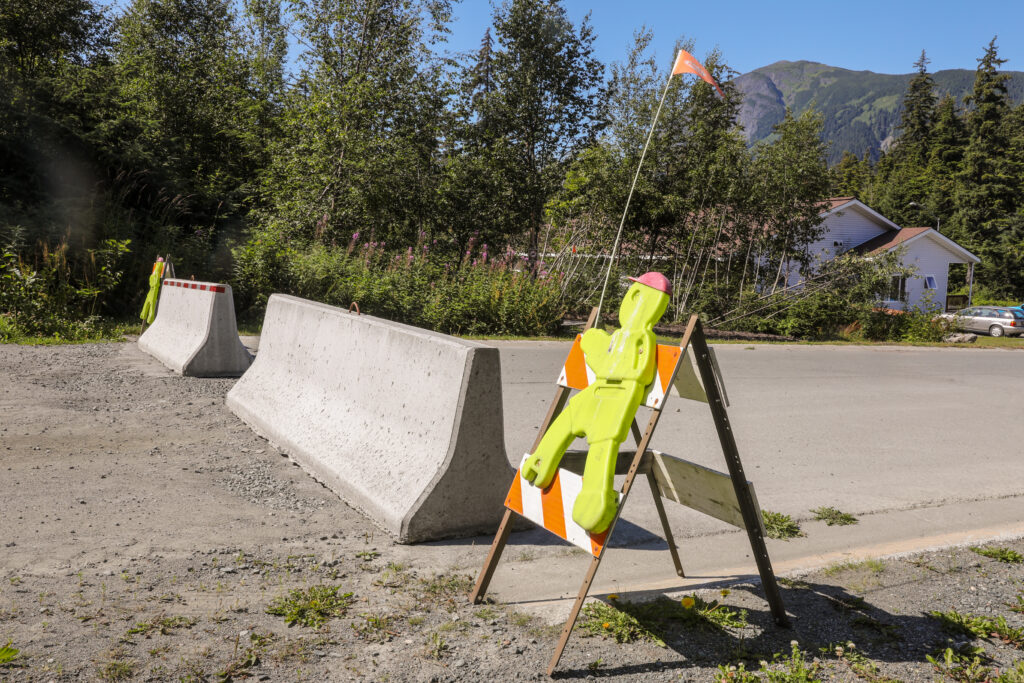
(Rashah McChesney/Chilkat Valley News) A new barricade blocking Chilkoot Road

After years of traffic driving down a gravel road many had forgotten was privately owned, a set of barriers blocking access to the south end of the Chilkoot Estates subdivision was erected in late July. 

Complaints from a resident in an unfinished subdivision on the other side of the concrete barriers prompted a review by borough officials, who later determined the gravel extension of Jilkoot Déiyi/Chilkoot Street, which it had put street signs on and been plowing for years, was actually on private property. The borough has since taken down its street signs and put up a sign at its intersection with Major Road indicating that it is not a through-street. 

At either end of the blocked road, residents in two neighborhoods said they just want to feel safe in and around their homes. 

In the Hill Top subdivision, which is currently being developed, Ben Giese said he started asking questions of borough staff, and on social media, when the road barriers went up because it effectively left him with one working entrance into and out of his subdivision. 

Giese, a former firefighter who moved to Haines from Spokane, said this made him nervous.

“When they did this [blocked off Chilkoot Road], there was a burn ban,” he said. “If there’s one way and it’s on fire, where am I supposed to go?”

There are currently two alternate routes into the Hill Top subdivision, but one – a dirt road extending Tower Road – could be difficult to navigate for emergency vehicles. 

“You couldn’t get an engine through that one,” he said. “In the summer it’s sketchy, in the winter it’s impassable.” 

Giese said it was particularly frustrating as the borough has been plowing the road and so he thought he was paying for a public road he could no longer use, though he understands that it was a mistake. 

He also said the sudden blockade felt like an aggressive fix to a problem that could have been resolved in other ways. Though, when pressed, he added that he could understand why people living in the Chilkoot Estates subdivision might think of it as a defensive action, particularly given that, when completed, the subdivision he lives in could include up to 59 lots, which could put a lot more cars on the road in the area. 

Coming from a much larger city and years of experience driving emergency vehicles through crowded streets,  he said he’d prefer to have as many entrances and exits to a subdivision as possible. 

And, while he understands that the blockade is legal, he said he’d like to see other solutions to the problem – ones that allow him to continue driving down the roads the borough does own and maintain through the Chilkoot Estates subdivision. 

He suggested stepping up law enforcement in the area, and maybe offering some of the large boulders uncovered during construction of his neighborhood to the other end of the contested street to protect people who live there from the traffic. 

On the other side of the barriers, Rob Martin lives near the north end of Jilkoot Déiyi/Chilkoot Street in the Chilkoot Estates subdivision. He said it appeared people were using the street he lives on to avoid having to drive by the police station. That meant occasional drivers who seemed drunk. 

“It’s people who have unregistered trailers or heavy equipment, whatever illegal things that they’re towing,” he said. 

He also described people speeding through the neighborhood and regularly ignoring a nearby stop sign.

“It’s not like a California Roll. They’re flying. My wife and dog, years ago, almost got hit,” he said. 

Martin’s house is adjacent to the stop sign. While there are speed bumps on the road, Martin said people still pick up speed on the downhill slope toward his home.  

“I’ve come outside and that stop sign has been completely run over in the wintertime,” he said. 

Martin said he has pulled people’s cars out of a ditch on the other side of the road from the stop sign and he’s worried an out-of-control vehicle might careen into his home.  He said reached out to Haines police who suggested he put a boulder in his yard to keep that from happening.  But while that could protect his own home, it wouldn’t solve the problem of people speeding through a residential neighborhood where children and grandchildren play outside. 

“We encourage people to come into our neighborhood and skateboard or ride their bikes, walk on the trails, whatever you know? It’s fun. It’s great having people through, but also terrifying because of the way people fly down the road,” he said. 

The now-blocked, unpaved section of road is part of a 15-acre strip of land that belongs to the Port Chilkoot Company. 

Company President Lee Heinmiller said technically it was never supposed to be a through street. Rather, both his undeveloped section of the road, and the portion of Chilkoot Street in the Chilkoot Indian Association subdivision were originally planned as cul-de-sacs. 

Heinmiller said his portion of the road started seeing more traffic after the tribal government approached him about using it to help extend its construction season on the subdivision. He said once he agreed to let the Chilkoot Indian Association put gravel on it, the borough began plowing it. 

Then as the Hill Top subdivision construction began, workers started bringing heavy equipment down it as well. 

Developer Roger Schnabel attributed that traffic, at least in part, to working closely with the borough’s wastewater treatment plant, which is located on Fair Drive just past the Chilkoot Estates subdivision. As Schnabel’s crews put in utilities, the quickest way to the plant was to drive to Chilkoot Street and go through the subdivision. 

While he prefers to use the shortest route, Schnabel said he recognizes that the construction traffic may have had an impact on the neighborhood. 

“It was definitely a benefit to use, up to the point where the blocks went in,” he said. “I guess I have to thank somebody.”

Who owns the roads? 

Giese’s confusion about who owned the road is understandable given that there is disagreement over the question of tribal, public and private ownership of Jilkoot Déiyi/Chilkoot Street. 

Acting borough lands director Donna Lambert said borough staff was confused about the gravel extension of the road. “We took a ride up there and found out we put in a stop sign,” she said. “I think we thought it was a borough road.” 

The borough does plow the rest of the street and the Chilkoot Estates subdivision because, as borough staff and manager Alekka Fullerton say,  the paved roads running through the Chilkoot Estates subdivision belong to the borough. 

Generally, when a subdivision gets its final plat approved, the borough does take over the roads. Fullerton’s understanding is that there are portions of the Chilkoot Estates subdivision that are different from other subdivisions in the borough: for example the tribe pays a payment-in-lieu-of-taxes on its property instead of property taxes because governments aren’t subject to property tax. 

But, the roads have been turned over to the borough, Fullerton said. She provided a final plat map of the subdivision showing that the borough received a public right of way easement “dedicated to the Haines Borough for highway and street purposes.” 

But  Heinmiller said while those paved subdivision roads are plowed by the borough, they still belong to – and are maintained by – the tribe. Heinmiller said the tribe asked him if it could block off his portion of the road as a courtesy because he had made it available for use, Ωnot because it couldn’t legally put the barriers on its own paved roads. 

Heinmiller’s portion of the road will likely remain that way for some time as the Port Chilkoot Company has no immediate plans to develop its property. 

And Schnabel’s roads in the Hill Top subdivision are currently private, but will soon be public as the development approaches its final stages and gets a final plat approved by the borough. 

Fullerton said she asked the tribe to replace its concrete barriers with ones that will allow emergency access to its subdivision from Major Road and it agreed to do that.

Rashah McChesney is a multimedia journalist and editor who has reported and edited newsrooms from the Deep South to the Midwest to Alaska. For the past decade, she has worked in collaborative news as the...