
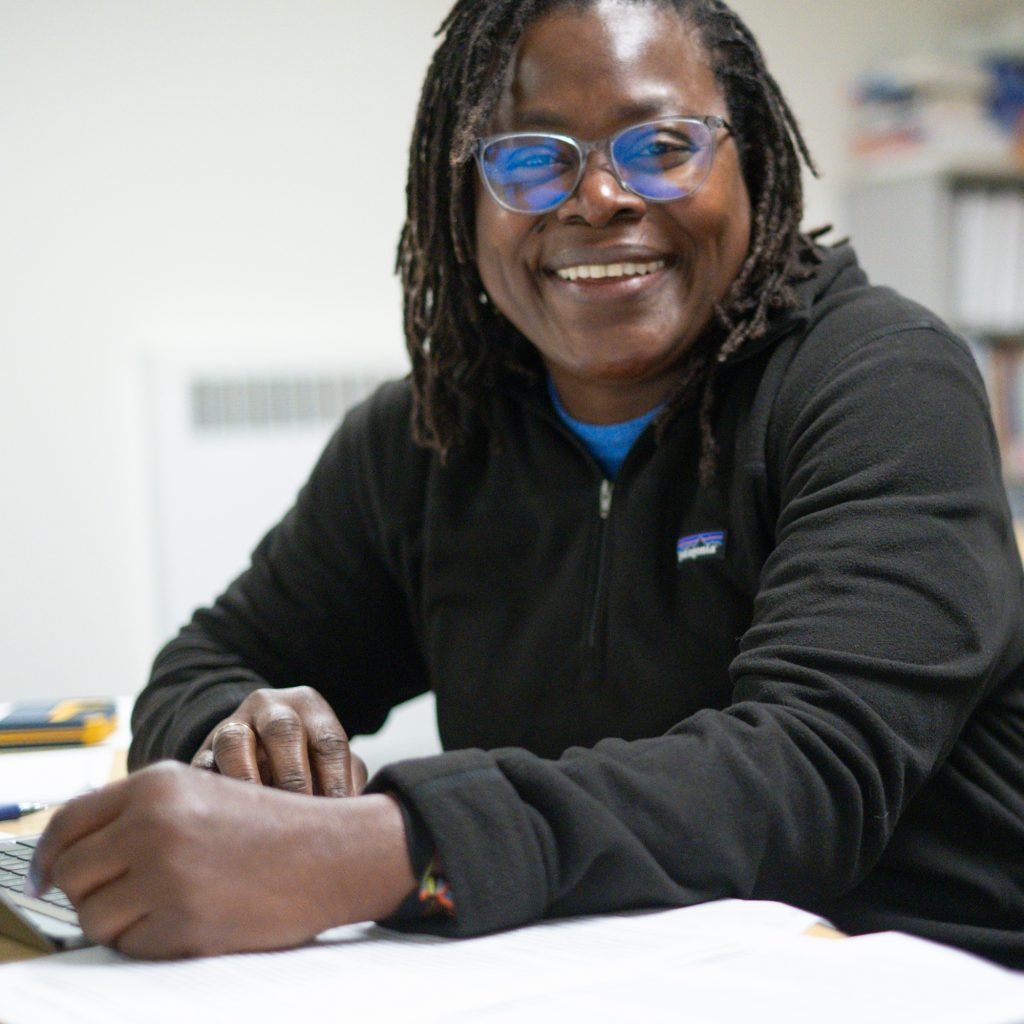
New high school special education teacher Stacey Spencer, Friday, Aug. 15, 2025. (Will Steinfeld/Chilkat Valley News)

Stacey Spencer (High School Special Education)

I’m originally from Trinidad and Tobago — South Trinidad — and I came to the United States in 2001. I started off at Tuskegee University, and then I went to Grambling State University in Louisiana, and then I moved to Dallas to teach math and special education. On my 50th birthday, I was like, you know what, I’m going to do something different. Why not go to Alaska?

I stopped off in Nome for 10 months. Great, great, great, community. And then from there, I decided I wasn’t ready to go home yet. Lily Boron reached out and said, ‘Do you want to come to Haines?’ I still can’t believe it happened. And I’m here. 

Will Steinfeld: How was your experience in Nome?

The director of special education, Mary Donaldson, is an inspiration. I’ve never really seen that before, when you have a director who is willing to go above and beyond for the students, but still supports the teachers so they can do what they need to do. I also loved being part of the Special Olympics team, helping with the basketball team and leading the track and field team to the state championship. And I ended up making good friends. 

Nome is a pretty different climate than Texas or Trinidad.

It’s like the polar opposite. If it weren’t for the sports and for Special Olympics, I don’t know if I would have made it. But there was this thing that bridged the two places together—Trinidad and Tobago and Alaska. And that was the sense of community, sense of family. 

The first time I got sick (in Nome), my friend drove to my house just to bring me some medicine. That’s like my home country — you just let your neighbor know you’re not feeling well and they’ll provide for you. 

I’ve found that same community here. I came here on Thursday and Lily (Boron) was like, ‘I got you’ and took me in, let me stay at her house, and fed me. 

WS: Is there anything you’re hoping to do to find community here in Haines?

I really hope some sort of coaching position will come up. I really love soccer — what we call football in Trinidad. I can’t ski, but I want to try that. Before the sea freezes over, I want somebody to take me fishing, and I want to go moose hunting. I’m a really outdoorsy person, so I would love to do those things, and I think if I do, then it’s going to be an awesome school year. 

I’m looking forward to this school year. The teachers I’ve met here, they’re grounded — grounded in the sense that it’s not about them, it’s about the students. That makes it very easy for an outsider to come in. 

New high school math and government teacher Jim Daniels, Friday, Aug. 15, 2025. (Will Steinfeld/Chilkat Valley News)

Jim Daniels (High School Math and Government)

WS: Where are you coming from? Have you always been an educator?

I’m from Philadelphia, grew up there, and then did college, grad school, and a good bit of my teaching there. Philly will always be home. You give me any destination, and I feel like I can find it blindfolded.

When I graduated undergrad in 1991, it wasn’t the strongest economy, and I wasn’t sure what I wanted to do. But I had really great teachers in high school. I started pursuing (being an educator), and I found out that I wasn’t too bad at it. I’ve tried jobs in the corporate sector and private sector, only to fail miserably. I just can’t sit in one place, be the cubicle guy. 

When I was 38 I decided to enlist in the Army Reserve. I went to basic training at Fort Benning. I was one of the oldest guys in basic training, and I met some of the best and worst people I’ve ever met there. You see the full gamut of humanity there. It’s people from everywhere. 

I ended up in psychological operations. I break it down for people, maybe somewhat tongue in cheek, and I say it’s marketing, only instead of trying to get somebody to buy a product, the product you’re selling is being on our side. 

I ended up being deployed for 10 months, to Kandahar, Afghanistan. You always hear about the language barrier, but what I found was, people had no idea what makes these people tick. We brought in scholars, and advisers, people from academia, to try to understand the complexity of what constitutes the nation of Afghanistan. 

During the deployment we created a radio literacy program to broadcast to these rural areas. Everyone listened to these hand-crank radios. That was the available medium. They were these very rudimentary literacy lessons, but even being able to move the needle very slightly, it was very satisfying. That was the highlight of my military deployment. 

WS: Did that experience affect how you travel to new places now and learn about them?

I’ve never been just a put-out-a-chair-by-the-beach-guy. I want to see things, see historic places, travel using the public transportation. I like to deep dive into wherever it is I am. 

I didn’t travel much when I was younger. My dad was a factory worker and my mom was a secretary. We didn’t have a lot of money, we took day trips to the Jersey Shore. I certainly always had the desire and ambition to see the world, if not the opportunity. So after the military and teaching, I realized that I could parlay what I do into opportunity. 

WS: How did you find Haines?

I taught in the Aleutians, in King Cove, for the 2022 school year. I loved it, and I’m actually still in touch with some of the students. I kind of regret that I left after one year. 

Haines looked like a place I definitely wanted to go to. Then I talked to (superintendent Lily Boron) and (former superintendent) Roy Getchell, and I was just blown away by the conversation I had with them. They were tremendously welcoming and sincere. They really know how to sell a place. I came away from that conversation thinking, yeah, it sounds like a perfect fit. 

This is the most stunningly beautiful place. There’s been a couple days I’ve been walking around thinking, I’m living in some kind of dream.  

Because I did 180 days in a combat zone, there’s a variety of different types of training and school (the federal government) will help pay for. I enrolled in a truck-driving school in Philadelphia and got my CDL (commercial driver’s license). I loved it on so many levels. I had no idea how to do it, I was learning something from scratch. There was the challenge of making yourself vulnerable again with a completely new experience. 

That kind of ties in with the decision to come up here and try commercial fishing before the school year. Teachers will tell you professional development can be hit or miss — though I’ve had some really good ones. But nothing compares to just going out and picking something up completely outside of your wheelhouse. Being in a position where you can make mistakes, learning what to do when you reach a block and you don’t get something, that gets to the whole notion of instruction. 

WS: What was fishing like this summer?

I think people around the world — fish lovers, fish eaters — don’t know how much they owe to the people in this state that are toiling away. I mean, between the sleep deprivation, and the complexity of the tasks, and the potential danger — it was astonishing. 

I had no idea what I signed up for, I had no idea what set-netting was. I was on a crew with at least seven kids — I call them kids because I’m 55 and they were 19 — but a couple of them were highly experienced. We had a mutual respect, and we established a really good banter and understanding. They reveled in the opportunity to share their knowledge, being really good at something. I tried to take the time to tell them, ‘You teach really well, I’ve learned a lot from you.’

WS: Are you heading back up to Bristol Bay next summer?

No, definitely not! Maybe if I was in my 20s, and not my 50s. It’s just, I’m in pretty good physical condition for 55, but by the time I got out of there, I felt like I aged. 

New high school english teacher Jane McCormack, Friday, Aug. 15, 2025. (Will Steinfeld/Chilkat Valley News)

Jane McCormack (High School English)

WS: What brought you to Haines?

I’m originally from Massachusetts. This is going to be — I want to say — my 25th year of teaching. 

I loved the sense of community that I got during my interviews. I’ve always wanted to see Alaska. I just felt like I was ready for a change. I believe that, just like we push our kids to go out of their comfort zone, I needed to kind of push myself to go out of my comfort zone. 

WS: I’m also from Massachusetts, and people always ask me if coming to Haines is a big change from that part of the country. I’m curious to hear your impression.

So far I don’t feel that it is. Part of the attraction to Haines, in addition to the community, is that I love to hike and I love to be outside. So the fact that I can just walk out the door and be in this landscape is spectacular. 

I have a dog and I’ve always been happier outside than in. So I love that this community values nature and celebrates it. 

WS: Do you have anything you’re hoping to bring with you to the classroom this year?

I’m really hoping to bring the community in here to show the kids all the opportunities. I really want to have people come in and get the kids engaged in the possibilities beyond high school. That’s a great part about being a high school teacher, particularly juniors and seniors who have one foot out the door, and are wondering, ‘what can I do?’

WS: What book are you most looking forward to teaching this year?

Oh, I love all the books. That’s why I’m an English teacher. There’s one that I haven’t read yet, and it’s set in British Columbia, and it’s called “Monkey Beach.” And interestingly enough, right after I had grabbed it from the bookroom, I was watching a television show and one of the characters was reading “Monkey Beach.” So I’m looking forward to reading and teaching that. It’s always exciting for me to have books in the curriculum I haven’t taught yet. 

WS: You talked about hiking – is there anything else you’re looking forward to doing here?

I would love to get out on the water. As you know, coming from New England, everything’s different here. Hiking of course, and the same with kayaking. I used to kayak in my local river in Kingston, Massachusetts, but I know it’s nothing compared to the kayaking here. Like, everything here just feels bigger and more grand. 

Everyone’s been so welcoming, you can just feel the sense of community. 

New third grade teacher Lya Duncan, Tuesday, Aug. 19, 2025. (Will Steinfeld/Chilkat Valley News)

Lya Duncan (Third Grade)

WS: Tell me about where you’re coming from before this

We came from west of Nome in the Bering Strait District. We were in Gambell and Elim and we moved here for a change of scenery. In Gambell, it’s only the little pebble rocks and snow and mountains. There’s no greenery, there’s only one grocery store, there’s no pool or playground or anything. So yeah, it’s a bit different here. 

Are you originally from that part of the state?

No, we were there for three years. We moved there from the Carolinas, near Raleigh. We were looking for some place low key where our kids could actually grow up and not try to keep up with, like Gucci bags. That’s not us. 

Did you always expect to be living in a quieter place than Raleigh?

No, I always expected to live in a big city. I was born and raised in a big city. I never thought I’d be in Alaska. 

Have there been any surprises about moving to Alaska?

Not so much surprises, but we really like getting to know different cultures. Out (near Nome) with Siberian Yupik and Yupik, and now Lingít (culture) — it’s all really interesting. In Gambell, the children speak (Yupik), so you have to know at least some words. I didn’t know all the words, but I could, within context, pretty much follow along. 

Was teaching third grade a choice you made or did you stumble into it?

I love third grade. If there’s a third grade position open, I want it. (Students) aren’t babies anymore, they aren’t just learning to read. They’re not learning to add and subtract. They can tie their shoes and speak in a complete sentence. But they’re not old enough where we’re doing, like, book studies and Romeo and Juliet. It’s right in the middle. And it’s a big transition. They get lockers. It can be really stressful. 

Are there any hobbies or ways of connecting with people you and your family are looking forward to in Haines?

We’ve hiked a lot. Battery point was great. It was really manicured and looked really well taken care of, and we had fun hiking that one. (My family) tried Seven Mile Saddle and they said that was exhausting. 

Were there any moments that stood out from the first day of school? 

Probably the helpfulness. The kids are super helpful, and they’re still kids.

Will Steinfeld is a documentary photographer and reporter in Southeast Alaska, formerly in New England.