

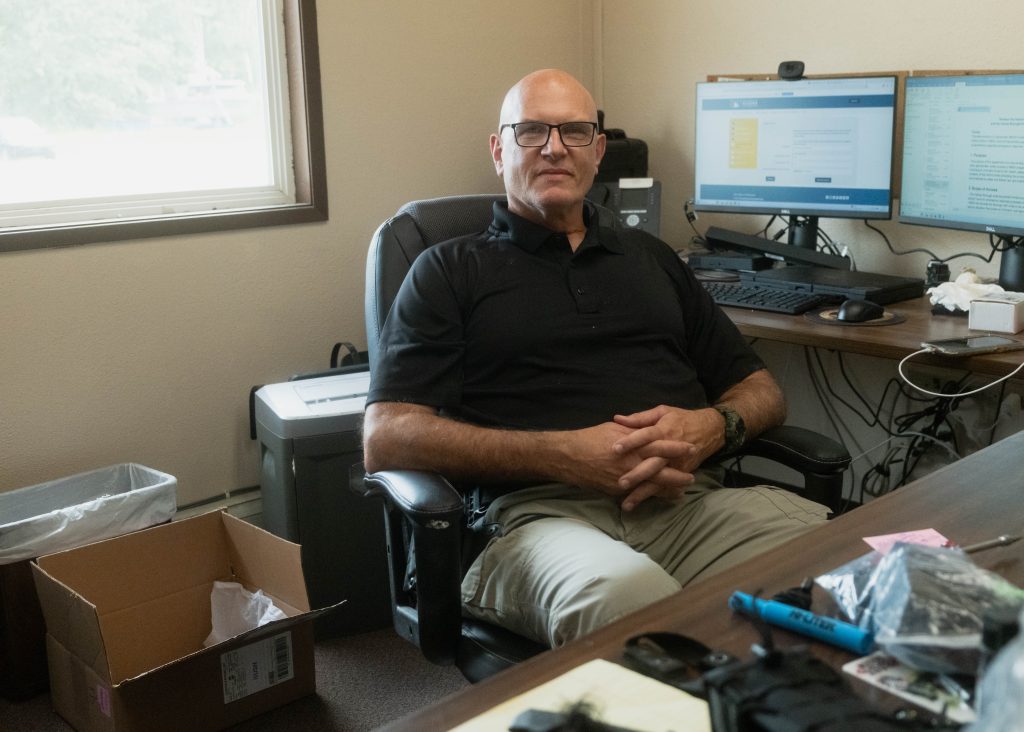
Haines’ newest police chief Jimmy Yoakum arrived earlier this week from Loudon County, Tenn. He’ll be adding policing capacity to a department that has been down to just two officers since former police chief Michael Fullerton stepped down at the end of April.
Yoakum will spend the rest of the summer in this new position.
This fall, he’ll have to leave for the state police training academy as his previous law enforcement certifications did not transfer to Alaska.

Yoakum sat down with the Chilkat Valley News reporter Will Steinfeld to talk about his start in Haines and his background in policing.
The following interview has been edited for length and clarity.
Will Steinfeld: When did you arrive in town, and what was your trip like?
Jimmy Yoakum: I had been on the road for seven days when I got to 26-mile. It was probably 7 in the evening, and I stopped at the turnout there and it was gorgeous. I was right by the river, and the sun was somewhat going down, and I took out my camp chair and got my old Western paperback book out and just sat by the river and read my book and prayed a little bit, and thanked God for a safe journey.
The one thing that I kept thinking about was my dad. He brought me up here to go fishing when I was a junior in high school. And we fished the Kenai, and I think maybe we went and caught halibut out of Homer. He would go every year, but eventually his health got to a point where he couldn’t fly.
I was just sitting there thinking about how all my old Westerns ended up down at his house, and before I left (for Haines), he called me and said “hey, you need to take some of these books with you.”
So I was sitting by the river, and I just thought, my dad would really like to be sitting right beside me, just doing the same thing.
Can you give people an idea of your backstory and how you got here?
I graduated college and I went into the military as an intelligence officer. I was stationed at Fort Bragg and I served with the 82nd Airborne and served with Special Forces. Did my time there and got out.
Honestly, I thought I would do 20 years in the military. I stayed in the reserves for another six years but I got out and I was like, now what? Just like most 23, 24 year old kids, life was coming at me fast. My degree is in criminal justice, and I decided I would try local law enforcement.
In 1995, I started with the Blount County Sheriff’s Office. I took about a year in 2005 to do youth ministry in Montana and then came back to law enforcement again. Then, up until four years ago, I was a canine officer at my last department.
My canine passed and the high school needed a [school resource officer], so I started that, and they were going to need a criminal justice teacher, and so I applied for that job too.
I taught four years of criminal justice, was coaching baseball and football, and then I happened to reconnect with an old buddy who was taking a chief position in Cordova. So I started thinking about that.
I love teaching and coaching. There’s something in a kid’s eyes when they get it. That’s something I hope to always do. But there’s a sense of apathy in kids today. And man, I am not an ‘anti-rock and roll, rap music’s the devil’ guy. I just think that they are so consumed with their electronics.
I guess my thing was, criminal justice has been my whole life, essentially. It’s really frustrating when you care so deeply about something and you want to convey the fun and the lessons that you can bring, and students just don’t care.
So that’s what drove me to move away from teaching. And of course, when my buddy went to Alaska, I remembered my time there with my dad and just how beautiful it was. There were other job openings, but there was just something about Haines that just kept sticking with me. Seven months later, here I am talking with you.
What’s your first impression? Any surprises?
It’s beautiful. My kid called the other day, and said, “oh, my gosh, it’s 98 degrees and 100% humidity.” And I’m like, yeah, I don’t miss that.
The thing I love is that just, aside from the natural beauty, is just that everybody is just genuine. We have Southern hospitality down there, but people have just been so welcoming in Haines.
And my wife, what a trooper. She is taking care of business with her kids and finishing up some things (in Tennessee). We both realized that I’m probably going to be flying solo for a year, especially with having to go to the academy. But throughout this whole process, with the ups and downs and the not knowing, she would look at me and just say, “quit worrying about it. You are the best man for the job.”
I really love this department. We are understaffed, and we do need people. It’s really nice, to walk into a small department because Officer Travis Russell and Sergeant [Max] Jusi have just been great to me. Michael (Fullerton) as well, holding the fort down, keeping everything together. Max stepping up when Michael left.
My whole point is that I love the small feel that we have and that feeling of family that we’re developing. I told them yesterday — I want to train you guys well enough where you can go anywhere you want, but I want to treat you well enough that you want to stay here.
You have a few months before you go to the police academy. What are you planning on prioritizing before you head out?
Starting Wednesday, we’re going to look at some budget items to see where we’re at. I want to get their input on each line item and what we want to do with it over the next fiscal year.
We’re going to inventory all of our stuff, make sure we know exactly what we have, what we don’t have, because we’re fiscally responsible to the community. The community needs to know that we are on top of caring for the stuff that is provided to us by the borough. We have to do policy and procedure, and we have to hire some folks.
I’m also going through a field training program with Travis Russell as my field training officer and my evaluator. I’m a field training officer myself, but he is my grader for this. We’ve talked together about how we’re going to build the field training program for the new guys that are coming in.
We’ve talked in the past about the number of hours Officer Russell and Sergeant Jusi have been taking on. Is there anything you’ve been working on to address that?
Yes, as soon as I can get through the field training program then I will be able to take calls and be on standby. What we hope to accomplish with that is being able to start giving a day off for those guys here and there where they don’t have to worry about having a phone or a radio with them.
It seemed like a long journey trying to get your credentials transferred to Alaska. Eventually the Alaska Police Standards Council decided they could not be transferred. Do you know what happened?
On the state’s website there is a reciprocity list. I went back and I got over 600 pages of training records from the past nine years that addressed every single one of the reciprocity requirements. I don’t know if it was too much, but I had to resubmit the training file in a much more condensed format. And then I spoke with the reviewer who makes the determination; he’s got a lot of liability on him because it’s his job to determine if I meet the standard. And if he signs off on me and I go do something silly, then it falls on him. I get it.
But I’ll give you a couple examples. We were doing the review and came to weapons qualifications. I did firearms training every year. I had my academy schedule that showed the whole week worth of firearms training, pistol and shotgun. And the question was posed to me, “what about low light qualifications?” I said, “Well, you know, I was at the academy in the fall and winter. And if you look on Tuesday and Wednesday of the schedule, from 1800 to 2200 (hours), we’re on range. That was our low-light qualification. We were on the range at night.
And he said, but it doesn’t say low light. How do I know that your range didn’t have spotlights on the targets? I said, the only lighting we had was the police lights, which is what you do in low-light training.
Then CPR/AED certification came up. I got recertified two months ago and had my card from the American Red Cross, but he couldn’t accept it because it wasn’t from an accredited law enforcement agency. I think the issue was, I had all the training, but the terminology from Tennessee was probably not synonymous with Alaska terminology.
You have a lot of training but you’re headed back to the academy. What’s your mindset for that? Are you hoping to learn anything?
You can never get too much training. My mindset is, go in knowing nothing. After 28 years (in law enforcement), we all get bad habits. It would behoove me to go in there and be humble and take in as much of the training as they give. For example, I don’t know the Alaska laws yet. So that will be a really good course.
Maybe I can mentor some of the some of the men and women that are there. Because when I started in ’95, the culture was, if you talked about stuff that bothered you, you’re weak. I hope I get the opportunity to help some of these folks understand the importance of taking breaks from the job, focusing on family, [and] talking to people. It’s OK to tell people something’s bothering you. The need for mental health breaks, mental health checkups, even if that just means you go out to your pond and sit and try to catch a [fish] all day.
This is your first chief position. Are there any lessons or prior experiences you’re looking to as you step into this new role?
I went into the military straight out of college, gung ho, thinking I was going to change the world as a second lieutenant. I made a stupid call one day on something – I think it was vehicle maintenance. And it was just ridiculous, the decision I made. I had a very seasoned, very smart E7, which is a senior NCO, who’d been in the Army a while. He pulled me aside, and he said, “You need to take care of your troops.”
I was kind of offended. I was like, “I’m the officer. You’re the NCO.”
He said, “I understand you’re an officer, I understand you outrank me. But you don’t know diddly about the Army.” And so we continued that conversation, and at the end of it, basically, I told him, tell me what I need to do. How can I take care of my troops?
Something my old lieutenant told me when I first started was, it’s all about relationships. So right now, obviously I want to get up to speed on the administrative aspect of the job, but I want to take care of my guys and my gals.