Alaska lawmakers convened in Juneau on Tuesday and essentially rejected any lingering hope that they would override Gov. Mike Dunleavy’s veto of $87 million in school funding from last year’s budget.

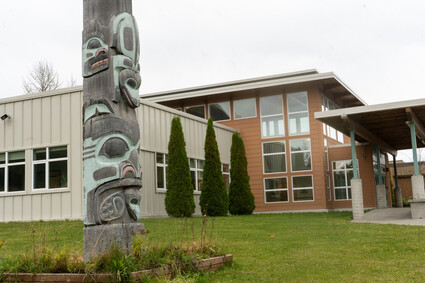
It’s an end to a year of intense coordination and lobbying effort for an increase in funding for public schools and one that Chatham School Superintendent Ralph Watkins said has been deflating. Watkins, whose district includes the Klukwan School, said he doesn’t know if that level of coordination can happen again.
“I think last year was our year,” he said. “We did so much work. We spent ten days in Juneau during the legislative session. Going and meeting with legislators and bringing our students and having our students testifying.”
The legislature approved hundreds of millions in state funding for schools before Dunleavy vetoed it.
“We’re exhausted. We’re tired and we’re going to be in the same position again,” Watkins said. “I think it took the wind out of the legislators’ sails because they realized how powerless they are.”
It has been eight years since the state last increased its per-student funding formula for public schools — a 0.5% nudge that year — and years of stagnant funding have caught up with districts statewide.
In Haines, the state’s K-12 funding covers about 60% of the school district’s budget for the current school year; borough funds covered the rest.
Superintendent Roy Getchell said despite the static state funding and inflation, the Haines school district has kept its budget balanced and the district has worked hard to maintain savings, or fund balance. The max it can carry is about 10% of its spending.

“I think we’re at 9.2%,” Getchell said. “A lot of the districts that you’re hearing about that have hit the wall have zero fund balance, or are in deficit spending.”
Those percentages translate to about $531,000 in savings for Haines schools, but as costs have increased with inflation, and without an increase in state funding, Getchell said the district could spend those savings quickly.
“It probably wouldn’t eat through it this year but we’d get a long way through it and certainly by next year,” he said.
In an emergency, Haines schools could ask the borough for more funds; Getchell said he believes that would be successful. The borough allocated $200,000 last year after Dunleavy’s veto.
But the Chatham School District does not have that option. As an Rural Education Attendance Area, or REAA district, Watkins said his district’s schools can get some grants and occasional tribal support, but are much more heavily reliant on state funding.
“What we get is what we get. So when we’re flat funded, our impact is …we’re more greatly impacted,” he said.
Inflation has totaled about 27% since the Legislature and governor last approved a permanent increase in the funding formula for the 2016-2017 school year. Both districts reported fixed costs that skyrocketed due to inflation.
“We probably had a 12% increase in fuel costs,” Watkins said. “Shipping, we went from paying 35 cents a pound for shipping to over $1 a pound. So when we have to bring food in … the shipping costs are astronomical. The fuel costs are astronomical.”
Both Getchell and Watkins said they’ve also had trouble with hiring. There is a teacher shortage and rising costs have made it difficult to keep teacher pay competitive. Getchell said, with the help of the borough, Haines schools raised pay by 10% last year. In the Chatham School District, Watkins said they issued teaching contracts in January, just to make sure they’d have enough people for the next school year.
That looming teaching shortage could have a huge impact in Klukwan, which has seen a spike in the number of students – from 6 to 22 – in the last year.
“We’re at the point where we’re putting a cap on it. We can’t take anymore,” Watkins said. “We have a full preschool program. We have three certified teachers and a cook and a secretary and a Tlingit language para.”
Watkins said the tribe used COVID-19 funding to support some of those positions but that money is gone now.
“It’s scary,” he said.
Getchell said the Haines school board is set to start work on next year’s budget in February, aiming to have a spending plan in place by June, though that process is complicated by the state’s budget process. Generally, the Legislature doesn’t pass a budget until mid-May, but it can still be changed by the governor.
And, despite the state’s anemic support, Watkins said there are bright spots in the Chatham School District. Angoon, the district seat, got some grant funding that allowed it to expand its career and technical education programming. Watkins said the district is providing a robust correspondence program for students in places like Tenakee Springs.
And in Klukwan, students have been growing and harvesting food and sharing food with the community in the school’s hydroponic garden.
“Lettuce and herbs and basil – it’s just beautiful. From their first harvest they have about 40 bags of lettuce that they grew right here in the school in Klukwan that they distributed to the community,” he said. “In spite of everything, it feels good to be part of a school and a district that’s thriving.”
Larry Persily with the Wrangell Sentinel contributed to this reporting.

