
Ceri Godinez
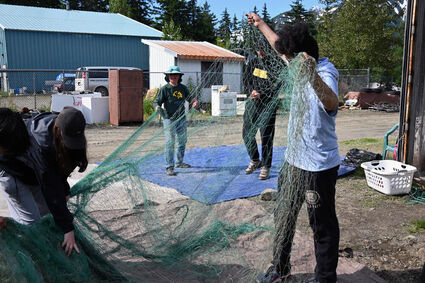
Southeast Alaska Independent Living and Takshanuk Watershed Council’s Summer Work Program interns clean fish nets at a work party Tuesday for Haines Friends of Recycling’s fish net recycling program. Once cleaned, the roughly 6,000 pounds of fish net will be shipped to Portugal for processing.

With the help of a Haines Borough grant, a recycling program that accepts old fish nets is getting back on track, despite recent setbacks. This year’s borough budget includes $4,000 so the Haines Friends of Recycling fish net recycling program can ship an estimated 6,000 pounds of net in the fall.

“The nylon in fish nets can be recycled multiple times. Pellets or yarn made of recycled fish nets become raw material used in manufacturing new clothing, rain gear, athletic shoes, skateboards, phone cases and many other items by companies like Grundens and Adidas,” program manager Molly Sturdevant said. “It’s a great way to reduce our waste stream.”

The last time Haines Friends of Recycling shipped a load of fish nets for recycling was in 2015. Sturdevant, a retired marine biologist, became involved with the program the following year. In 2019, the standards for recycling nets tightened, requiring that all “contaminants”-non-nylon materials-be removed.

Because the standards changed, many of the nets collected prior to 2019 need to be cleaned because they were cut in a way that left twine hangings attached. Fishermen were already removing the cork, weed and lead lines as required. Last fall, Haines Friends of Recycling began the task of cleaning the hangings out of 6,000 pounds of fish net. Sturdevant said the process was slowed by COVID-19.

Tuesday and Wednesday marked the sixth and seventh fish net cleaning work parties of the year. Work party volunteers include Southeast Alaska Independent Living and Takshanuk Watershed Council’s Summer Work Program interns, Haines Friends of Recycling members and “a number of fisher folks who are helping to process that backlog,” Sturdevant said.

“We stretch out (the nets) and remove the hangings, which are a different type of material,” intern Kayden Beck said at Tuesday’s volunteer event. “It’s tiring, but it helps the community.”

The importance of net recycling is two-fold, according to Sturdevant. If the nets aren’t properly disposed of and remain in the ocean or river, they’re what’s known as “ghost nets.”

“They float in the sea and kill a lot of fish or entangle marine animals needlessly,” Sturdevant said. Taking the time to recycle the nylon keeps it from ending up in the landfill where it takes up space and eventually breaks down into microplastics, which can be harmful to all life down the line.

Sturdevant estimates that roughly 250 volunteer hours have gone into stripping the nets, and they’re a little more than halfway through the backlog.

“Hopefully, just a couple more work parties and we’ll be done,” she said.

Once the nets are cleaned, Haines Friends of Recycling can begin accepting more nets for recycling from the local gillnet fleet and subsistence fishermen. Moving forward, nets must have all contaminants removed in order to be accepted.

Haines Friends of Recycling charges $15 to accept a net, a cost that doesn’t fully cover shipping expenses, Sturdevant said. The $4,000 from the borough will pay to get the nets to a processing plant in Portugal. Haines Friends of Recycling and groups in other Alaska coastal communities like Cordova coordinate with Net Your Problem, a Seattle-based fishing gear recycler working around the state.

Those with questions about fish net recycling or interest in volunteering can contact Sturdevant by calling 723-7182.