
Learns to adapt to life without electricity
Ceri Godinez
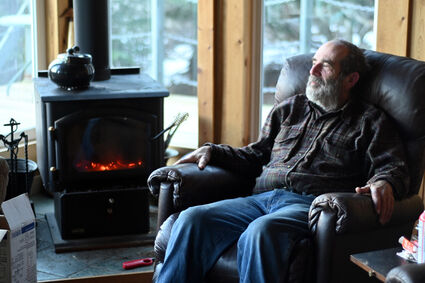
Phil Pink sits by the fire in his cabin, located in the “green zone” at the end of Beach Road. Pink has been living there mostly full time since the Haines Borough lifted the mandatory evacuation on Dec. 18.

Phil Pink, 71, did not sign up to live off the grid when he moved from Florida to his cabin at the end of Beach Road, but for the past two months he’s been hauling drinking water, gasoline for his generator and propane for his backup heat.

Despite the hardships of learning to live off the grid in his early seventies, he said he can’t bring himself to leave the house. “I can’t. I just can’t.”

On Dec. 2, a landslide on Beach Road ended two lives, destroyed several homes and separated the neighborhood from the rest of town. Since Dec. 18, when the Haines Borough removed houses at the end of Beach Road from the mandatory evacuation zone, Pink has been spending between five and seven nights per week living at his house with limited ATV road access and without power, water and, as of last week, a septic system.

Pink estimates he now spends 70% of his time working to keep the place running, cleaning the increasingly messy cabin; splitting wood; melting snow for dishes; and troubleshooting when things inevitably break.

“I make glop,” he said. The recipe is simple–lentils plus whatever frozen vegetables he has on hand. “I use lettuce, tomatoes, onions, garlic.” Pink hasn’t had a working refrigerator since he moved back home, so all food is stored either at room temperature or frozen.

With the other 30% of his time, Pink gets to enjoy being back at home, going for walks at Battery Point, streaming basketball games using his phone as a hotspot, reading books in Hebrew and Greek, and listening to music ranging from Chopin to 1950’s Rock and Roll on a portable speaker.

“It’s not bad living here as long as you don’t make any serious mistakes,” Pink said, adding that unfortunately, there’s no manual for what to do when your house is suddenly cut off from utilities by a landslide. Most of these concepts, like how to run a generator, Pink has picked up through trial and error.

One night, he left the power to his septic system on and ended up overloading the generator. Everything shut down and the septic system pipes froze. Pink said he’s now waiting for temperatures to warm so the system will thaw again. In the meantime, he’s making trips into town on “Little Mule,” his newly purchased four-wheeler, to use the facilities at the apartment he’s rented in town.

Pink estimates that before the Dec. 2 landslide, when his house had power to run the water and septic systems, and when the propane truck would deliver to his driveway, he spent 20% of his time getting the place to run smoothly.

Pink said he remembers the first time he came to Battery Point in 2018, seeing the houses along Beach Road, and being amazed that people could live in such a beautiful setting.

He said he feels at home in the cabin in a way he hasn’t since he was a teenager. It’s located on the beach, instead of the road, down a set of steep, ladder-like steps built into the cliff, and the porch has a view looking up Lynn Canal toward Skagway.

“I do not understand why the hell I feel about this place the way I do. Objectively, it makes no sense,” Pink said. “But I’m happy. I’m home.”

He said he recognizes that there’s heightened risk involved in his current lifestyle, driving across a mandatory evacuation zone on a daily basis, but he’s seen relatives go the way of the nursing home.

“I’m firmly convinced you live until you die,” he said, adding that the property at Beach Road is where he feels alive.

Other Beach Road residents have expressed similar sentiments, although none have moved back to their houses to the same extent as Pink.

“I want to return to my home and enjoy my home in the last years of my life. I don’t want to be forced to leave yet,” Dawn Woodard said.

But she said for her and her husband, Art, it’s not feasible without electricity. They’re both in their mid-70s.

“It’s very costly and labor intensive to run a generator,” Woodard said. And without it, she can’t run the house’s water or septic system, so for now, she and Art and their 160-pound malamute Gooch will remain at Covenant Life Center, which Woodard said is comfortable but not home.

Since the Dec. 2 landslide, Beach Road residents have made repeated requests to the borough and AP&T to restore power, but officials say that is still a ways off.

Before AP&T will send in employees to restore power, “we would need to have the road opened full-time and accessible at all hours of the day and night, by a full-size vehicle. (We) would have to receive a signed document from the state or borough entity that originally declared the area unsafe and previously gave the evacuation orders that states that the geotechnical studies have now found the area stable and safe to return to and also know that the borough is also willing to start resuming twenty-four-hour police/fire and EMS services in the area,” the company’s Haines power operations manager Lance Caldwell said.

State geologists have said the area remains at heightened risk of another landslide due to a crack observed in the bedrock near the site of the Dec. 2 slide.

“Residents were permitted access at their own risk… but those homeowners should not expect others to be exposed to those risks on their behalf,” Caldwell said.

Borough Mayor Douglas Olerud agreed with Caldwell’s assessment and added that the borough can’t compel AP&T to restore power to Beach Road.

Ceri Godinez
Phil Pink’s Beach Road home is located down several flights of steep, ladder-like steps built into the cliff. It’s a challenge to get to under normal circumstances. Pink has been living in the house without power, water or septic.

“What happens if something happens?” said assembly member Gabe Thomas, who has been a steady advocate for increased access to the Beach Road neighborhood. “I would love to give them power. I know they never signed up to be like Chilkat Lake or Excursion Inlet, but we have to get this (geotechnical) study done.”

As a first step toward restoring power, the state has hired geotechnical engineering firm R&M Consultants, Inc. to study the geology of the area. The study will help inform decisions about search and rescue activities, short-term access to houses and whether it’s safe to occupy the area in the long term.

Pink said he understands where the borough and the power company are coming from.

“Do I want (power) now? Of course. My life would be so much easier,” he said. “But if we need to wait two months to do it in the safest, most cost-effective way, then that’s what we should do.”

R&M is scheduled to conduct a “winter field reconnaissance” to gather preliminary information about site stability beginning in early March, followed by a more in-depth summer study.